Fleming’s Left and Right Hand Rules — Electromagnetic Force and Electromagnetic Induction Explained
Fleming’s Left and Right Hand Rules stand together as two of the most important conceptual tools in understanding how electricity, magnetism, and motion interact. Although both rules are often introduced through simple vector-style illustrations of a hand with three perpendicular fingers representing current, magnetic field, and force or induced voltage, their deeper significance extends far beyond these gestures. They reflect the elegant unity of electromagnetic principles: one rule describes how electricity produces motion, while the other describes how motion produces electricity. Together, they illuminate how electric motors, generators, and countless electromagnetic devices operate, revealing the reciprocal nature of mechanical and electrical energy conversion. When explored through detailed narrative rather than mathematical formulas or compact diagrams, these rules become powerful conceptual frameworks for understanding the physical world.
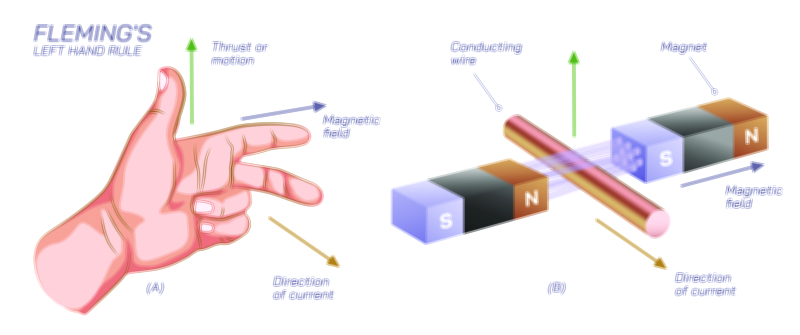
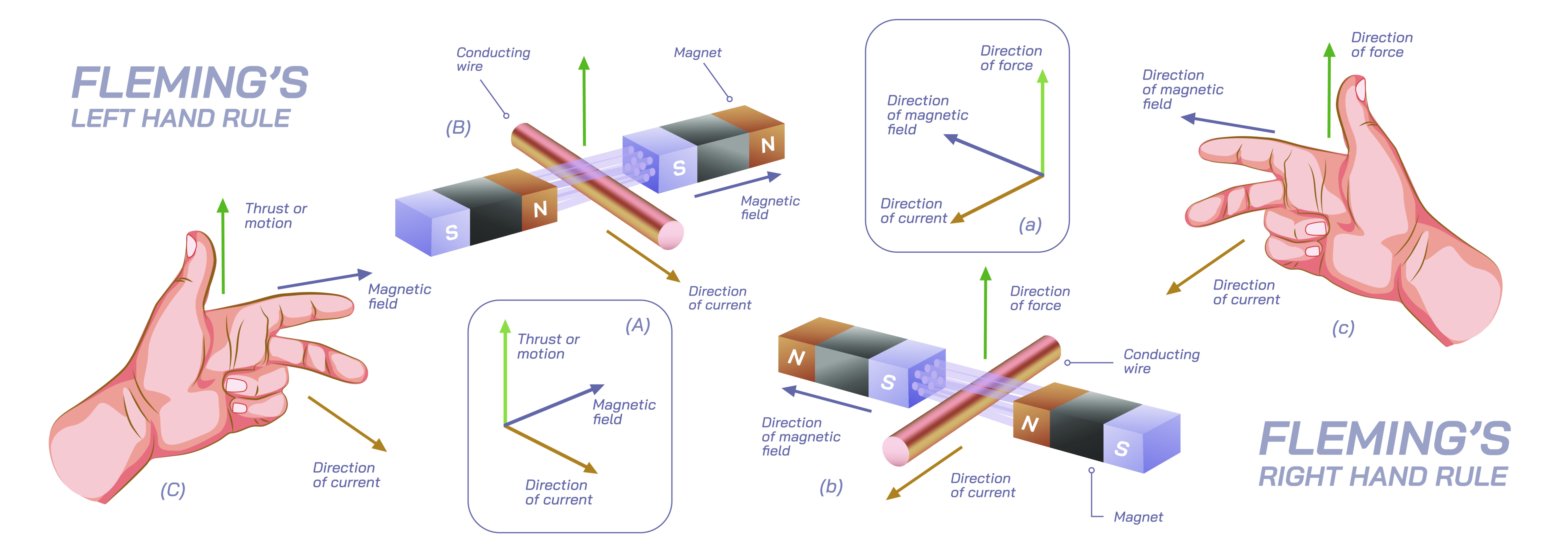
Fleming’s Left Hand Rule corresponds to the motor effect, which explains how a current-carrying conductor experiences a force when placed inside a magnetic field. This rule helps determine the direction of that force. When the first finger points in the direction of the magnetic field—conventionally from the North pole to the South pole—and the second finger points in the direction of electric current, the thumb indicates the direction of the force acting on the conductor. This force is neither aligned with the magnetic field nor with the current; instead, it acts at right angles to both. This orientation emerges from the underlying structure of electromagnetic interactions where moving charges experience a sideways push in a magnetic field. At the microscopic level, electrons moving through the conductor are deflected due to their motion through the magnetic environment. These individual deflections add together to produce a macroscopic mechanical force on the entire wire. Through this interaction, electric energy is transformed into kinetic energy, making the Left Hand Rule the cornerstone of motor operation.
Inside an electric motor, coils of wire sit within strong magnetic fields. When current flows through the coils, the forces predicted by the Left Hand Rule act in specific directions, causing the rotor to turn. As the motor rotates, the direction of current within different parts of the coil must be reversed at precise intervals to maintain consistent rotational movement. This reversal is achieved with components such as commutators or advanced electronic controllers, but the underlying force always arises from the perpendicular relationship between current, magnetic field, and mechanical motion. Whether in small devices such as fans and toys or large industrial machines driving elevators, trains, and manufacturing equipment, the same principle applies: electrical input produces mechanical output through the directional force predicted by Fleming’s Left Hand Rule.
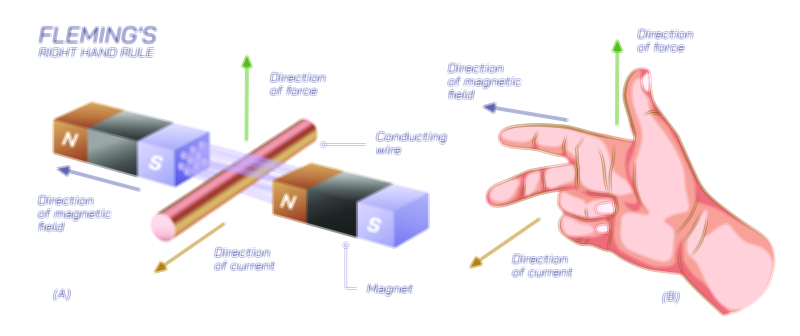
Fleming’s Right Hand Rule, in contrast, corresponds to the generator effect, which describes how mechanical motion within a magnetic field induces an electric current. This rule is used to predict the direction of the induced current when a conductor moves relative to a magnetic field. When the first finger points in the direction of the magnetic field, and the thumb indicates the direction of motion of the conductor, the second finger reveals the direction of the induced current. This rule describes the reverse of the motor effect. Instead of electric current producing mechanical force, mechanical movement produces electric current. This is the fundamental operating principle of electric generators, alternators, bicycle dynamos, and countless systems that convert kinetic energy into electricity.
Generators rely on coils rotating within magnetic fields or magnets rotating near coils. As the conductor moves through the magnetic field, the magnetic environment around the moving charges changes. This change induces an electromotive force, compelling electrons to move and creating an electrical current. The direction of this induced current depends on the vector relationship described by the Right Hand Rule. Through this mechanism, mechanical energy—from turbines turned by steam, falling water, wind, or engines—is converted into electrical energy that flows into power lines, homes, industries, and devices. Thus, the Right Hand Rule reflects the heart of electricity generation, demonstrating how motion within a magnetic field produces electrical output.
The elegance of Fleming’s two rules is found in their mirrored relationship. They are conceptual opposites: the Left Hand Rule explains how electricity produces motion, while the Right Hand Rule explains how motion produces electricity. These rules are not isolated conveniences but expressions of a deeper symmetry in electromagnetism. They reflect the reciprocal nature of electromagnetic interactions described by Maxwell’s equations and the Lorentz force. In physical terms, the same electromagnetic laws govern both the motor effect and the generator effect, with direction determined by the orientation of motion, magnetic field, and electrical flow. The two rules simply describe these processes from opposite perspectives.
Beyond motors and generators, these principles appear in numerous technologies. In loudspeakers, electric current flowing through a coil creates forces that move a diaphragm back and forth, generating sound waves. This is a direct application of the motor principle. In microphones, sound vibrations move a conductive diaphragm or coil within a magnetic field, inducing a corresponding electrical signal. This is the generator effect at work. In power plants, turbines spin coils inside magnetic fields to produce electricity. In maglev trains, electromagnetic interactions create both lift and propulsion. Industrial actuators, electromagnetic relays, and robotic systems all rely on the motor effect. Meanwhile, wind turbines, hydroelectric generators, and regenerative braking systems exploit the generator effect to convert kinetic energy into electrical power. In every case, Fleming’s rules help predict the direction of movement, force, or induced current, serving as intuitive guides to complex electromagnetic interactions.
These rules also help explain natural phenomena. Charged particles moving through Earth’s magnetic field experience forces that create spiraling motion and shape auroras near the poles. Plasma in the Sun interacts with magnetic fields in ways that mirror the forces described by these rules, influencing solar flares and coronal loops. Even in astrophysical environments, moving charged particles interact with magnetic fields according to the same directional relationships. In laboratory physics, particle accelerators and electromagnetic confinement systems rely on the underlying principles expressed through Fleming’s rules to control the paths of charged particles.
In educational settings, the rules serve as bridges between abstract concepts and real-world behavior. Students can observe a conductor jumping in a magnetic field when current flows, or a galvanometer needle deflecting when a magnet is moved near a coil, and immediately relate these actions to the directions predicted by the rules. These simple demonstrations reveal the invisible structure of electromagnetic fields and show how electricity and magnetism interact at a fundamental level. By extending one’s fingers, one can visualize how unseen forces act within physical systems.
The distinction between the two rules is also important for avoiding conceptual confusion. The Left Hand Rule applies when electric current causes motion—that is, in motors. The Right Hand Rule applies when motion causes electric current—that is, in generators. Because the physical processes run in opposite directions, a different hand is used for each rule. This prevents misinterpretation and reinforces the idea that motors and generators operate through inverse yet related processes.
Although often taught as mnemonic devices, the hand rules embody profound physical insight. They reveal the inherent three-dimensional geometry of electromagnetic interactions: current, magnetic field, and force or induced voltage are always mutually perpendicular. This perpendicularity is not arbitrary but arises from the mathematical structure of electromagnetic fields. The rules offer a human-scale way to grasp these complex vector relationships, making electromagnetism more accessible and intuitive.
Ultimately, Fleming’s Left and Right Hand Rules form a complete conceptual framework for understanding the essential mechanisms that power modern technology. They explain how mechanical energy becomes electrical energy and how electrical energy becomes mechanical energy. They describe the force experienced by conductors in magnetic fields and the electric currents generated by moving conductors. Through detailed comprehension of these principles, one gains a unified understanding of motors, generators, electromagnetic devices, natural phenomena, and the broader laws that govern electricity and magnetism in the physical world.