FFleming’s Left Hand Rule — Motor Principle and Electromagnetic Force Explained in Physics
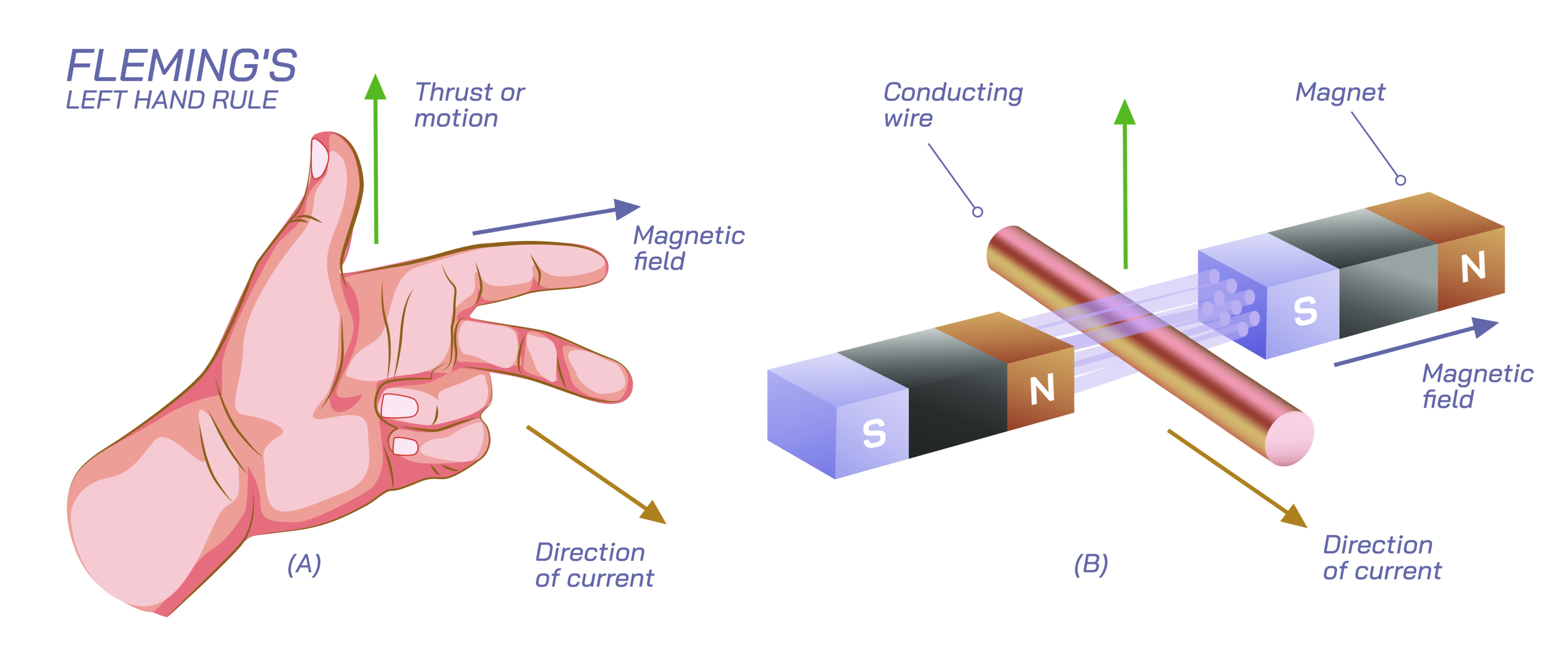
Fleming’s Left Hand Rule is one of the most intuitive and powerful conceptual tools in electromagnetism, offering a simple way to understand the forces acting on a current-carrying conductor placed within a magnetic field. Although vector illustrations typically portray the rule using a hand with three fingers held perpendicular to one another—representing the directions of current, magnetic field, and force—the deeper meaning of the rule reaches far beyond the gesture itself. It reveals the essence of how electric motors operate, how mechanical motion arises from electromagnetic interactions, and why magnetic forces behave in structured and predictable ways. Through a richly detailed conceptual explanation, the Left Hand Rule becomes far more than a mnemonic: it becomes a window into the interaction between electricity and magnetism, demonstrating how moving charges respond to magnetic environments and how these responses translate into real-world applications ranging from motors to loudspeakers to industrial machinery.
At the core of Fleming’s Left Hand Rule is the relationship between three fundamental vectors: current, magnetic field, and force. These three quantities are linked through a universal physical principle known as the motor effect. When an electric current flows through a conductor, moving charges inside the wire interact with any magnetic field present around them. This interaction produces a sideways force on the conductor—neither pushing in the direction of the current nor pulling along the magnetic field lines, but rather acting at right angles to both. This perpendicular relationship is a hallmark of electromagnetic phenomena. Nature organizes electric and magnetic interactions in such a way that when charged particles move through a magnetic field, the resulting force acts in a direction perpendicular to their motion and to the magnetic field. Fleming’s Left Hand Rule provides a simple way to visualize and predict that direction, using the orientation of the fingers as a model for the three interacting components.
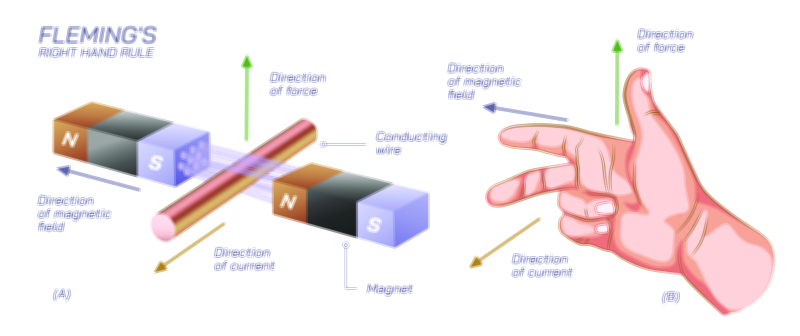
The rule is expressed through an arrangement of the left hand. When the thumb, first finger, and second finger are extended mutually perpendicular to one another—like a three-dimensional coordinate system—they represent the directions of the primary vectors in the motor effect. The first finger points in the direction of the magnetic field, which conventionally runs from North to South. The second finger points in the direction of the electric current, which means the direction of positive charge flow (from positive to negative). The thumb then indicates the direction of the force experienced by the conductor. By aligning the fingers with the field and current directions in a given situation, one can quickly determine the direction in which the conductor will move. This directional force is the basis for converting electrical energy into mechanical motion, which lies at the heart of countless technologies.
The motor effect occurs because electric charges moving within a magnetic field experience a force known as the Lorentz force. Even though positively charged particles and negatively charged electrons differ in direction of movement, the force acts on the conductor as a whole in a consistent orientation determined by the rule. The magnitude of the force depends on the current, the strength of the magnetic field, and the length of the conductor situated within that field. However, the direction of the force—what the Left Hand Rule predicts—is always perpendicular to both current and magnetic field. This results in mechanical movement that can be directed, controlled, and sustained, forming the operational basis of electric motors.
To understand why this force emerges, imagine electrons flowing through a wire placed in a region where magnetic field lines run in a particular direction. Each moving electron experiences a magnetic push due to its movement through the field. These individual microscopic pushes add up to create a macroscopic force on the entire wire. Because electrons are constrained within the metal conductor, the force acts collectively on the wire rather than pushing individual electrons out of place. This synchronized force pushes the wire sideways, illustrating how microscopic interactions create large-scale mechanical effects. The Left Hand Rule captures this relationship, turning what could be an abstract concept into a clear, memorable physical model.
This principle becomes even more powerful when applied to the operation of electric motors. In a typical motor, coils of wire are placed within a magnetic field generated by either permanent magnets or electromagnets. When electric current flows through these coils, the magnetic forces acting on them cause rotational motion. The orientation of the coils changes continuously as the motor rotates, requiring careful coordination of current direction to ensure smooth and continuous rotation. The Left Hand Rule allows designers and engineers to determine how coils will move at each moment, guiding the design of systems that convert electrical energy into mechanical rotation efficiently. In simple DC motors, a commutator reverses the direction of current at key moments to keep the torque acting consistently in one rotational direction. In more complex AC motors, alternating current interacts with rotating magnetic fields to maintain sustained motion. In every case, the foundation of motor operation lies in the electromagnetic force that the Left Hand Rule helps to predict.
The same principle underlies the operation of loudspeakers, where an electric current flows through a coil attached to a vibrating membrane. When the current changes direction in response to an audio signal, the magnetic forces on the coil push it back and forth. This motion vibrates the attached diaphragm, producing sound waves that replicate the original audio input. The coil moves left or right depending on the instantaneous direction of current and magnetic field orientation, with the Left Hand Rule informing which way the force acts. Through this mechanism, electromagnetic force becomes audible vibration, converting electrical signals into sound.
In industrial machinery, electromagnetic force is exploited in devices such as electromagnetic actuators, solenoids, relays, and automated switches. These devices use controlled currents to create precise movements, enabling mechanical automation, robotics, and precision control systems. Whether lifting a heavy load with an electromagnetic crane or performing delicate micro-motions in automated equipment, the underlying force remains the same: a conductor carrying electric current experiences a directional force in a magnetic environment. Fleming’s Left Hand Rule helps technicians, engineers, and students understand how these forces arise and how to orient systems to achieve desired mechanical outcomes.
Even transportation technologies utilize the motor principle extensively. Electric trains rely on motors powered by onboard or external electricity sources. Electric cars use high-efficiency motors to drive wheels with instantaneous torque. Magnetic levitation systems exploit related electromagnetic principles to lift and propel vehicles with minimal friction. In aviation, electromagnetic actuators control flap systems and internal components. The forces predicted by the Left Hand Rule underpin all of these systems, demonstrating that electromagnetic motion is pervasive across modern infrastructure.
In physics education, the Left Hand Rule is invaluable because it provides students with a tangible way to relate abstract vector quantities to real-world interactions. Magnetic fields, which cannot be observed directly, become more understandable when visualized through the effect they have on moving charges. Current direction, often an abstract concept since electrons move invisibly within wires, gains meaning when associated with physical movement of objects. The force, which results from the interaction, becomes a grounded and intuitive idea once students see physical conductors jump, rotate, or deflect when placed in magnetic fields while current flows through them. Classroom demonstrations with simple wire loops, magnets, and power supplies come alive as the Left Hand Rule reveals the underlying cause-and-effect relationship.
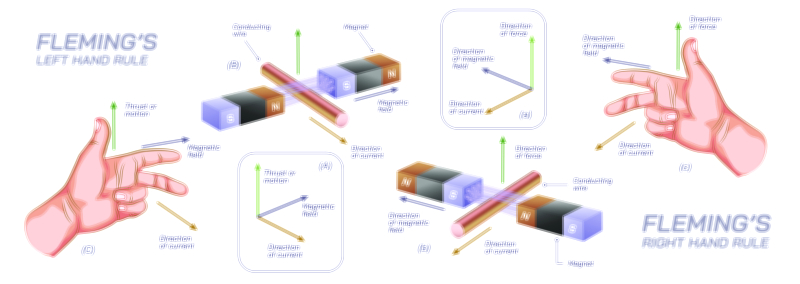
The Left Hand Rule also highlights a deeper symmetry in the laws of electromagnetism. It mirrors Fleming’s Right Hand Rule, which applies to generators and electromagnetic induction, where mechanical motion produces electrical energy. The Left Hand Rule applies to motors, where electrical energy produces mechanical motion. These two processes form a conceptual pair that reflects the elegant reversibility within electromagnetic systems. The same physical principles that allow mechanical work to generate electricity also allow electricity to generate mechanical work. Through Fleming’s rules, students and professionals alike can navigate the relationships between motion, magnetism, and current with confidence and clarity.
Fleming’s Left Hand Rule also connects to many natural phenomena. Charged particles moving through Earth’s magnetic field experience forces that shape auroras, radiation belts, and atmospheric currents. In astrophysical environments, moving charged particles spiral along magnetic field lines, producing radiation and shaping cosmic structures. The direction of these motions corresponds to the same vector relationships described by the rule. Even in laboratory plasmas, confinement systems rely on cross-field forces that follow the same perpendicular relationships between current, field, and force.
Moreover, the rule reinforces the importance of coordinate systems and vector geometry in physics. The orientation of perpendicular directions—right angles between field, current, and force—reflects the deeper structure of electromagnetic laws, which are governed by cross products, vector fields, and spatial transformations. Although the Left Hand Rule provides a simple mnemonic, it ultimately points toward complex mathematical relationships governing electromagnetic interactions. By starting with the rule, learners can build intuitive understanding that supports deeper exploration of Maxwell’s equations, Lorentz forces, and electromagnetic field theory.
Despite its simplicity, Fleming’s Left Hand Rule embodies a remarkable amount of scientific insight. It distills a complex set of vector relationships into a single hand gesture that anyone can understand. Yet beneath this ease of use lies a description of how the universe behaves at the level of charged particles interacting with magnetic fields. It explains why motors spin, why currents in conductors feel magnetic forces, why electromagnetic devices function, and why motion emerges from invisible fields. It bridges human intuition and mathematical precision, offering both a conceptual starting point and a practical tool for analyzing real-world electromagnetic systems.
Ultimately, Fleming’s Left Hand Rule stands as one of the most accessible and illuminating tools in physics education and engineering practice. It reveals how electricity and magnetism combine to produce mechanical motion, how motors convert energy efficiently, and how electromagnetic forces shape technologies that define everyday life. Through detailed understanding of this rule, one gains insight not just into motor operation, but into the broader unity of electromagnetic phenomena—a unity that underlies countless devices, systems, and natural processes across the physical world.