Ferromagnetism Vector Illustration — Magnetic Domains and Strong Atomic Alignment Explained for Physics Education
Ferromagnetism remains one of the most foundational topics in physics, especially for students learning how microscopic atomic behavior can generate large-scale forces that shape countless technologies in daily life. A vector illustration designed to explain ferromagnetism typically highlights how the internal structure of materials such as iron, nickel, cobalt, and certain rare-earth alloys becomes highly ordered under the influence of magnetic interactions. Although magnets appear to function as single unified objects, their strong magnetic field is actually the outcome of billions of individual atoms working cooperatively. Each atom can be thought of as possessing its own miniature magnetic moment due to electron spin, but these moments do not become significant unless they align in large coordinated groups. When a vector illustration shows these tiny magnetic arrows pointing in the same direction, it makes visible the invisible structure that gives ferromagnetic materials their defining power. This alignment of countless microscopic magnets inside a substance is not accidental; it arises because the atoms inside the material prefer to orient in the same direction due to strong exchange forces, forming regions called magnetic domains. Understanding how these domains behave is crucial to understanding why some objects become magnets while others do not.
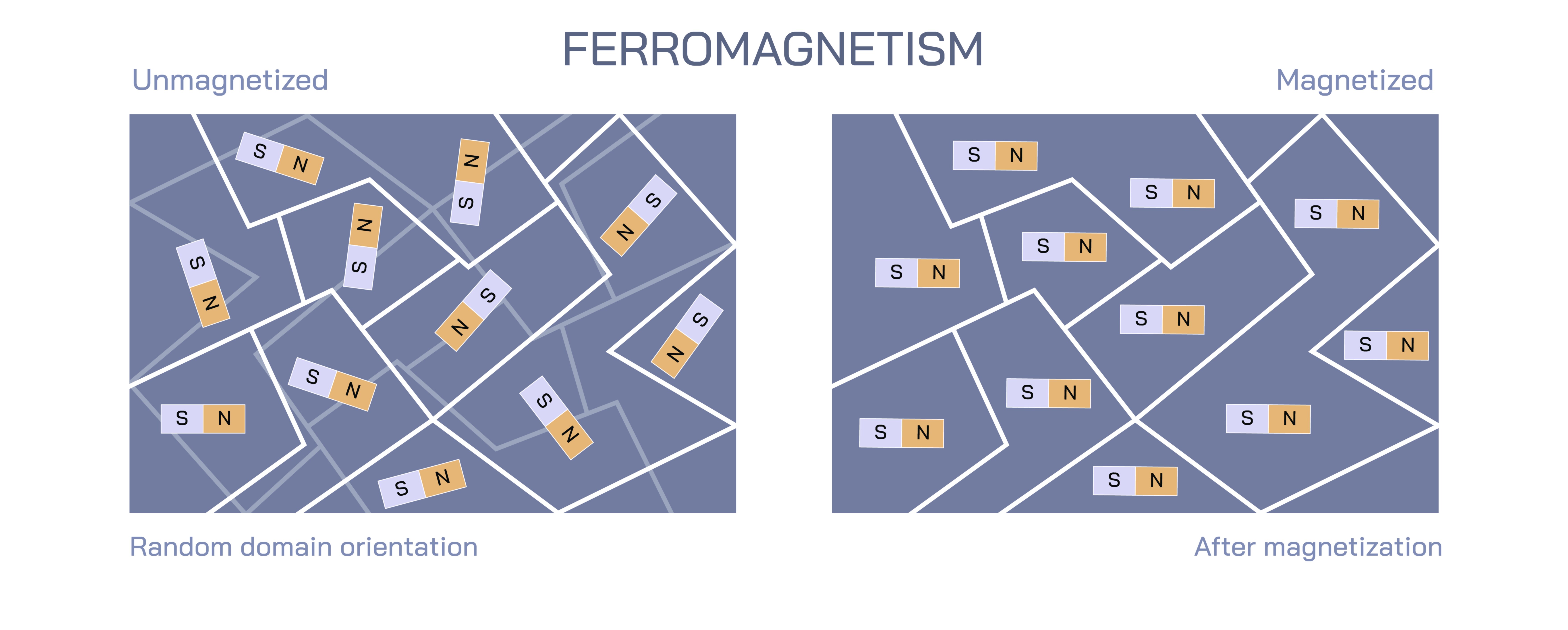
Initially, before magnetization has occurred, these magnetic domains are not arranged in any particular order relative to the overall shape of the material. Although each domain contains atoms aligned strongly within itself, the domains point randomly in many different directions, which causes the magnetic effects to cancel out at large scales. A piece of iron lying on a table does not behave like a magnet because its domains are misaligned, even though every single region inside it contains aligned atomic spins. A vector illustration of this state typically displays clusters of arrows pointing in various directions, creating a visual sense of disorganization. The key transformation begins when an external magnetic field is applied. As the material interacts with this external field, domains begin to rotate so that their local magnetic moments line up toward the direction of the applied magnetic force. Domains oriented favorably expand and grow stronger by recruiting neighboring atoms, whereas oppositely oriented domains shrink and eventually vanish. As more domains align in the same direction, the material as a whole begins to behave as a magnet. Behind this process is a delicate balance of atomic forces that reward cooperative spin orientation, making the material respond to magnetizing forces quickly if the structure and temperature conditions are favorable.
When fully magnetized, almost all domains point in the same direction, producing a powerful and long-lasting magnetic field that persists even after the external magnetizing force has been removed. A vector illustration depicting this state displays smooth, parallel arrows across the entire material, representing complete internal order. This visual portrayal helps students understand why a magnet acts strongly when domains reinforce one another instead of cancelling. However, this stable configuration does not always remain constant forever. Heat, mechanical shock, or opposing magnetic fields can disrupt the alignment of domains again. At high enough temperature — the Curie temperature — thermal energy becomes strong enough to knock spins out of alignment, causing the material to transition from a ferromagnetic state to a paramagnetic one where magnetism becomes temporary and weak. This change in internal structure highlights the sensitivity of ferromagnetic order to environmental conditions and helps explain why certain magnets lose their strength when heated or struck.
The vector-based approach to illustrating ferromagnetism is extremely valuable in physics education because it turns an abstract concept into something students can picture clearly as a physical mechanism. When beginners hear that a magnet contains “aligned atoms,” the statement can sound vague without a visual representation. With arrows showing direction and grouping, the domains become intuitive: disordered arrows for an unmagnetized object, partially aligned arrows for a partially magnetized object, and smooth synchronized arrows for a fully magnetized one. Beyond that, vector diagrams also help students understand saturation — the point at which all available domains are aligned and no further increase in magnetism is possible no matter how strong the external field becomes. The same illustrations can be extended to show coercivity — the degree of difficulty in reversing domain alignment — by depicting materials where arrows remain locked in place even when opposing forces are applied. These concepts are essential for selecting proper materials for magnets, memory devices, transformers, and other electromagnetic systems.
Ferromagnetism gains even greater significance when connected to real-world technology. Electric motors and generators rely on the ability of ferromagnetic cores to amplify magnetic flux, making mechanical and electrical energy conversion efficient and practical. Transformers require ferromagnetic materials to channel changing magnetic fields and transfer power between coils with minimal loss. Magnetic recording media such as hard drives, audio tapes, and certain types of sensors depend on the switching of microscopic domains to record information. Loudspeakers use ferromagnets to convert electrical signals into mechanical vibrations that produce sound. Even small devices like mobile phones, headphones, magnetic latches, and electricity meters rely on controlled magnetic behavior rooted in domain alignment. Rare-earth magnet compositions such as neodymium-iron-boron and samarium-cobalt demonstrate the power of optimizing microscopic magnetic forces to produce extremely strong and compact permanent magnets used in robotics, aerospace devices, drones, electric bicycles, and advanced medical tools.
Beyond the technological applications, ferromagnetism also ties directly into natural systems and planetary physics. Earth’s core consists of molten iron alloys that generate the planet’s magnetic field through complex convection and rotational motion. Rocks containing ferromagnetic minerals record signatures of the direction of Earth’s field as they cool; these magnetic records provide critical evidence for continental drift and plate tectonics. Even animal navigation relies on magnetic interactions; some species possess specialized biological receptors that detect Earth’s magnetic field, allowing them to migrate with astonishing accuracy across vast distances. All of these phenomena would be difficult to understand without the underlying principle that enormous magnetic effects can originate from the cooperative behavior of many atoms acting like aligned spinning magnets inside matter.
When physics educators use vector illustrations to teach ferromagnetism, they help students bridge the gap between microscopic quantum-level interactions and large-scale forces visible in everyday life. The concept becomes more than an isolated chapter in a textbook — it becomes a vivid demonstration of how patterns of alignment generate order and function. It also reinforces the broader theme in science that large effects often emerge not from a single cause, but from the organized collective behavior of countless components working together. Whether students are preparing for careers in engineering, electronics, materials science, robotics, or physics research, ferromagnetism stands as an essential lesson about how the behavior of atoms shapes the functionality of the modern world.