Ferromagnetism — Magnetic Domains and Strong Magnetism Explained in Physics
Ferromagnetism is one of the most striking and intuitive manifestations of magnetism in nature, yet beneath its familiar outward behavior lies an astonishingly intricate and beautifully coordinated physical mechanism. The ability of certain materials to become strongly magnetized, to retain this magnetization even after an external field is removed, and to interact dramatically with other magnetic objects reflects a deep internal order that emerges from the collective behavior of countless microscopic components. Although vector illustrations often depict ferromagnetism through simple arrows representing aligned magnetic domains, these diagrams only hint at the remarkable cooperative effects that occur within ferromagnetic substances. When described through a richly detailed conceptual narrative, ferromagnetism becomes a window into how matter organizes itself under the influence of quantum mechanical interactions, how internal structures govern macroscopic behavior, and why certain materials—such as iron, cobalt, and nickel—display magnetism powerful enough to shape technologies, geophysical processes, and everyday experience.
At its core, ferromagnetism arises from the alignment of magnetic moments within a material. A magnetic moment is a tiny magnetic influence generated by the motion and intrinsic properties of electrons. Every electron possesses a type of angular momentum known as spin—a quantum property that gives the electron a tiny magnetic field of its own. In many materials, these magnetic moments are randomly oriented, canceling each other out and preventing the material from showing large-scale magnetism. But in ferromagnetic materials, the electrons’ magnetic moments have a tendency to align collectively, forming coordinated regions of uniform magnetic direction. This cooperation among atomic-scale magnets creates an amplified magnetic field that can extend across a crystal structure and even outward into the surrounding environment.
This collective behavior is stabilized by an interaction known as exchange coupling. Unlike classical interactions that depend on the alignment of charges or currents, exchange coupling is a purely quantum mechanical phenomenon. It arises from the requirement that electrons obey the Pauli exclusion principle, which states that no two electrons can occupy the same quantum state. When electrons in neighboring atoms possess parallel spin alignment, their wavefunctions arrange in a way that lowers the system’s overall energy. This reduced energy state encourages electrons to align their spins with those nearby. Through this mechanism, the material naturally forms large regions where magnetic moments point in the same direction. These regions are known as magnetic domains, and they represent a fundamental structural element of ferromagnetism.
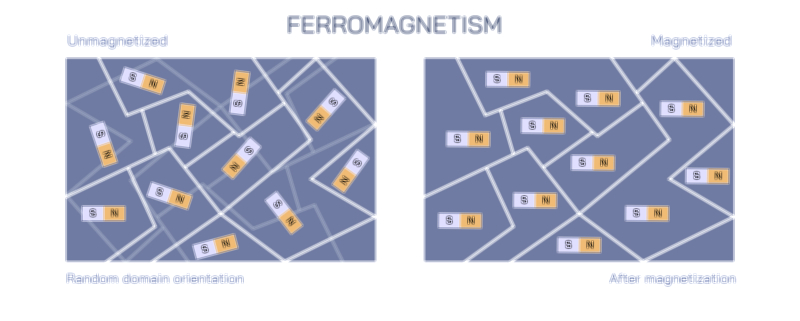
Despite this internal order, a ferromagnetic material in its natural, unmagnetized state does not necessarily exhibit a net external magnetic field. This occurs because magnetic domains within the material are often arranged so that their magnetic influences cancel out. Imagine a material divided into multiple regions, each with perfectly aligned magnetic moments internally, but with adjacent domains oriented in different or opposing directions. This arrangement yields stability within the material but no overall magnetization when viewed from the outside. It is only when an external magnetic field is applied that domain walls—the boundaries between differently aligned regions—begin to shift. Domains whose alignment matches or complements the external field grow at the expense of others. Through this process, the material becomes magnetized, and a strong external magnetic field emerges.
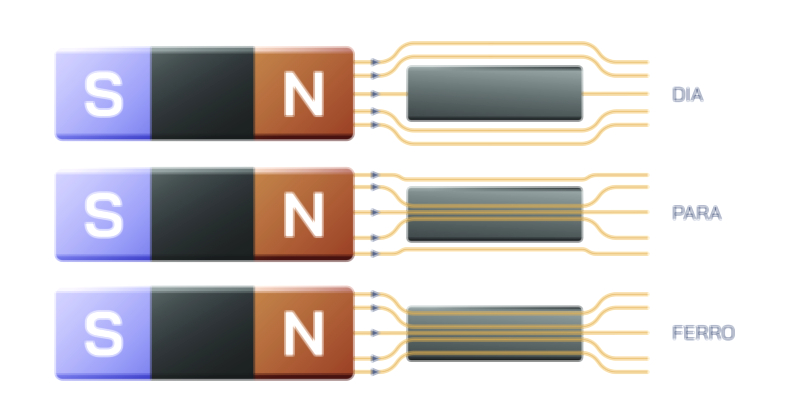
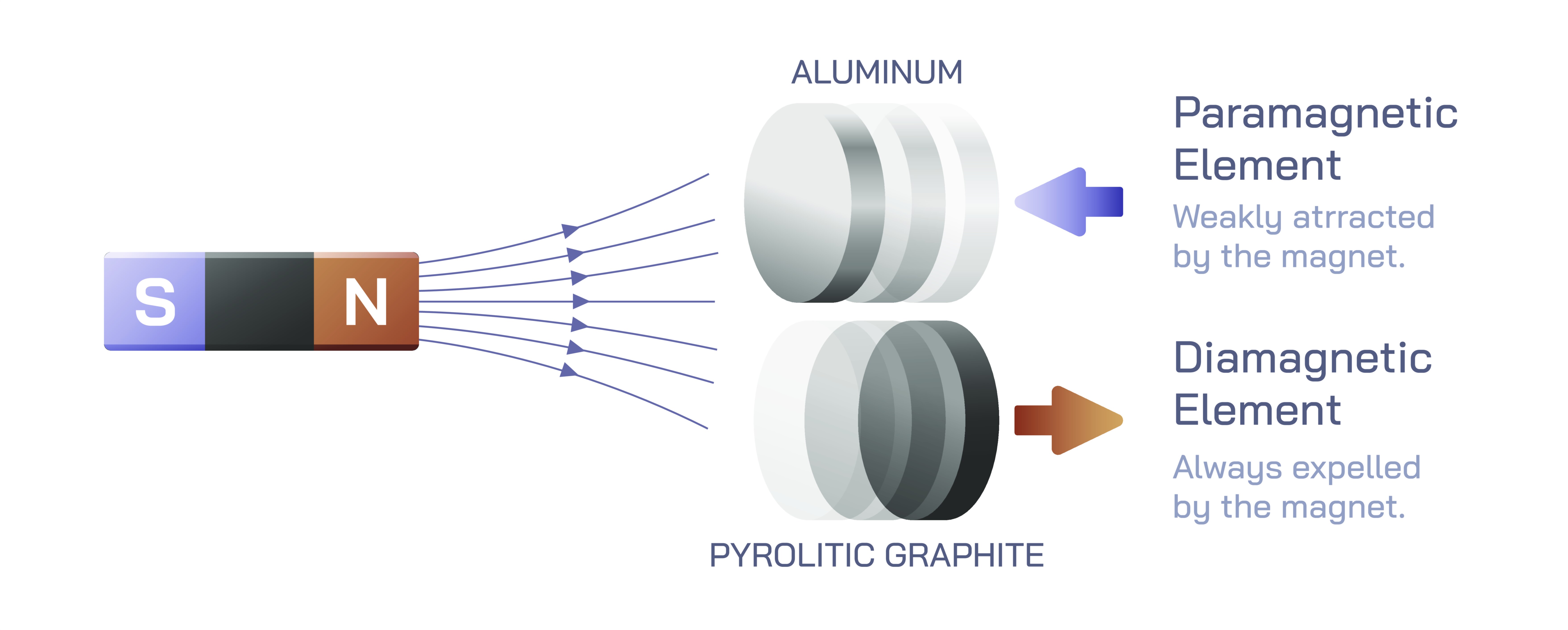
Magnetization occurs not because individual atoms change their magnetic strength but because domains reorganize. When an external magnetic field is present, it exerts a directional influence on all magnetic moments in the material. Domains aligned with this direction become more energetically favorable, while misaligned domains contract or transform. The result is a net magnetic field extending outward, giving the material its characteristic magnetic force. This behavior is highly cooperative: the internal realignment of billions of atomic magnetic moments magnifies the external field to a degree far greater than any single atom could produce. This collective amplification is what makes ferromagnetic materials extraordinarily powerful compared with paramagnetic or diamagnetic substances.
One of the most remarkable features of ferromagnetism is the ability of materials to retain magnetization even after the external magnetic field is removed. This phenomenon, known as remanence or remanent magnetization, arises because domain alignment becomes energetically locked into place once it has been achieved. The internal structure of the material—its lattice, impurities, stresses, and microscopic irregularities—helps pin domain walls, making it difficult for the domains to return to their original random pattern. This persistence of domain structure allows permanent magnets to retain their magnetic fields for years, decades, or even longer without requiring external energy input. The same effect underlies the operation of magnetic storage, where domain orientation encodes information in a durable form.
However, not all ferromagnetic materials behave identically. Some, known as soft ferromagnets, magnetize and demagnetize easily. They have domain structures that shift readily, making them ideal for devices such as transformers and electromagnetic cores where magnetization needs to change rapidly in response to electric currents. Hard ferromagnets, by contrast, resist changes in domain structure and maintain stable magnetization. These materials form the basis of permanent magnets used in motors, generators, audio equipment, and many other technologies requiring consistent magnetic fields. The difference between soft and hard ferromagnets lies in their internal composition, structural defects, and crystal anisotropy—properties that determine how easily magnetic domains can move or become pinned within the material.
Temperature plays a crucial role in ferromagnetism as well. Ferromagnetic order exists only below a specific temperature known as the Curie temperature. Above this temperature, thermal agitation becomes strong enough to disrupt exchange coupling, causing magnetic moments to lose their collective alignment. The material transitions into a paramagnetic state, where individual atoms still possess magnetic moments but no longer exhibit domain-based organization. This transition illustrates how ferromagnetism is a delicate balance between cooperative alignment and disruptive thermal motion. When cooled below the Curie temperature, the material regains its ability to form domains and exhibit strong magnetism once again. This temperature dependence influences how ferromagnetic materials are used in technology, ensuring that devices operate within stable magnetic conditions.
Ferromagnetism is not limited to pure metals like iron, cobalt, and nickel. Many alloys exhibit enhanced or modified ferromagnetic behavior. For example, neodymium–iron–boron and samarium–cobalt alloys form exceptionally powerful permanent magnets by optimizing internal electronic structure and domain stability. These advanced magnetic materials power modern electric motors, wind turbines, audio systems, hard drives, medical devices, and countless modern technologies. Even in these complex alloys, the fundamental mechanism remains the same: exchange interaction produces magnetic alignment within domains, and domain structure determines macroscopic magnetic properties.
The physics of ferromagnetism extends beyond engineering to influence geological and cosmic phenomena. Earth’s crust contains ferromagnetic minerals, and when rocks form or cool in the presence of the Earth’s magnetic field, their domains align in ways that record the planet’s magnetic history. These preserved alignments, stored in volcanic and sedimentary rocks, form the basis of paleomagnetism, a field that allows scientists to reconstruct past movements of continents, reversals of Earth’s magnetic field, and patterns of seafloor spreading. The magnetic signatures locked within rocks act like ancient memory traces, revealing the dynamic processes that shaped the planet over millions of years.
Ferromagnetism also affects cosmic environments. In certain neutron stars—called magnetars—extreme densities and unusual quantum states create magnetic fields trillions of times stronger than any magnetic field on Earth. Although these fields arise through mechanisms far more complex than terrestrial ferromagnetism, the underlying principle of aligned magnetic moments remains relevant. In astrophysical plasmas, magnetic fields influence the movement of charged particles, shaping stellar winds, solar flares, galactic fields, and the behavior of interstellar gas. Thus, while ferromagnetism in its strict form applies only to certain solid materials, its conceptual threads extend into far larger and more energetic systems in the universe.
In everyday life, ferromagnetism appears in countless forms. The magnets holding notes on a refrigerator, the motor turning an electric fan, the magnetic strip encoding data on a card, the speaker that vibrates to create sound—all rely on the interaction of magnetic domains within ferromagnetic materials. Even simple demonstrations, such as iron filings aligning around a bar magnet, visualize the external field that arises from domain alignment inside the magnet. These experiences reveal how microscopic order creates macroscopic behavior, translating quantum-level interactions into familiar physical forces.
Ferromagnetism also highlights the importance of domain structure in explaining magnetic attraction and repulsion. A magnet does not simply attract metal because it has a magnetic field; instead, the field influences domains within the material being attracted. In ferromagnetic objects, the external field from a magnet encourages the domains in the nearby object to align, creating a region of induced magnetization that pulls the object toward the magnet. This is why a nail or steel object becomes temporarily magnetized when brought near a strong magnet. When removed from the field, the domains may relax back into a disordered state unless the material has sufficient domain stability to retain partial magnetization.
Understanding ferromagnetism also helps explain demagnetization. When a ferromagnetic object is exposed to impacts, vibration, or alternating magnetic fields, the domain structure can become disturbed. Domain walls may shift, collapse, or reorganize, reducing the net magnetization. Heating a magnet above its Curie temperature produces complete demagnetization by disrupting the exchange coupling that maintains domain alignment. These processes demonstrate how fragile and dynamic domain structure can be, even though ferromagnets often appear stable and solid.
Ferromagnetism represents a remarkable example of how microscopic and macroscopic physics intersect. The magnetism experienced in daily life emerges from quantum mechanical principles governing electron behavior, yet produces effects powerful enough to move objects, store information, shape geological formations, and drive technological systems. The alignment of countless tiny magnetic moments into coordinated magnetic domains produces the strong, persistent fields that characterize ferromagnetic materials. Whether depicted through vector illustrations of arrows and domains or explored through detailed conceptual understanding, ferromagnetism remains one of the most compelling and accessible demonstrations of cooperative physics in the natural world—an interplay of quantum interaction, structural organization, and emergent macroscopic force.