Fleming’s Right Hand Rule — Generator Principle and Electromagnetic Induction Explained
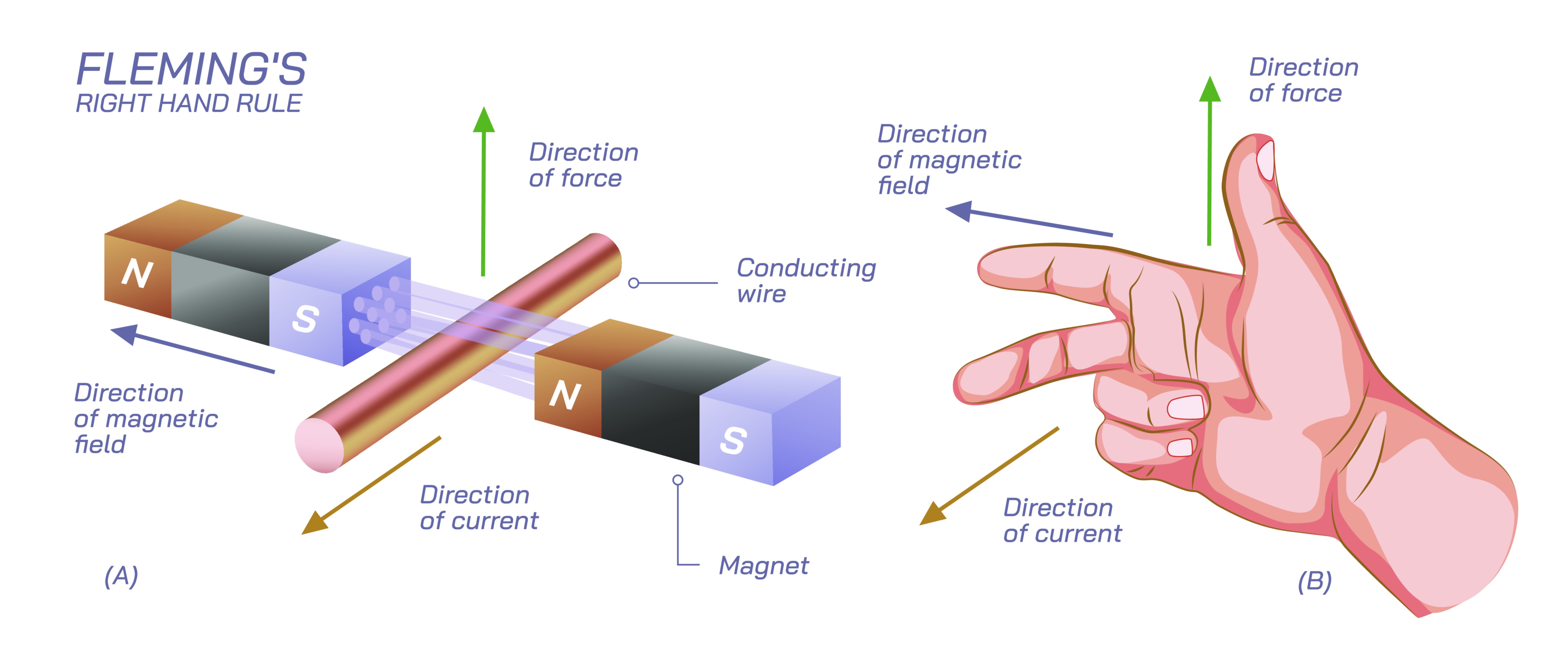
Fleming’s Right Hand Rule stands as one of the clearest conceptual tools in understanding one of the most important processes in physics: electromagnetic induction. Although vector illustrations often display the rule using a hand with three mutually perpendicular fingers—each representing the directions of motion, magnetic field, and induced current—the deeper meaning behind this simple gesture lies in the core principles that make modern electricity possible. At its heart, Fleming’s Right Hand Rule describes how electrical energy is generated whenever a conductor moves through a magnetic field. It reveals how motion can be converted into electricity and why generators, alternators, and power-producing machines operate the way they do. When examined through a full, richly detailed conceptual narrative, the rule becomes not just a memory aid but a window into the workings of electric power plants, renewable energy systems, induction devices, and countless natural phenomena.
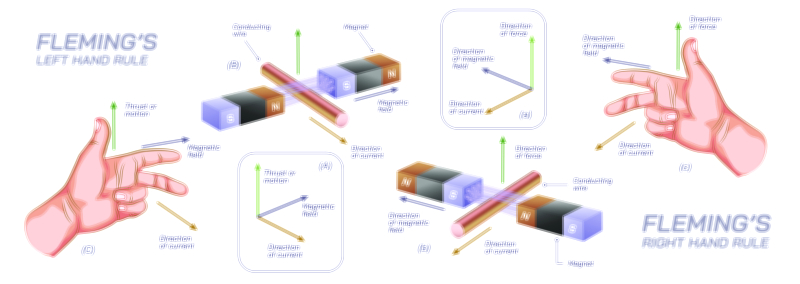
The rule begins with three essential components: motion of a conductor, magnetic field, and induced current. These three elements form the basis of all electromagnetic induction. When the thumb of the right hand is pointed in the direction of the conductor’s motion, and the first finger is pointed in the direction of the magnetic field—traditionally from the North pole of a magnet to the South—the second finger, held at right angles to the other two, indicates the direction of the induced current. This simple arrangement reflects a profound principle: when a conductor cuts through magnetic field lines, electrons inside it experience a force that pushes them along a specific path, creating electrical current. This connection between motion and electricity is known as the generator effect, and it is one of the most important discoveries in electromagnetism.
At the microscopic level, the generator effect emerges because magnetic fields exert forces on moving charged particles. When a conductor moves across a magnetic field, the electrons within it are forced sideways relative to both the direction of motion and the field. This sideways push makes electrons accumulate at one end of the conductor, creating a potential difference. If the conductor is part of a closed circuit, this potential difference causes electrons to flow, producing current. Fleming’s Right Hand Rule provides a simple way to visualize this directional relationship, turning an invisible three-dimensional vector interaction into a physical gesture that anyone can understand. Although the electrons are tiny and their motion cannot be seen directly, the rule accurately predicts how they will move when subjected to magnetic influences while the conductor is in motion.
This principle is the foundation of electric generators, devices that convert mechanical energy into electrical energy. In a generator, coils of wire rotate within magnetic fields, or magnets rotate around coils. As the coil moves, its segments cut across magnetic field lines, and electrons inside the wire experience the sideways push described by the rule. The direction of current alternates as the coil rotates, producing alternating current (AC). In other designs, mechanical components guide current in a single direction, generating direct current (DC). Regardless of design, the same basic principle applies: moving conductors in magnetic fields induces current. Every power plant—whether driven by steam turbines, water flow, wind turbines, or engines—ultimately relies on this process. Mechanical motion spins coils or magnets, magnetic induction generates electrical energy, and the Right Hand Rule predicts how that energy flows.
Consider a simple coil rotating in a magnetic field. As the coil turns, segments of wire move upward, downward, or sideways through the field. In each position, the direction of motion relative to the magnetic field changes. Using Fleming’s Right Hand Rule, one can determine the direction of the induced current at each moment. This makes the rule invaluable in understanding how alternating current arises naturally from rotational motion. When the coil rotates one-half turn, the motion direction reverses relative to the field, causing the induced current to reverse direction as well. This periodic reversal is the essence of AC electricity, the type used in homes and industries around the world. Without understanding this directional relationship, the behavior of generators would seem mysterious. With the Right Hand Rule, it becomes predictable and intuitive.
The same principle governs alternators, which are specialized generators used in automobiles, power stations, and many other systems. Alternators use rotating magnetic fields interacting with stationary coils—or vice versa—to produce electrical power efficiently. The Right Hand Rule helps engineers and technicians determine how the motion and magnetic field orientation inside an alternator produce the electrical output that charges batteries, powers vehicles, or feeds transmission lines. Whether the alternator is large enough to supply an entire city or small enough to fit inside a car engine, its behavior follows the same principles described by Fleming’s Right Hand Rule.
The rule also applies to bicycle dynamos, where a small wheel rotating against the bicycle’s tire turns a magnet inside a coil. As the magnet spins, the magnetic field around the coil changes, and the motion induces current. The Right Hand Rule predicts the direction of this current and explains why the light glows brighter as the bicycle speeds up: greater motion leads to more rapid cutting of magnetic field lines, increasing the induced current. This relationship between speed and induced voltage is fundamental in many induction-based systems. Faster motion results in stronger induction, while slower motion produces weaker electrical output.
In power plants, motion is provided by enormous turbines driven by various energy sources—steam from boiling water, high-pressure gas, falling water in hydroelectric dams, powerful wind flows, or even nuclear-reactor-generated steam. Regardless of the method used to spin the turbines, the same generator principle applies. Moving coils through magnetic fields produces electric current, and the Right Hand Rule explains its direction. This universal process highlights the stunning simplicity beneath the complexity of global electricity infrastructure: the electricity that powers modern society is ultimately produced by wires cutting through magnetic fields under controlled conditions.
The Right Hand Rule is also at the heart of induction phenomena in transformers and induction coils, although these devices rely on changing magnetic fields rather than physical motion to induce current. Even without mechanical movement, a changing magnetic environment can produce induction. The principle is similar: electrons respond to changes in magnetic conditions with directional movement that aligns with the relationships described by the rule. This extends the role of the Right Hand Rule beyond mechanical generators to the broader realm of electromagnetic induction, where magnetic variation alone can create electrical effects.
The rule even explains induction in everyday situations. When a magnet is moved quickly near a coil, the motion creates a momentary current. When a magnetic field collapses rapidly around a conductor, electrons are pushed, generating a spark. Even in situations such as electromagnetic braking, where motion through a magnetic field induces currents that slow the system, the directionality predicted by the Right Hand Rule remains relevant. In these systems, induced currents produce opposing magnetic effects that resist the original motion, creating a braking force. The rule helps predict not only induced current but also the direction of forces arising from that current.
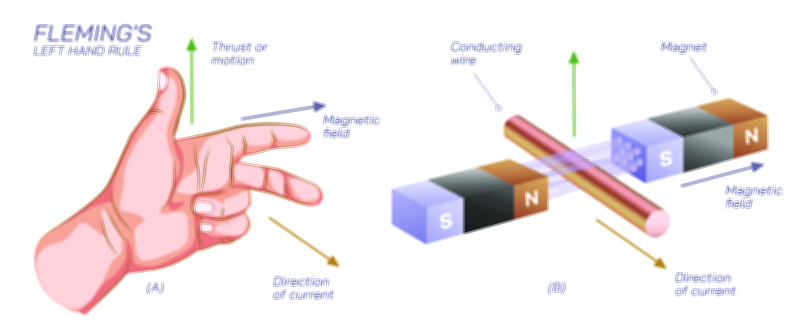
On a deeper level, Fleming’s Right Hand Rule highlights the profound symmetry of electromagnetic laws. It represents the generator counterpart to Fleming’s Left Hand Rule, which describes the motor effect. Together, the two rules form a conceptual bridge between electricity and motion. The Left Hand Rule predicts how electricity produces motion. The Right Hand Rule predicts how motion produces electricity. These two processes—motor action and generator action—mirror one another perfectly, reflecting the reciprocity at the heart of modern electromagnetic theory. Motors convert electrical energy into mechanical energy, while generators convert mechanical energy into electrical energy. The underlying physics is unified, and the two rules simply describe opposite perspectives of the same fundamental interactions.
In education, the Right Hand Rule serves as one of the clearest entry points into electromagnetic induction. Students can observe small coils generating voltage when rotated, galvanometers deflecting as magnets move near them, or metal rods producing sparks when swept rapidly through magnetic fields. With the Right Hand Rule, these behaviors become understandable. The rule helps visualize the invisible and translate theoretical concepts into a physical gesture that makes electromagnetic induction real, intuitive, and accessible.
At the same time, the rule guides engineers, electricians, and technicians who design or troubleshoot electrical machinery. Understanding the direction of induced current is essential when designing generator windings, aligning coils with magnets, or predicting the behavior of alternating-current systems. The rule ensures proper wiring, correct rotational direction, and safe operation. Even in advanced fields such as electromagnetic research, particle accelerators, and plasma confinement, the basic directional relationships remain grounded in the same vector interactions described by the Right Hand Rule.
Ultimately, Fleming’s Right Hand Rule provides a simple but profound insight into how the physical world works. It reveals how mechanical motion transforms into electrical energy, how moving conductors interact with magnetic fields, and how induction underlies everything from household electricity to large-scale power grids. By understanding this rule through a deeply detailed conceptual lens rather than just a diagram, one gains a clearer view of the unity between motion, magnetism, and electricity—an elegant connection that powers modern technology and illuminates some of the deepest principles of physics itself.