Kirchhoff’s Laws of Electrical Circuits — Principles of Current and Energy Distribution
Kirchhoff’s laws of electrical circuits form one of the most fundamental theoretical frameworks in the study and analysis of electric networks, shaping the way electrical engineers design circuits, analyze power flow, predict current behavior, and ensure safe, efficient system performance. These laws, developed by Gustav Kirchhoff in the nineteenth century, describe how electric charge and energy behave in interconnected loops and branches of a circuit. Their brilliance lies in the fact that they apply universally to all electrical circuits, whether the system is tiny and embedded inside a microchip or massive and spread across a national power grid. Because most real circuits involve multiple branches, multiple sources, and complex interconnections, Kirchhoff’s laws serve as the practical tool that allows engineers to calculate unknown currents, voltages, and power distributions that would otherwise be impossible to determine using simple series and parallel formulas. Beyond theory, these laws support nearly every field of modern electronics—communications, power distribution, control systems, renewable energy, automation, and computing—making them foundational to electrical design and analysis.
The first of the two laws, known as Kirchhoff’s Current Law (KCL), describes how electric current behaves at the junctions or nodes where circuit branches divide or converge. It states that the total current entering any node must equal the total current leaving that node. This reflects a simple but profound physical truth: electrical charge cannot accumulate at a point in a steady-state circuit. Charge carriers, whether electrons in a metal or ions in an electrolyte, do not gather indefinitely at a junction—they flow continuously. The law expresses conservation of electric charge, ensuring that what flows in must flow out. If 6 amperes enter a node and divide into two branches carrying 4 amperes and 2 amperes, the total remains balanced because energy and charge flow never disappear or appear from nowhere. This principle governs the distribution of current in branching circuits such as household wiring, circuit breakers, power supplies, and printed circuit boards.
KCL has deep consequences for understanding how circuits function. When a circuit contains multiple resistors, capacitors, loads, sensors, or electronic components branching from common nodes, KCL provides a systematic method to calculate the current through each part. Current does not divide randomly; it splits in proportion to the electrical characteristics of each branch. Because the law ensures that current flow remains continuous across the entire network, it forms a core step in the analysis of nodal voltages, transistor amplifiers, integrated circuits, and parallel power distribution systems. KCL becomes especially powerful in DC networks, AC power grids, and electronic signal paths where steady-state operation requires current equilibrium. Its value increases in complex integrated circuits where numerous current paths interact, and its role in digital and analog hardware design remains essential.
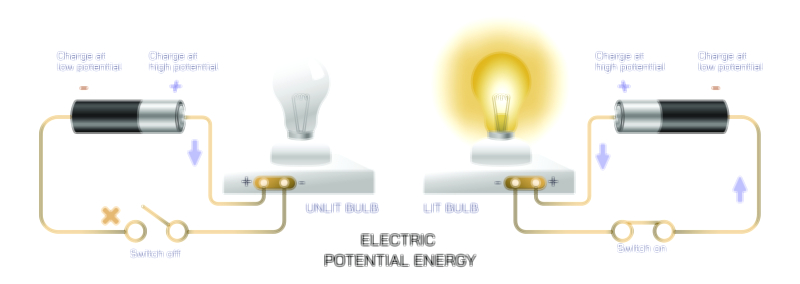
The second law, known as Kirchhoff’s Voltage Law (KVL), concerns the distribution of electrical potential—energy per unit charge—within closed loops of a circuit. KVL states that the sum of voltage rises must equal the sum of voltage drops around any complete circuit loop. In other words, all energy supplied by sources such as batteries, generators, or power converters must be completely used by the elements in that loop, including resistors, motors, sensors, light bulbs, or electronic components. Voltage, which represents the energy required to move charge between points, cannot accumulate or vanish; the total energy gained equals the total energy spent as charge carriers move throughout a closed path. If a voltage source provides 12 volts and the circuit contains two loads dropping 5 volts and 7 volts respectively, the totals balance because that exact energy is consumed by the circuit’s components.
KVL is grounded in the principle of conservation of energy, ensuring that charge completes a closed loop without gaining or losing unintended energy. Engineers rely heavily on KVL to determine unknown voltages and to design safe and efficient power systems. Every branch of a loop consumes a share of the supplied electrical energy in proportion to its electrical properties. For example, a light bulb in a home circuit converts electrical energy into heat and light; a resistor in an amplifier converts energy into controlled heat dissipation; and a motor converts energy into rotational motion. KVL enables engineers to evaluate the voltage consumed in each stage to ensure components operate within safe levels, preventing overheating, underpower conditions, and failures.
Together, Kirchhoff’s laws strengthen each other. KCL governs current balance at nodes, while KVL governs voltage balance in loops. Real circuits contain both nodes and loops simultaneously, so using the two laws in combination allows a complete solution to complex circuit behavior. For instance, in a bridge network, an alternating current power distribution grid, a multi-branch LED lighting array, or a computer motherboard working with power rails and sensitive components, both current and voltage distribution must be known. Kirchhoff’s laws provide the mathematical and conceptual framework to determine how the circuit shares energy and charge throughout its entire structure.
Their importance becomes even clearer in circuits with multiple power sources. Household electrical systems, solar power systems, electric vehicles, and backup power networks often include more than one voltage source. Without Kirchhoff’s laws, determining the contribution of each source would be nearly impossible. KVL ensures that each source’s energy contribution is properly accounted for, while KCL ensures that all currents settle into stable proportions. Engineers construct system matrices, apply nodal analysis or mesh analysis, and solve simultaneous equations derived directly from Kirchhoff’s rules to compute the operating conditions of the system. Even sophisticated computer-based circuit simulation software, such as SPICE models used in industry, executes algorithms based on Kirchhoff’s laws to calculate voltages and currents at every point of the circuit.
Kirchhoff’s laws also play a crucial role in transient and AC system behavior. In alternating-current applications, voltage and current vary continuously with time, interacting with resistance, capacitance, and inductance in dynamic ways that include phase differences. KCL still requires that instantaneous currents entering and leaving a node must match, while KVL ensures that instantaneous voltage rises and drops sum to zero in a loop. For inductors and capacitors, energy is stored temporarily and later returned to the circuit. Even in these time-dependent cases, Kirchhoff’s laws continue to govern balance, producing sinusoidal relationships and phasor analysis used in power engineering, signal processing, and electronics.
Kirchhoff’s laws are equally important for safety considerations. Incorrect current distribution can overload wiring, melt insulation, trigger fires, or damage sensitive electronic components. Voltage imbalances can destroy microprocessors, disrupt sensor accuracy, or cause electric shock hazards. By designing and evaluating circuits using Kirchhoff’s principles, engineers avoid dangerous scenarios and optimize system reliability. In the design phase, the laws assist in selecting proper conductor sizes, fuse ratings, overload protection devices, voltage regulation components, and grounding or isolation techniques.
The universality of Kirchhoff’s laws extends beyond small-scale electronics and into large power systems. Modern electrical grids must operate under complex variations of demand, incorporating renewable energy sources like solar and wind, energy storage systems, and bidirectional power flow. At every substation and every distribution line, Kirchhoff’s laws determine how power spreads through the network, whether hundreds of megawatts or a few milliamps are involved. They govern microgrids, smart grid technologies, high-voltage transmission lines, and electric vehicle charging infrastructures. The intricate stability of power networks rests on the same principles that describe the current in a small flashlight circuit.
Even in educational settings, Kirchhoff’s laws are powerful because they teach students to think about electricity as a conserved physical quantity. They encourage mental models of energy transfer and current flow that align with real-world physics. Mastering these laws opens the door to advanced subjects such as semiconductor physics, control theory, embedded systems, electromagnetic fields, power electronics, and digital design.
Ultimately, Kirchhoff’s laws express the deep relationship between conservation of charge and conservation of energy in electrical circuits. Together, they form the backbone of circuit theory by revealing that electrical systems, no matter their complexity or scale, behave according to strict physical principles. Whether applied in a tiny sensor or a global power grid, Kirchhoff’s laws continue to enable precise calculation, safe design, optimized performance, and technological progress. Through their clarity and universality, they highlight the elegant logic that underlies all electrical systems, showing how predictable and stable the flow of energy and charge can be when guided by physical law.