Gauss’s Law — Electric Flux, Field Lines, and Charge Distribution Explained
Gauss’s Law is one of the most fundamental principles in electromagnetism, providing a deep conceptual framework for understanding how electric charges create electric fields and how these fields extend through space. Although the law is mathematically elegant, its true value emerges most clearly through a vivid conceptual exploration grounded in physical intuition rather than equations. At its essence, Gauss’s Law tells us that electric fields originate from electric charges and that the strength of these fields depends on how much charge is present and how that charge is distributed. The law introduces the powerful idea of electric flux, which describes how electric field lines pass through an imaginary surface in space and how this behavior changes with the presence of charge inside the enclosed surface. When understood in a highly conceptual way, Gauss’s Law becomes a unifying idea that explains why electric fields behave the way they do around spheres, conductors, insulators, planets, atoms, wires, and even empty space.
To grasp Gauss’s Law deeply, one must first appreciate the meaning of electric flux. Electric field lines represent the direction a positive test charge would move if placed in an electric field. These lines do not exist physically, but they serve as a visual language to depict how electric influence spreads outward from charges. Flux describes how many of these imagined field lines pass through a chosen surface. If the surface is oriented so that many field lines pass through it, the flux is considered high; if few or no lines pass through, the flux is low. Flux therefore acts as a conceptual bridge between field strength and geometry. It depends not only on how strong the electric field is at different points around the surface but also on the shape and orientation of the surface itself. A surface tilted relative to the direction of field lines does not “intercept” as many lines, reducing the flux, while a surface positioned perpendicular to the lines intercepts the maximum amount. Gauss’s Law builds on this idea to show how flux around a closed surface gives direct insight into the total electric charge enclosed within that surface.
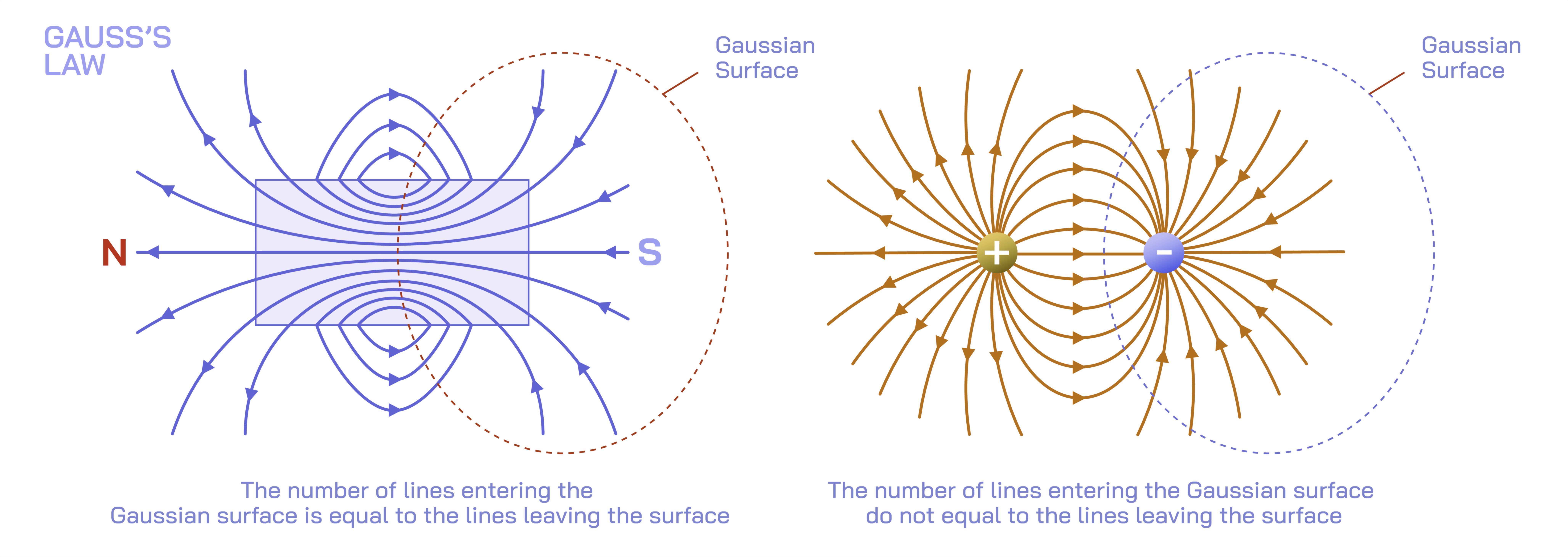
The profound core of Gauss’s Law is that the total electric flux through any closed surface depends only on the net charge inside the surface, not on how the charge is arranged or spread out. If there is no net charge inside the surface, the net flux is zero even if electric field lines from external charges pass through the surface in complicated ways. This means that electric fields caused by charges outside the surface will enter and exit the closed surface in perfectly balanced amounts, leaving no net flux. Only charges located inside the closed surface can cause a net imbalance in how field lines pass through it. This insight allows physicists to ignore enormous geometric complexity and focus attention only on what exists inside the imagined boundary. A small charged particle enclosed by a huge closed surface produces the same total flux as it does when enclosed by a tiny surface wrapped tightly around it. Conversely, a surface placed around multiple charges produces flux that reflects the sum of their net charge, taking cancellations into account. Positive charge contributes outward-pointing field lines and negative charge contributes inward-pointing ones, establishing a direct conceptual relationship between field direction, charge sign, and flux.
One of the most powerful implications of Gauss’s Law concerns the distribution of electric fields around symmetric charge distributions. Symmetry simplifies the situation in such a way that the law becomes an extraordinarily effective tool for deducing the behavior of electric fields. For example, around a point charge or any spherically symmetric charge distribution, the electric field spreads out equally in all directions. By imagining a spherical Gaussian surface around the charge, one sees that flux is uniformly distributed across the surface. Because all points on that surface experience the same field strength and orientation, Gauss’s Law allows us to determine the field by focusing only on the total charge—not on the microscopic details of the distribution. This explains why the field outside a uniformly charged sphere behaves exactly like the field outside a single point charge concentrated at its center. It also explains why the field inside a hollow spherical conductor is zero, because no charge within the metal contributes to a field inside the empty space; the net flux within the interior remains zero due to the absence of enclosed charge.
A similarly profound result emerges for infinitely long charged cylinders and charged planes, where electric fields distribute uniformly in directions dictated by these shapes’ symmetry. Around a long cylindrical charge distribution, field lines radiate outward perpendicular to the cylinder’s surface. Around a uniformly charged infinite plane, the field strength remains constant and does not weaken with increasing distance, because field lines remain parallel and do not diverge. These results, while surprising to intuition, follow naturally from Gauss’s Law once the intimate connection between symmetry, flux, and surface geometry becomes clear. The law shows that symmetry dictates not just elegance in shape but necessity in physical behavior, creating electric fields that obey patterns of space and distribution.
Another deep outcome of Gauss’s Law concerns the behavior of electric fields in and around conductors. In a conductor at electrostatic equilibrium, charges move until they reach positions where no further internal forces act on them. This causes the electric field inside a conductor to vanish completely. Gauss’s Law provides the conceptual logic for this phenomenon: if any net internal electric field existed, charges would keep moving, indicating that equilibrium had not yet been reached. The disappearance of the interior field means that internal flux must be zero, and therefore no net charge can reside within the interior. All excess charge must reside on the outer surface. Furthermore, the field immediately outside the surface of a conductor is perpendicular to the surface, because any sideways component would cause charges to shift until the tangential field component vanished. Through this reasoning, Gauss’s Law explains not only where charge sits on conductors but also why the electric field appears the way it does near their boundaries.
The law has equally remarkable implications for insulators and materials where charge can be distributed throughout the interior. For insulators containing uniformly distributed charge, Gauss’s Law shows how the field inside increases gradually with distance from the center until reaching a maximum at the surface and then decreases outside. In contrast with conductors, insulators can sustain interior electric fields because their charges are fixed and cannot move to cancel the internal field. Across both conductor and insulator cases, Gauss’s Law creates a thread of consistency, linking the presence or absence of mobile charge to the structure of electric fields and the distribution of flux.
Beyond classical physics, Gauss’s Law becomes one of the four Maxwell’s equations that form the foundation of electromagnetic theory. It reveals that electric charge is the fundamental source of electric fields — electric fields do not appear without charge, and charge cannot exist without shaping the surrounding field. The law also explains why electric field lines never form closed loops; they originate from positive charges and terminate on negative charges or extend to infinity if no negative charge is present. This behavior distinguishes electric fields from magnetic fields, which always form loops because magnetic monopoles have never been observed. In this way, Gauss’s Law not only describes electric behavior but also hints at deeper structural truths about the universe.
A conceptual appreciation of Gauss’s Law also shows its role in solving real-world problems. In electrical engineering, it assists in designing capacitors by defining how fields behave between conductive plates. In atmospheric science, it explains how lightning forms when charge separation grows strong enough to produce overwhelming field lines through air. In particle physics, it influences the study of ion traps and the behavior of plasmas. In medical technologies, it contributes to understanding how electromagnetic forces interact with tissues. Across every application, Gauss’s Law serves as a high-level conceptual compass, guiding our interpretation of how charges influence the space around them.
When viewed through this expanded narrative, Gauss’s Law becomes far more than a mathematical statement. It is a window into the nature of electric charge and its influence on space, revealing that electric fields are not random but precise reflections of charge distribution. It shows that flux serves as a natural indicator of charge and that symmetry plays a guiding role in shaping fields. It teaches that conductors hide charge within surfaces and that insulators organize internal charge differently. It connects microscopic physics to large-scale phenomena and anchors the entire structure of electromagnetism. Through its conceptual clarity, Gauss’s Law provides a profound understanding of how the invisible electric fabric of the world unfolds around every charged particle, shaping interactions at every scale—from the smallest atom to the largest storm cloud.