Ampere’s Law Hand Rule — Right-Hand Rule for Magnetic Field Direction
Understanding the Purpose of the Right-Hand Rule in Electromagnetism
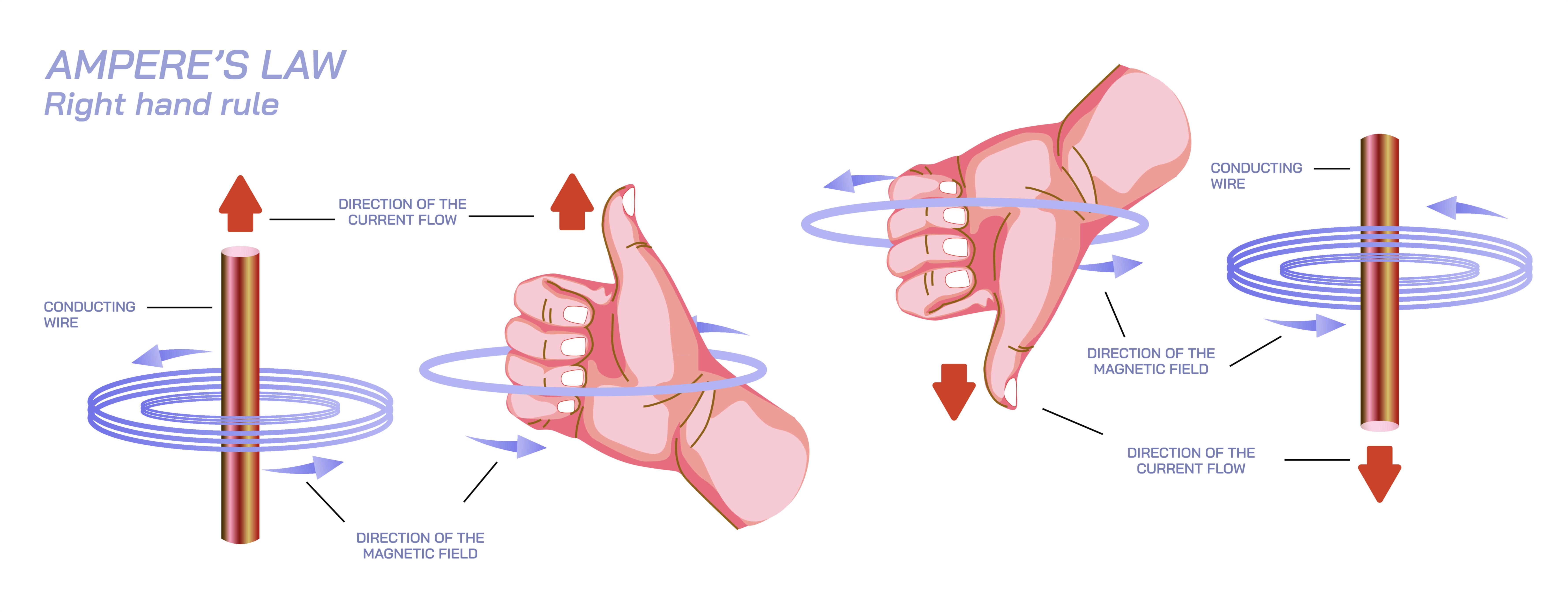
The right-hand rule associated with Ampere’s Law is one of the most intuitive and essential tools in electromagnetism, designed to help visualize the direction of magnetic fields produced by electric currents. While Ampere’s Law explains that electric currents generate magnetic fields that circulate around the conductor, it is the right-hand rule that tells us which way those circular magnetic fields wrap. This simple hand gesture transforms an abstract physical principle into a clear spatial interpretation: your hand becomes a map that aligns current flow with the magnetic field’s rotation. A vector illustration of the Ampere’s Law hand rule typically shows the thumb pointing along the direction of current and the curled fingers representing the circular magnetic field lines encircling the conductor. Understanding this relationship is crucial in fields ranging from electrical engineering to physics and electronics, because the rule predicts how magnetic forces interact with wires, coils, motors, and other current-driven systems.
How the Right-Hand Rule Determines Magnetic Field Circulation
When applying the right-hand rule, you begin by orienting your right hand so that your thumb points in the direction of conventional current flow—that is, from positive to negative in a straight conductor. Once your thumb is aligned with the wire, your curled fingers naturally wrap around the conductor in the direction that the magnetic field lines travel. This visual and physical alignment reflects the circular nature of the magnetic field that Ampere’s Law describes. The magnetic field does not point outward or inward from the wire; instead, it forms concentric loops that expand outward as distance increases. By simply curling your fingers, you trace the very path that magnetic field lines take around the current-carrying wire. This makes the right-hand rule a powerful mental and physical shortcut for determining magnetic direction without needing complex calculations or diagrams. A vector illustration often shows this gesture directly, with arrows circling the wire to mark the direction of the magnetic field.
Magnetic Field Behavior Around Straight Wires and the Role of the Right-Hand Rule
In the case of a straight, vertical wire carrying current upward, the right-hand rule predicts that the magnetic field circles around the wire in a counterclockwise direction when viewed from above. If the current flows downward, the direction reverses, and the magnetic field circulates clockwise. This relationship is essential for interpreting magnetic interactions between parallel wires: currents flowing in the same direction attract each other, while currents flowing in opposite directions repel. These interactions arise from the circular magnetic patterns predicted by the hand rule. In a vector illustration, arrows draw looping circles around the wire, reinforcing how the magnetic field forms a symmetrical, ring-like structure. The right-hand rule thus becomes a guide that aligns physical intuition with the invisible magnetic geometry surrounding the wire.
Applying the Right-Hand Rule to Coils and Solenoids
For coils and solenoids, the right-hand rule helps determine the direction of the magnetic field inside and around the loops. When current flows through a coil, each loop produces its own circular magnetic field. These circular fields reinforce one another inside the coil, creating a strong, uniform magnetic field. To apply the right-hand rule in this context, curl the fingers of your right hand in the direction of the current flowing through the loops. Your thumb will then point in the direction of the magnetic field inside the solenoid. This interpretation aligns with Ampere’s Law, which shows that the magnetic field within a long coil is strong and directed along its axis. In vector graphics, this is often represented with the coil shown as a series of loops and the magnetic field inside the coil depicted as straight, dense lines pointing in the direction indicated by the thumb. This visualization reveals how coils concentrate magnetic fields and why solenoids form the basis of so many electromagnetic devices, including electromagnets, relays, and actuators.
Understanding Right-Hand Rule in Toroids and Circular Magnetic Circulation
In toroids, which are ring-shaped coils, the magnetic field forms a continuous loop around the toroidal core. Using the right-hand rule on any segment of the coil, you would find that the magnetic field flows around the ring in a circular direction that follows the geometry of the toroid. The field remains confined inside the torus, forming a perfect closed loop. This confinement helps minimize magnetic leakage and energy loss, which is why toroids are favored in transformer and inductor designs. In a vector illustration, the toroid is shown as a ring of wound wire with circular arrows inside the core marking the direction of the magnetic field flow, while a right-hand gesture is positioned next to a loop section to indicate how the rule predicts that direction.
Why the Right-Hand Rule Matters in Electrical Engineering and Physics
The right-hand rule is more than a mnemonic—it is a vital conceptual tool that underpins many aspects of modern technology. Understanding the direction of magnetic fields allows engineers to predict how forces act in electric motors, how coils induce current in transformers, how electromagnetic waves propagate, and how inductive sensors detect changes in magnetic environments. Without the ability to determine magnetic field direction intuitively, designing efficient and safe electromagnetic systems would be far more complex. The right-hand rule also underlies fundamental principles in electromagnetic induction, where changing magnetic fields create electric currents, and vice versa. These interactions govern the operation of generators, power grids, and countless electronic components.
Illustrating the Right-Hand Rule for Ampere’s Law Through Vector Graphics
A vector illustration demonstrating Ampere’s Law and the right-hand rule typically includes a straight wire with circular magnetic field lines surrounding it. A right hand is drawn nearby, with the thumb pointing upward or downward to show current direction and the curled fingers tracing the magnetic field’s circular path. In more advanced illustrations, coils and solenoids are shown with the hand rule applied to determine magnetic field direction through the center of the coil. These visuals help solidify the intuitive connection between current flow and magnetic field structure, translating abstract electromagnetic principles into an accessible, easy-to-understand gesture.