Ampere’s Law — Magnetic Field and Current Relationship Explained
Understanding the Foundation of Ampere’s Law in Electromagnetism
Ampere’s Law is one of the most fundamental principles in electromagnetism, describing how electric currents produce magnetic fields in the space surrounding them. Formulated by André-Marie Ampère in the early nineteenth century, this law forms a cornerstone of Maxwell’s equations—the unified framework that governs electric and magnetic interactions. Ampere’s Law reveals a direct relationship between the magnetic field circulating around a conductor and the electric current passing through it. This relationship is not only a theoretical insight but a practical tool that explains how electromagnets work, why magnetic fields wrap around wires in circular loops, and how large-scale electrical systems like motors, transformers, and inductors generate and control magnetic effects. A vector illustration of Ampere’s Law typically shows concentric magnetic field lines encircling a straight current-carrying wire or forming loops around coils. These diagrams help visualize how electric currents shape magnetic fields and how those fields influence physical systems.
Magnetic Field Behavior Around a Straight Current-Carrying Conductor
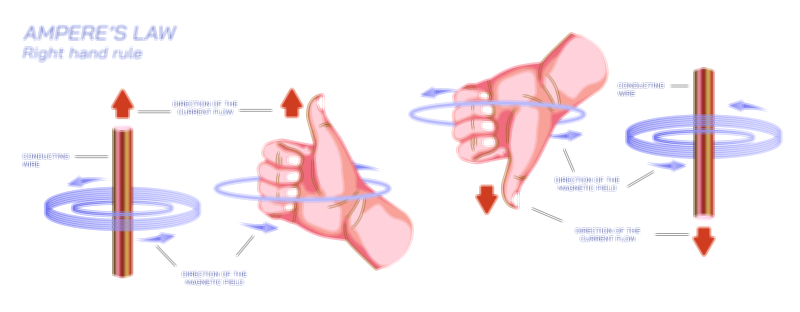
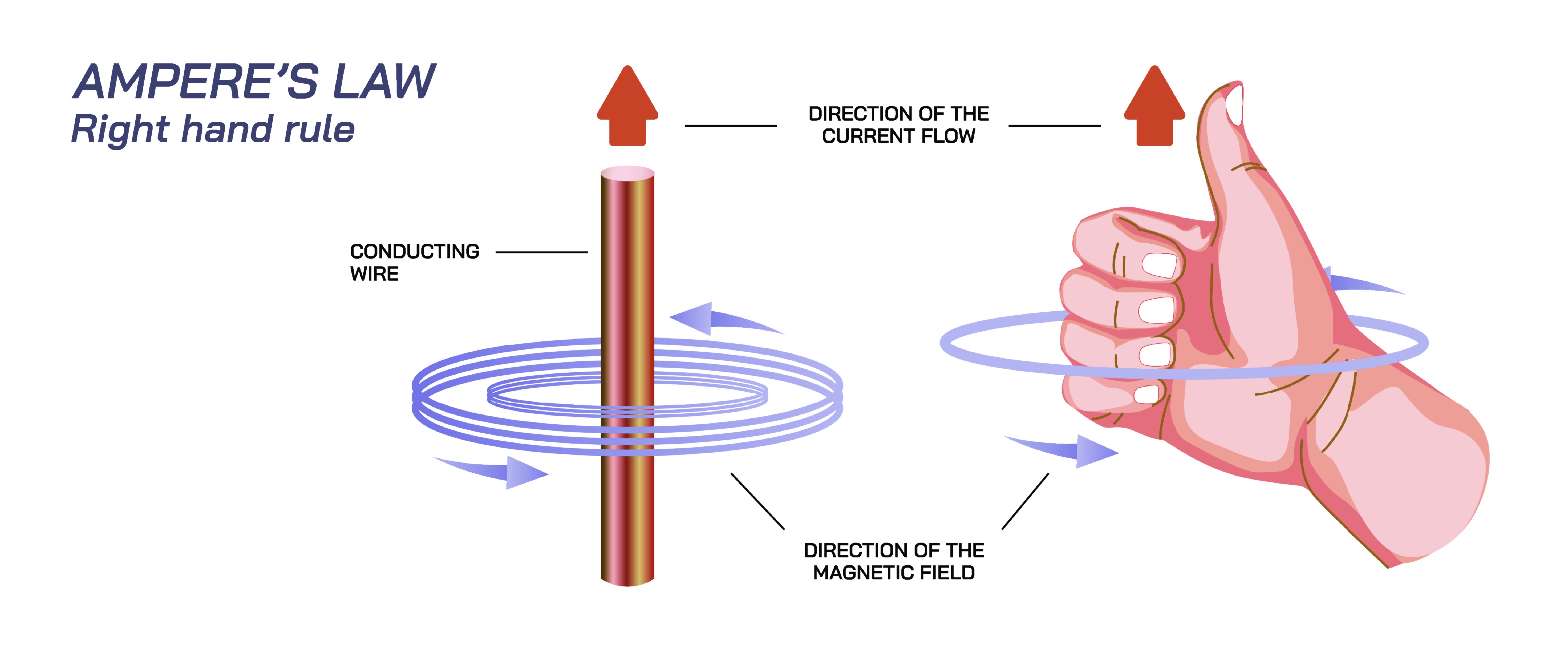
When a steady current flows through a long, straight conductor, the magnetic field that forms around it organizes itself into circular loops. These loops are centered on the wire, lying in planes perpendicular to the conductor. The direction of the magnetic field around the wire is determined by the right-hand rule: if you wrap the fingers of your right hand around the wire in the direction of the magnetic field, your thumb points in the direction of the electric current. This intuitive relationship between current flow and magnetic field circulation is one of the most accessible demonstrations of Ampere’s Law in real-world physics. A vector illustration often presents these field lines as evenly spaced circles around the wire, with arrows showing the direction of rotation. This graphical depiction highlights the elegance of electromagnetic symmetry, where electric movement naturally produces organized, circular magnetic patterns—patterns that form the basis of countless electrical technologies.
Ampere’s Law Applied to Loop Integrals and Circulation of Magnetic Fields
Ampere’s Law expresses that the circulation of magnetic field strength around a closed loop is directly proportional to the electric current enclosed by that loop. Conceptually, this means that if you imagine drawing a closed path around a current-carrying wire—whether a circle, square, or any shape—the total magnetic effect measured along that loop depends only on how much current lies inside it. This idea allows the magnetic field to be calculated for simple, symmetrical configurations such as straight wires, solenoids, and toroids. Even though the exact mathematics is not shown in paragraph-only form, the conceptual meaning remains clear: the magnetic field strength increases with current and decreases with distance from the wire. A vector illustration depicting a closed Amperian loop—often shown as a circular or rectangular path drawn around the conductor—helps viewers understand this idea visually. The magnetic field lines follow the loop’s path, reinforcing the connection between circulation and current.
Magnetic Fields in Solenoids and Coils — Amplifying Ampere’s Law
One of the most important and practical applications of Ampere’s Law is in solenoids: long, tightly wound coils of wire carrying electric current. Inside a solenoid, the magnetic field becomes strong, uniform, and aligned along the central axis of the coil. This occurs because the circular magnetic fields generated by each loop of wire combine and reinforce one another, creating a powerful cumulative effect. Outside the solenoid, the magnetic field is much weaker because the field lines tend to cancel out or disperse. This behavior explains why solenoids form the basis of electromagnets, electric relays, valves, and countless types of sensors and actuators. A vector illustration of a solenoid often shows magnetic field lines packed densely inside the coil and spreading out more loosely outside it. Such visualizations highlight how Ampere’s Law scales from single wires to complex coil structures, providing a consistent explanation for magnetic behavior in practical devices.
Magnetic Fields in Toroids — Perfect Closed-Loop Geometry
Toroids—ring-shaped coils—represent another powerful demonstration of Ampere’s Law. In a toroid, the magnetic field is completely confined within the circular core, forming a closed loop around the inner circumference. Because the coil wraps around in a continuous ring, the magnetic field does not escape outward into space the way it does in straight wires or open coils. This makes toroids extremely efficient at controlling magnetic fields, making them ideal for transformers, inductors, and power electronics where energy loss must be minimized. Ampere’s Law explains this confinement by noting that the magnetic field circulates in response to the enclosed current, and in a toroid, that current is distributed perfectly around the ring. Vector illustrations typically show smooth, circular magnetic field lines flowing inside the toroidal core, with no lines leaking outward. This captures the precision and control made possible by Ampere’s Law in engineered electromagnetic systems.
Understanding Magnetic Field Strength, Distance, and Symmetry
A key insight from Ampere’s Law is how magnetic field strength depends on distance and symmetry. For a long straight wire, the field weakens as you move farther away because the circular loops spread outward, reducing density. In symmetrical arrangements—straight wires, solenoids, toroids—the law simplifies beautifully because the magnetic field maintains predictable shapes. But in asymmetric or irregular systems, the distribution becomes complex. Ampere’s Law still applies, yet visualizing the field requires deeper analysis or computational tools. A video or vector illustration often simplifies these ideas through clean shapes and evenly spaced field lines, helping learners appreciate how magnetic field strength depends on geometry and distance, and why symmetrical configurations are essential for practical devices.
Illustrating Ampere’s Law Through Vector Graphics
A vector illustration of Ampere’s Law typically includes a straight wire surrounded by circular magnetic field lines, a solenoid with dense inward-pointing field lines, or a toroid with completely enclosed magnetic loops. Additional arrows indicate current direction, magnetic field orientation, and the circulation path along an imagined Amperian loop. These visual tools clarify how current generates magnetic fields and how those fields organize themselves in space. Through simplified, stylized diagrams, viewers can intuitively grasp the core concepts of Ampere’s Law—magnetic fields encircle current, their strength depends on proximity and enclosed current, and their geometry reflects the symmetry of the conductor.