Faraday’s Law of Electromagnetic Induction — Change of Magnetic Flux Explained
Faraday’s Law of Electromagnetic Induction stands as one of the most transformative principles in all of physics, shaping the foundations of modern electrical technology, guiding the behavior of electromagnetic systems, and revealing the profound way in which electricity and magnetism intertwine as inseparable aspects of a single physical reality. Although many diagrams and vector illustrations simplify it into loops of wire, magnetic field lines, and moving magnets, the true significance of Faraday’s Law emerges only through a richly detailed conceptual explanation that connects changing magnetic environments with induced electric responses. This law describes not just a physical effect but a deep symmetry in nature: whenever magnetic flux through a circuit changes, an electric influence appears, compelling charges to move and creating currents capable of powering devices, transmitting energy, and enabling technologies that define modern civilization. The phenomenon of electromagnetic induction is far more than a classroom demonstration; it is a universal mechanism that underlies generators, transformers, motors, sensors, and even many natural processes occurring throughout the universe.
At the heart of Faraday’s Law lies the concept of magnetic flux, a measure of how many magnetic field lines intersect a given area. Although magnetic field lines are visual constructs rather than physical threads in space, they offer a valuable intuitive way to picture how a magnetic field interacts with a material region. When the density, direction, or coverage of these field lines changes relative to a conducting loop—even if the loop itself moves—the magnetic flux through that loop changes. Faraday discovered that such a change, regardless of how it is produced, creates an electrical effect: an induced electromotive force, which manifests as an electric pressure that pushes charges along a path. This induced effect arises from change alone, not from the magnitude of the magnetic field, not from the presence of the loop, but from the fact that the magnetic situation is not static. The universe responds to changing magnetic environments by generating electrical influences, connecting the two realms with elegant reciprocity.
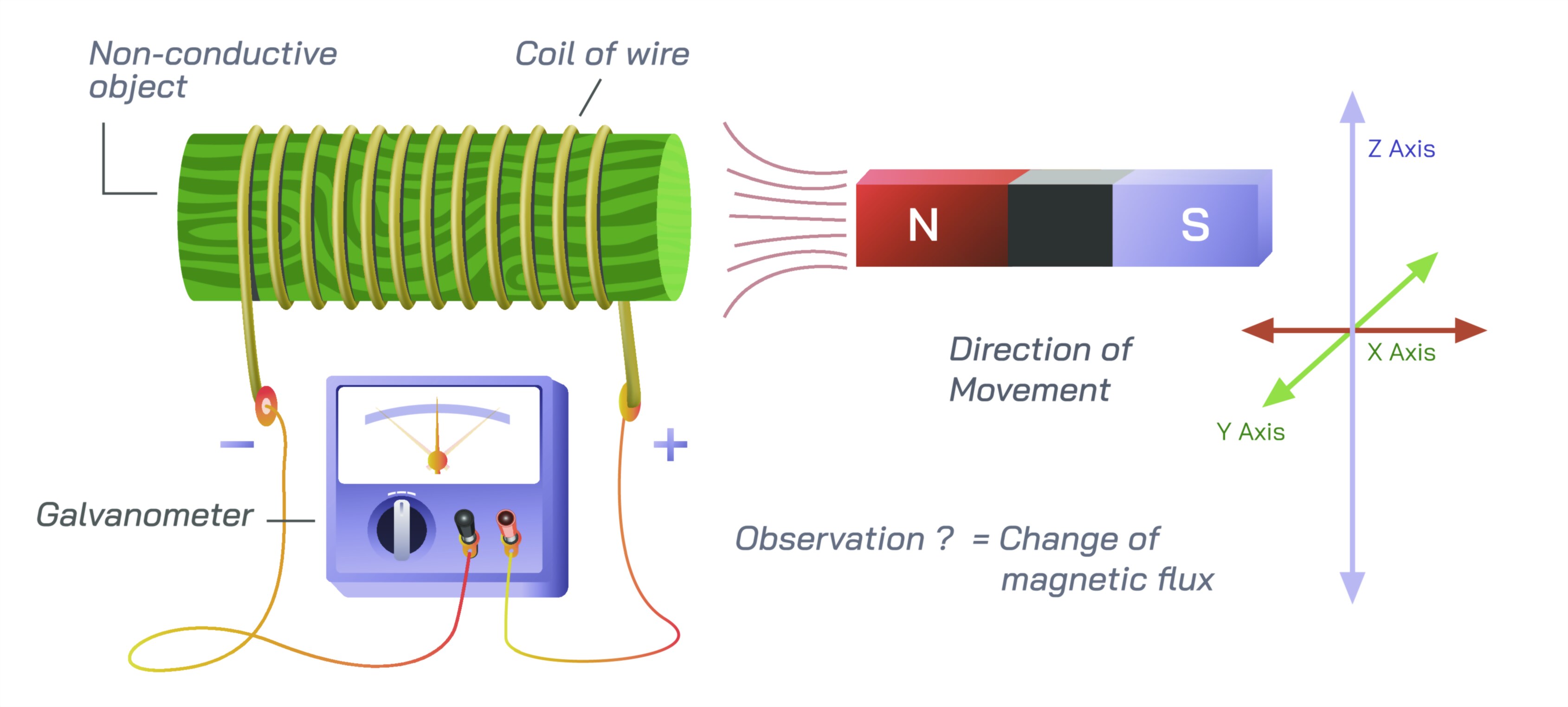
Faraday’s insight emerged through a series of meticulous experiments involving coils, magnets, wires, and galvanometers. He found that simply bringing a magnet toward a coil could produce a momentary deflection on a sensitive current meter, indicating that charges in the coil had been forced to move. Pulling the same magnet away produced a deflection in the opposite direction. Leaving the magnet motionless, however, created no current at all. This behavior puzzled early scientists because it seemed counterintuitive that a stationary magnet near a coil had no effect, yet a moving magnet produced measurable electrical consequences. The key was not the magnet’s presence but the change in magnetic flux. Whether the magnet moved, the coil moved, the magnetic field varied in strength, or the size or orientation of the loop changed, the essential requirement remained the same: magnetic flux through the loop must change over time to induce current.
This discovery revealed a profound principle: electromagnetic induction depends purely on dynamic relationships. Nature fundamentally links electric and magnetic fields, and this connection is activated by change. A loop of wire sitting in a steady magnetic field experiences no electrical pressure because nothing in the magnetic environment shifts. But tilt the loop, stretch it, shrink it, increase the field, decrease the field, or move the loop through the field, and the magnetic flux through the loop changes. This change immediately generates an electric response within the conductor, which may appear as a spark, a circulating current, or simply a measurable voltage difference along the wire. Faraday’s Law thus articulates a dynamic relationship between magnetism and electricity: the evolution of one produces the emergence of the other.
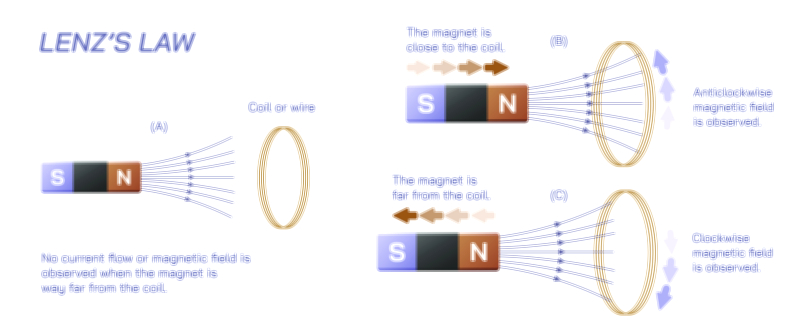
The direction of the induced current is not arbitrary. Nature implements a built-in rule known as Lenz’s insight: the induced current always flows in a direction that opposes the change that created it. This principle reflects the deeper conservation laws governing physical systems. If magnetic flux through a loop increases, the induced current produces its own magnetic effect that tries to counter the increase. If flux decreases, the induced current produces magnetic influence that tries to rebuild it. In this way, the universe responds to change by resisting abrupt or unbalanced shifts, preserving stability through induced electrical motion. Although this is often drawn as arrows and loops in illustrations, the underlying meaning expresses the harmonious balance in electromagnetic systems, where induced currents act as natural regulators against sudden transformations of magnetic environments.
Understanding Faraday’s Law also requires appreciating that magnetic flux can change in multiple ways. One of the most straightforward involves physical motion. When a conductor moves through a magnetic field, the charges within it experience a force that drives them along the wire. This effect can be observed in the simple case of sliding a loop across a region where magnetic field lines are present. As the loop enters or exits this region, the number of lines threading the loop changes, and the induced current can be seen. Variations in the magnetic field itself produce the same outcome. Increasing the strength of the magnetic field in the region of the loop, even without any motion, forces flux to rise, triggering induction. Conversely, decreasing the field triggers induction in the opposite sense. Changing the orientation of the loop also alters how many field lines intersect it, producing induction without moving the field source. These different mechanisms reveal that electromagnetic induction is not dependent on mechanical movement alone but on any shift in the relationship between field and conductor.
This principle becomes particularly powerful when applied to more complex systems like coils. When one coil carries a varying current, its magnetic field changes accordingly. This changing magnetic field extends outward and can pass through a second coil placed nearby. As the flux through the second coil changes, an induced voltage arises in that coil even though it is not connected directly to the first. This process forms the basis of mutual induction, a core mechanism behind transformers. In a transformer, alternating current flows through a primary coil, creating a continually changing magnetic field. This changing field induces a voltage in the secondary coil proportional to the number of turns and the rate of change. Transformers can therefore step voltages up or down, enabling long-distance power transmission, voltage regulation, and safe distribution of electricity throughout homes, industries, and infrastructure. Faraday’s Law, therefore, is not only a conceptual statement but the operational principle behind the global electrical grid.
In electric generators, Faraday’s Law manifests even more directly. A generator rotates coils within magnetic fields or rotates magnets around coils, continually changing the magnetic flux and thereby producing electrical energy. The fundamental operation of any generator—whether a small hand-crank model, a large hydroelectric turbine, a wind turbine, or a complex industrial alternator—depends on converting mechanical motion into electrical energy by exploiting electromagnetic induction. As the mechanical components turn, the magnetic flux through the coils varies, and this variation drives currents through external circuits. This elegantly demonstrates one of the most important energy transformations in human technology: mechanical energy becomes electrical energy because magnetic flux does not remain constant.
Electric motors operate on the same principles but in reverse. Instead of mechanical motion producing electrical energy, electrical energy flowing through coils produces magnetic forces capable of generating rotation. While motor operation depends primarily on the interaction of magnetic fields created by currents, Faraday’s Law plays a significant role. Whenever the magnetic configuration in the motor changes—because of rotating parts, varying currents, or changing magnetic fields—induced voltages appear that influence how the motor responds. These induced effects regulate speed, stabilize performance, and contribute to efficient operation. Thus, Faraday’s Law underlies both the generation and utilization of electrical power, forming a complete technological cycle that powers industries, homes, transportation, and communication.
Faraday’s Law also plays a central role in the operation of inductors, one of the fundamental components in electrical circuits. An inductor consists of a coil of wire through which current flows. When the current changes, the magnetic field around the coil changes, and this change induces a voltage within the coil that opposes the change in current. This self-induction effect allows inductors to resist sudden current changes, smoothing out fluctuations, filtering electrical signals, storing energy, and shaping voltage behavior in countless electronic systems. Whether in radios, computers, power supplies, or communication circuits, inductors embody Faraday’s insight that changing magnetic flux creates induced electromotive forces.
Beyond technology, Faraday’s Law reveals how nature organizes itself. Lightning, for example, induces massive electromagnetic changes in the surrounding air and ground, creating currents that can travel long distances. The Earth’s magnetic field, constantly shifting due to movements in the planet's molten core, induces slow electrical currents in rock layers and oceans. Solar storms interacting with Earth’s magnetosphere induce currents in satellites, power lines, and even the ionosphere, illustrating how cosmic-scale magnetic changes influence our technological world. Biological systems exhibit subtle electromagnetic induction as well: the movement of charged ions in neurons creates minute magnetic fields that influence nearby cells and can be detected through sensitive instruments such as magnetoencephalography devices.
Faraday’s Law also reveals a deeper unity in physics by connecting electricity, magnetism, and motion. It paved the way for Maxwell’s equations, which brought together all known electromagnetic phenomena into a complete theoretical framework. The law demonstrates that electric fields can be created not only by charges but by changing magnetic fields, establishing a symmetry that helped scientists understand waves of combined electric and magnetic fields—electromagnetic waves. These waves include visible light, radio waves, X-rays, and microwaves, showing that Faraday’s experiments on coils and magnets uncovered processes that later explained the nature of light itself.
In more abstract terms, Faraday’s Law shows that electromagnetic systems resist sudden disruption. Any change in magnetic flux produces induced electric fields arranged in loops. These induced fields exist even in empty space, requiring no physical conductor. This means that electromagnetic induction is a property of the fabric of space itself. Whenever magnetic conditions shift, space responds by generating electric fields that loop, circulate, and propagate. This behavior is central to the existence of electromagnetic radiation, in which changing electric and magnetic fields continually create one another and move outward through space as waves.
In everyday experiences, Faraday’s Law appears more often than people realize. Moving a magnetic card near a reader, charging a device wirelessly, using an induction stove, or listening to audio through electromagnetic pickups all depend on induced electric effects. Even the simple act of moving a magnet near a metal object can subtly induce circulating currents, known as eddy currents, which create magnetic resistance. These eddy currents are exploited in braking systems, metal detectors, and magnetic damping devices to control motion and energy.
Ultimately, Faraday’s Law of Electromagnetic Induction articulates a deep and beautiful truth: changing magnetic environments generate electric influences, binding electricity and magnetism into a single, unified phenomenon. Through this law, one finds the conceptual foundation of modern electromagnetism. It explains why generators create current, why transformers operate with efficiency, why inductors resist change, why electromagnetic waves propagate, and why the universe is filled with dynamic interactions between magnetic and electric fields. In this sense, Faraday’s Law is not merely a scientific rule but a window into the fundamental structure of physical reality, revealing how the dance of magnetic flux gives rise to the electrical forces that power worlds both natural and technological.