Joule’s First Law of Heating — Relationship Between Electric Current and Heat Energy in Conductors
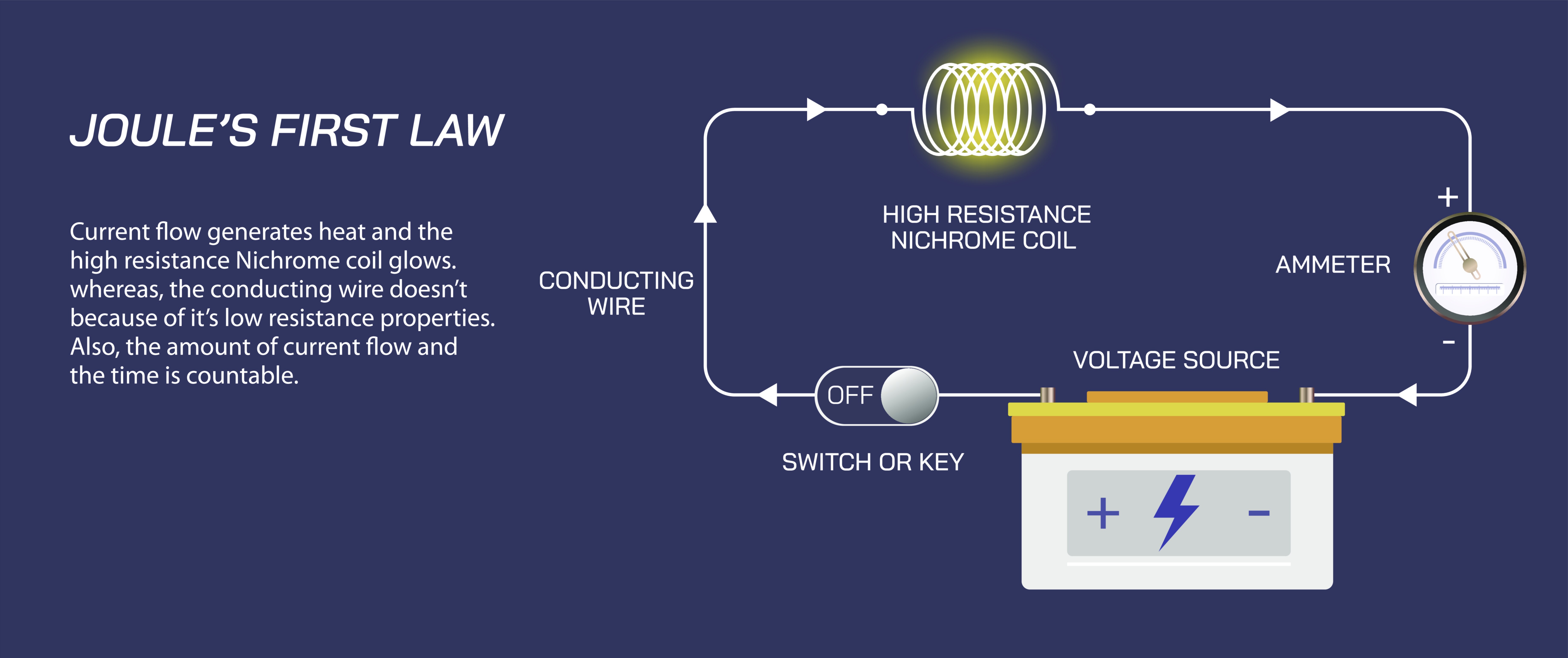
Joule’s first law of heating explains one of the most fundamental principles in electricity: when an electric current flows through a conductor, heat is produced, and the amount of heat generated depends on how much current flows, how strong the electrical resistance of the conductor is, and how long the current continues to pass. Although electricity is commonly associated with motion, light, sound, or magnetism, Joule demonstrated that electrical energy can also transform directly into thermal energy. This discovery not only deepened the scientific understanding of energy conversion but also laid the foundation for modern electrical heating systems that power household appliances, industrial machinery, transportation components, and temperature-control technologies. When a vector illustration of Joule’s first law of heating is used for education, it helps learners visualize the invisible transformation taking place inside a conductor when electrons move and collide, producing heat.
The law emerged from the experiments of James Prescott Joule in the mid-19th century, during a time when the nature of energy was not fully understood. Joule was determined to prove that heat was not a distinct separate substance, as many scientists believed, but a form of energy capable of being produced from other types of energy. He set up experiments in which electric currents were passed through wire coils submerged in water, carefully measuring temperature changes. Through meticulous research, he established that the heat generated inside a conductor increases when more current flows through it, when the resistance of the conductor is higher, and when the duration of current flow is longer. His work helped unify the concept of energy and laid the foundations for thermodynamics and electrical engineering.
In everyday life, Joule’s first law becomes visible wherever electricity creates heat. A glowing heater coil, an iron’s hot plate, an electric kettle warming water, the filament in an incandescent bulb, the warmth of a mobile charger, and even the heat generated by wires in an overloaded circuit are all real-world manifestations of Joule heating. The conductor, which seems solid and silent, is in fact filled with moving electrons. As these electrons travel through the lattice of atoms in the conductor, they collide repeatedly, losing energy in microscopic interactions. That lost energy becomes heat. A vector illustration showing electrons moving through a wire and striking atomic lattices can help students visualize why temperature rises even though nothing appears to move externally.
The importance of heat production through electrical current extends far beyond household appliances. In industry, Joule heating is a critical mechanism for processes such as metal melting, plastic extrusion, welding, furnace operation, and thermal treatment of materials. In medical applications, electric heating elements are used in sterilization equipment, therapeutic warming devices, and surgical tools. In transportation, train braking systems and electric vehicle battery management rely on understanding heat produced by current flow. Even in microelectronics, Joule heating plays a major role: as circuits get smaller and currents remain significant, excess heat must be controlled to prevent chip failure or reduced efficiency. Thus, while Joule’s first law appears simple, its consequences have shaped the development of nearly every electrically powered technology.
The practical benefits of Joule heating allow engineers to harness it where heat is desired and mitigate it where heat is dangerous. When controlled deliberately, the effect powers heaters, stoves, ovens, water-boilers, soldering equipment, and industrial furnaces. In these cases, designers select materials with high resistance so that electricity flowing through them generates heat efficiently. Nichrome wire, for example, is used in heating coils precisely because it resists current strongly and does not melt easily. On the other hand, when heat is undesirable — such as in household wiring, transformer systems, battery packs, and computer processors — engineers choose conductors with low resistance and implement cooling techniques to prevent overheating. Joule’s law therefore acts both as a tool and a warning: the same principle that makes an electric heater powerful can melt a wire or cause an electrical fire if energy is not managed safely.
Joule’s first law also illustrates the profound link between time and energy. Heating increases not only because more current flows or because the material resists that current but also because the passage of time accumulates heat. A plug that feels cool when briefly used becomes warm after prolonged operation. A laptop that remains cool for a few minutes gradually heats during extended work. A car’s electric components warm up during continuous driving. Time highlights the compounding nature of heat buildup. Educational graphics often emphasize this through time-based diagrams showing temperature rising steadily as current continues to flow, reminding students that electrical safety depends on both instant conditions and long-term usage.
The law also teaches one of the essential lessons of energy conservation: energy cannot be destroyed, only transformed. In this context, electrical energy traveling through a conductor does not disappear; part of it becomes thermal energy whether intended or not. When technology designers consider energy efficiency, they evaluate how much electrical energy is converted into useful work versus unwanted heat. In lighting, LED bulbs outperform incandescent bulbs because they minimize energy lost as heat. In power grids, large transmission cables reduce resistance to limit waste heat. In electric motors and transformers, cooling systems and advanced materials ensure that heat does not reduce performance. Joule’s first law, which at first seems like a simple classroom formula, becomes a guiding factor in sustainability and technological progress.
What makes visual representation so valuable in teaching this law is that the actual heat-producing process cannot be seen directly. A wire does not visibly deform when electrons collide inside it, nor do the atoms glow red unless temperatures become extremely high. A well-designed vector illustration representing electrons flowing, atomic lattices vibrating, and heat radiating outward helps learners connect abstract electric theory with physical experience. By making the invisible visible, the illustration reinforces that heat does not appear “mysteriously” — it is generated by quantifiable interactions between moving charges and the material through which they pass.
Joule’s first law of heating ultimately bridges theoretical physics with real-world intuition. Anyone who has touched a phone charging brick, a moving electric motor, or a working power adapter already has sensory knowledge of the law. Science gives language and structure to that experience, transforming curiosity into understanding. It teaches that electricity is not only a transport medium for power but also a source of thermal energy shaped by material properties and time. Whether students encounter it in basic school science, vocational training, electrical engineering courses, or industrial practice, Joule’s first law stands as an essential concept that supports both everyday convenience and global technological infrastructure, reminding us that energy constantly shifts and transforms — and that mastery of those transformations makes modern life possible.