Ferromagnetism Vector Illustration — Magnetic Domains and Atomic Alignment Explained for Physics and Material Science
Ferromagnetism represents one of the most remarkable and visually engaging phenomena in physics and material science because it explains how certain materials become strongly magnetic through the collective alignment of atoms. Unlike ordinary substances that show only weak magnetic responses, ferromagnetic materials display a powerful attraction to magnetic fields because their internal structure promotes uniform organization of countless microscopic magnetic moments. Each atom within a ferromagnetic material behaves like a tiny magnet due to the spin and orbital motion of electrons, and when millions of these atoms align in the same direction, they form a large-scale cooperative magnetic effect that becomes easy to detect even without measurement instruments. Although magnets often appear to behave as solid, indivisible objects, the truth is that their strong field results from the coordinated behavior of an enormous number of tiny contributors working together inside the material. Understanding ferromagnetism begins by appreciating that magnetism is not created by external forces acting on matter, but rather by the internal arrangement of atomic magnetic moments that can either amplify one another or cancel each other out depending on whether they are ordered or disordered.
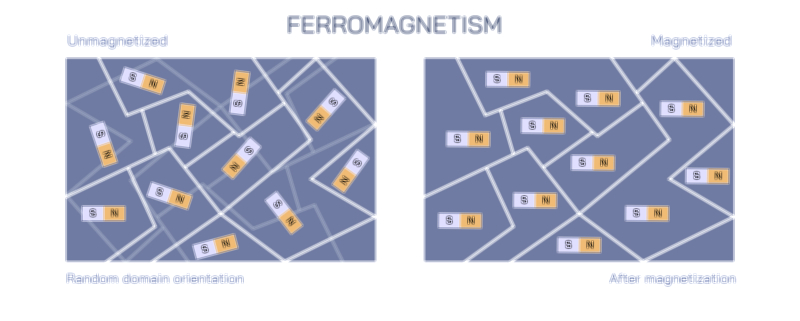
At the microscopic level inside a ferromagnetic substance such as iron, cobalt, nickel, or certain rare earth alloys, atoms group together into structured regions called magnetic domains. Within each of these domains, the spins of electrons belonging to adjacent atoms align in the same direction, generating a significant localized magnetic field. However, in an unmagnetized piece of ferromagnetic material, although each domain is strongly magnetic internally, the domains are oriented randomly relative to one another, which leads to cancellation when observed as a whole. The object therefore does not behave as a magnet even though every part of it contains tiny magnets within. When an external magnetic field is applied, something dramatic happens: the domains gradually rotate and expand to align along the direction of that field. Domains pointing in the same direction as the field widen and grow stronger, while domains oriented in competing directions shrink or disappear. This reorganizing process produces a cumulative effect that eventually transforms the entire substance into a magnet. A vector illustration of ferromagnetism visually captures this transformation by showing how disordered magnetic domains get rearranged into a unified orientation under the influence of an external field, revealing the powerful structural choreography hidden inside an ordinary-looking metal.
The permanence of magnetization in ferromagnetic materials is also closely tied to domain behavior. After the external magnetizing force is removed, many domains remain in the aligned configuration because the atomic structure stabilizes the newly oriented spins. This tendency to retain magnetic order is what creates permanent magnets, which continue producing strong magnetic fields without any external input. Only certain materials with specific crystal structures and electron arrangements can sustain such long-term alignment, which is why permanent magnet production is limited to a narrower group of substances compared to the broad range of metals available in nature. When a magnet loses strength due to heat, shock, or time, the process involves the gradual breakup and randomization of aligned domains. Reheating the magnet to high temperatures provides the thermal energy necessary to overcome the stabilizing forces within the material, causing domains to spread chaotically again and eliminating large-scale magnetic behavior. This phase is known as the Curie temperature, a critical point at which ferromagnetic materials transition into a different state known as paramagnetism where alignment becomes weak and temporary.
Ferromagnetism plays a crucial role in how technology around us functions. Many devices rely on the predictable ability of ferromagnetic materials to align, retain, and manipulate magnetic fields. Transformers, electric motors, generators, microphones, loudspeakers, and hard disk drives all operate using domain-driven magnetic behavior. In electric power systems, coils of wire wrapped around ferromagnetic cores amplify magnetic flux, allowing inductive energy transfer to occur efficiently. In data storage technology, bits of information correspond to tiny magnetic domains oriented in different directions on a recording medium, demonstrating how domain alignment becomes a method of encoding memory. Even advanced maglev transportation uses ferromagnets in conjunction with other magnetic systems to reduce friction and allow smooth, high-speed motion. Modern medical equipment such as MRI machines relies on predictable magnetic field patterns supported by ferromagnetic materials that help shape and stabilize strong fields safely.
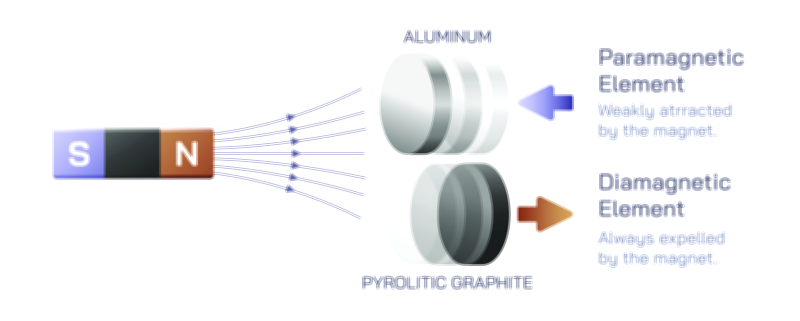
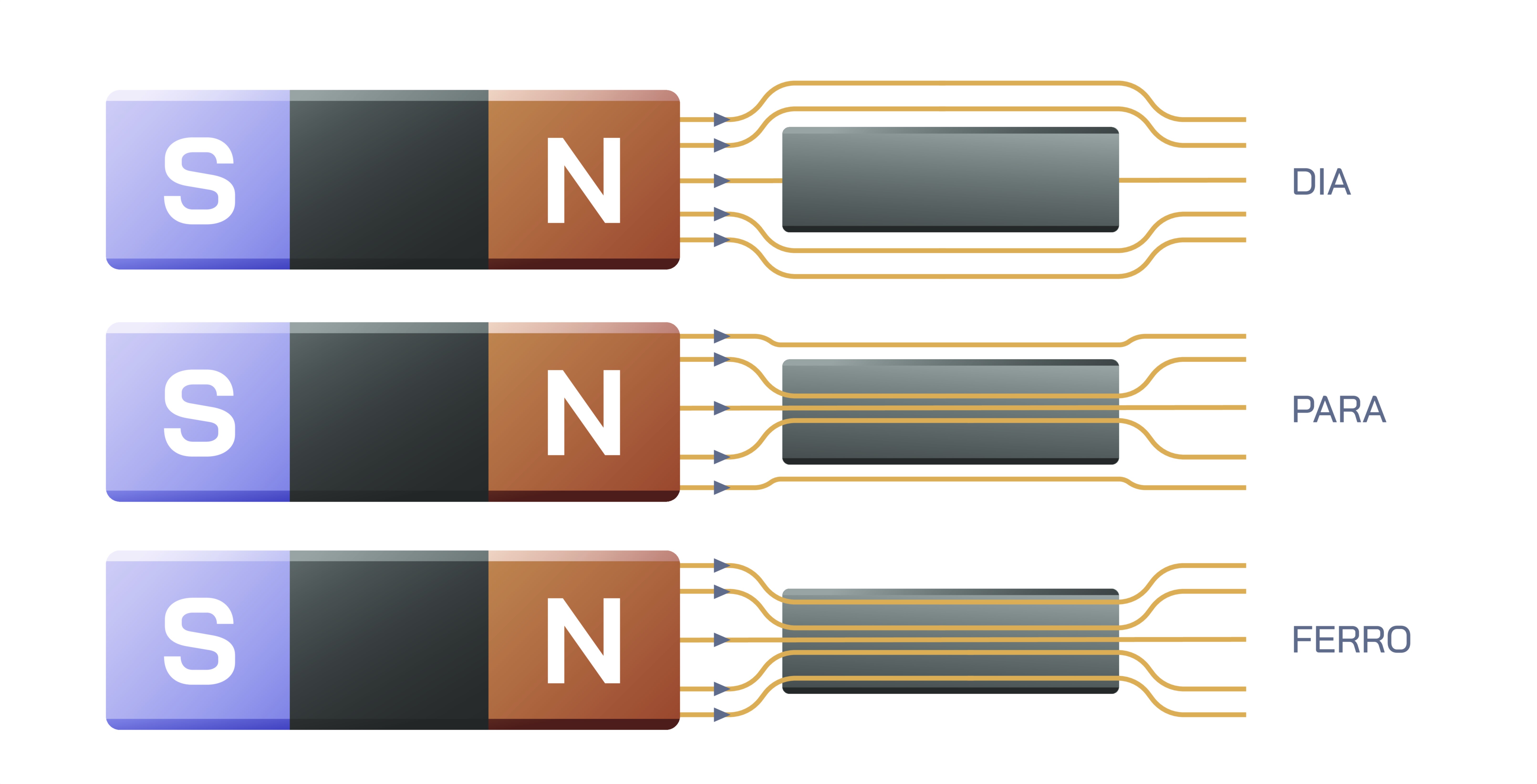
The study of ferromagnetism also encourages comparisons with other forms of magnetism, illustrating why this phenomenon is so special. Paramagnetism involves weak and temporary magnetic alignment that occurs only when an external field is present. Diamagnetism involves extremely weak repulsion from magnetic fields that occurs in all materials at the atomic level. Ferrimagnetism occurs in materials where unequal but opposing magnetic substructures create a net magnetic effect. Antiferromagnetism involves perfect cancellation due to equal but oppositely aligned atomic spins. Ferromagnetism stands apart because it produces a strong and lasting magnetic field generated through large-scale cooperative alignment of spins in the same direction across domains. These distinctions help scientists and engineers choose the correct material for applications where magnetic control is needed, such as sensors, shielding equipment, inductors, energy machinery, storage media, and medical systems.
Temperature, pressure, and atomic structure are critical in determining whether a material exhibits ferromagnetism. Materials that behave ferromagnetically at low temperatures can lose their magnetism at higher temperatures as thermal agitation disrupts domain alignment. Alloys can be engineered to enhance or suppress ferromagnetic properties by changing electron exchange interactions inside the crystal lattice. Rare earth magnets, including neodymium–iron–boron and samarium–cobalt, are manufactured to exhibit exceptional ferromagnetic strength due to extremely strong exchange coupling between magnetic atoms. These materials dramatically outperform traditional iron magnets in both field strength and energy retention, allowing compact high-performance products such as miniature motors, wireless earphones, magnetic clamps, drone propulsion systems, and precision sensors to thrive in modern industries.
Ferromagnetism is also vital in understanding geophysical behavior. Earth itself acts like a giant magnet because the movement of molten iron alloys in the outer core helps maintain the planet’s magnetic field. Rocks containing ferromagnetic minerals become magnetized as they cool, preserving information about the direction of Earth’s magnetic field throughout geological history. These natural magnetic records reveal that Earth’s magnetic poles have reversed many times, opening important insights into planetary evolution. Even wildlife interacts with ferromagnetism: many animals possess biological sensors that respond to Earth’s magnetic field, helping them navigate vast distances with remarkable accuracy during migrations.
A vector illustration showing ferromagnetism becomes particularly useful in education and research because it helps convert complex atomic interactions into easy-to-visualize patterns. Representing tiny atomic magnetic moments as arrows, showing the structure of well-defined domains, and demonstrating how those arrows gradually align under an external magnetic field gives students a tangible conceptual bridge between microscopic physics and macroscopic observation. The shift from random to ordered domain structures vividly explains why a block of iron that once behaved like an ordinary object suddenly becomes a magnetic tool after exposure to another magnet. It also helps clarify why magnetizing and demagnetizing processes are reversible, why magnetic saturation occurs when all domains are fully aligned, and why coercivity determines how difficult it is to reverse alignment in different materials.
The importance of ferromagnetism stretches far beyond the basic idea of attraction between a magnet and a piece of metal. It underpins countless technologies, supports industrial development, contributes to global infrastructure, and deepens understanding of natural forces and microscopic matter. From the atomic spin of electrons to the formation of magnetic domains, from educational diagrams to high-performance electric machinery, ferromagnetism showcases the power of organization within matter — a striking demonstration of how collective alignment, amplified over billions of atoms, produces the invisible yet immensely influential forces that shape both physical systems and everyday technology.