Hydrochloric Acid — Chemical Structure, Strong Acid Behavior, Uses, and Safety Guide
Hydrochloric acid is one of the most widely recognized and extensively used acids in science, industry, medicine, and everyday applications. Known for its powerful corrosive nature and highly reactive behavior in aqueous solutions, it stands as a defining example of a strong acid. Hydrochloric acid is essentially a solution of hydrogen chloride gas dissolved in water, forming a mixture where the molecules dissociate almost completely into hydrogen ions and chloride ions. This characteristic of near-total ionization gives hydrochloric acid its exceptional ability to protonate, dissolve, and react with many types of materials. Even though it is feared for its corrosiveness, this same strength is what makes it enormously valuable in laboratories and industries where controlled chemical reactions provide solutions to practical and scientific problems. To understand the full importance of hydrochloric acid, one must analyze its chemical structure, its role as a prototypical strong acid, its applications across fields ranging from metal treatment to food regulation, and the critical safety practices required when handling it.
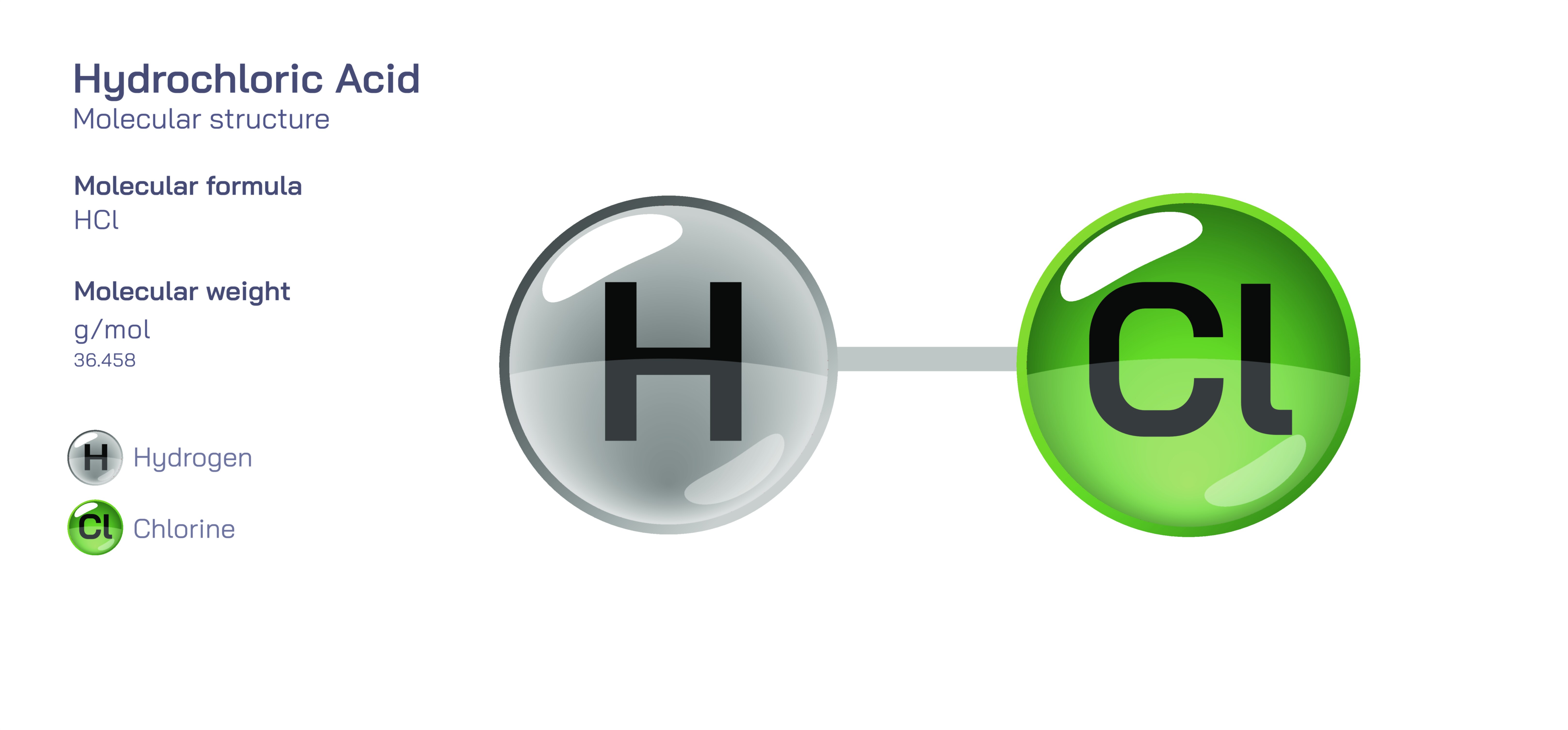
At the molecular level, hydrochloric acid originates from hydrogen chloride, a simple diatomic compound composed of one hydrogen atom bonded to one chlorine atom. In gaseous form, hydrogen chloride exists as a covalently bonded molecule, but when it dissolves in water, the polar nature of water pulls the molecule apart. The hydrogen ion separates from the chloride ion, effectively creating a solution rich in free hydrogen ions. Because these ions do not recombine readily, hydrochloric acid is classified as a strong acid, meaning it dissociates almost completely in water. This complete ionization is what makes the solution highly conductive and highly reactive with bases and many metals. In contrast to weaker acids that exist partly in molecular form with limited availability of free hydrogen ions, hydrochloric acid offers a full supply of reactive protons, which explains why its pH values can be extremely low even at relatively modest concentrations. The simplicity of its structure also contributes to its efficiency; containing only hydrogen and chloride ions, the acid reacts cleanly and predictably without producing large molecular by-products.
One of the most striking natural contexts in which hydrochloric acid plays an essential role is within the human digestive system. The stomach secretes hydrochloric acid as part of gastric juice to break down food, sterilize ingested materials, and activate digestive enzymes. Although the concentration in the stomach is strong enough to dissolve metals under certain controlled conditions, the protective lining of the stomach prevents damage and maintains an environment suitable for digestion. The presence of hydrochloric acid allows proteins to unfold, killing many harmful microbes and facilitating the conversion of food into nutrients. Without this biological use of hydrochloric acid, human digestion and immunity would function far less effectively. This natural context also highlights why careful regulation of acidity is critical; imbalances can lead to issues such as acid reflux or ulcers when the protective mechanisms weaken.
In industrial environments, hydrochloric acid is an indispensable chemical because its reactivity makes it suitable for a wide array of processes. It is commonly used in pickling steel — a process that removes rust, scale, and oxide layers from metal surfaces before further manufacturing steps. Its ability to dissolve mineral deposits also makes it valuable in cleaning and descaling equipment in power plants, boilers, and pipelines. The acid is used in the production of chlorides, fertilizers, dyes, and batteries. It is vital in petroleum processing, particularly in enhancing oil well output through treatments that dissolve rock formations obstructing fluid pathways. In wastewater treatment plants, hydrochloric acid helps neutralize alkaline substances and adjust pH levels to optimal ranges for biological and chemical purification. The breadth of its industrial applications underscores how fundamental acid-driven chemistry is to modern manufacturing and infrastructure maintenance.
Hydrochloric acid also has important uses in the food industry and healthcare, though in highly regulated forms and concentrations. In food processing, it is used to adjust pH, control microbial growth, and regulate acidity in products such as sauces, canned vegetables, and food additives. Pharmaceutical industries rely on hydrochloric acid in the synthesis of active chemical ingredients and in the control of purity and stability during drug production. It also supports laboratory work by serving as a reliable reagent for titrations, sample preparation, and pH adjustment. In water purification systems, carefully controlled amounts of hydrochloric acid prevent scale build-up and optimize conditions for disinfectants. These applications demonstrate that hydrochloric acid is not merely a harsh corrosive agent but a versatile tool that supports modern hygiene, nutrition, sanitation, and healthcare.
The same chemical properties that make hydrochloric acid valuable also make it dangerous if mishandled, which is why strict safety protocols are necessary. Its ability to dissolve organic tissue and metals means direct contact with skin or eyes can cause severe burns. Inhalation of concentrated fumes can irritate or damage the respiratory system because hydrogen chloride vapors turn into acid upon contact with moisture in the airways. When hydrochloric acid reacts with certain substances — especially oxidizing agents, bases, and some metals — heat and gases can be released suddenly, sometimes including hydrogen gas, which is flammable. Protective equipment such as chemically resistant gloves, goggles, face shields, and lab coats is essential in environments where the acid is used. Proper storage practices require materials resistant to corrosion, secure ventilation systems, and procedures that prevent accidental mixing with incompatible chemicals.
An essential rule when preparing diluted hydrochloric acid is that acid must always be added to water, rather than water to acid. If water is poured onto concentrated acid, the heat released can cause explosive splattering. Transportation and disposal must also follow regulations that protect both people and the environment; hydrochloric acid released into waterways or soils can alter the chemistry of ecosystems and harm living organisms. Safety procedures are not meant to discourage the use of hydrochloric acid but to ensure that its substantial power is controlled and applied only in ways that are useful.
Hydrochloric acid has also become a symbol of how chemistry influences modern innovation. Its production, storage, and controlled distribution allow industries to operate reliably at global scale. It links fundamental scientific principles — such as ionization, acidity, and proton reactivity — with real-world infrastructure that shapes transportation, agriculture, healthcare, and manufacturing. Even in education, hydrochloric acid serves as a key reference point for students learning about acids, bases, pH, electrolyte behavior, and chemical reactivity. It is a compound that transforms theoretical chemistry into tangible outcomes found across modern systems.
The story of hydrochloric acid is therefore not merely about corrosive strength — it is about transformation and utility. Its structure and ionization show how simple molecules can exhibit powerful chemical behavior, its natural role in digestion demonstrates the vital functions acidity serves in biology, its industrial applications illustrate how reactive chemistry fuels technological progress, and its strict safety guidelines reveal the respect and precision required when working with highly reactive materials. Hydrochloric acid reminds us that chemistry holds both power and responsibility: the same substance that breaks down steel scale can also break down food in a living stomach, and the same substance that enables large-scale manufacturing can cause harm if used without care. For these reasons, hydrochloric acid stands as one of the most significant and illustrative examples of how chemical substances shape industries, environments, and biological systems, all through the controlled use of a remarkably strong and fundamental acid.