Hydrobromic Acid Chemical Structure — Strong Acid Properties and Safety Guide Explained
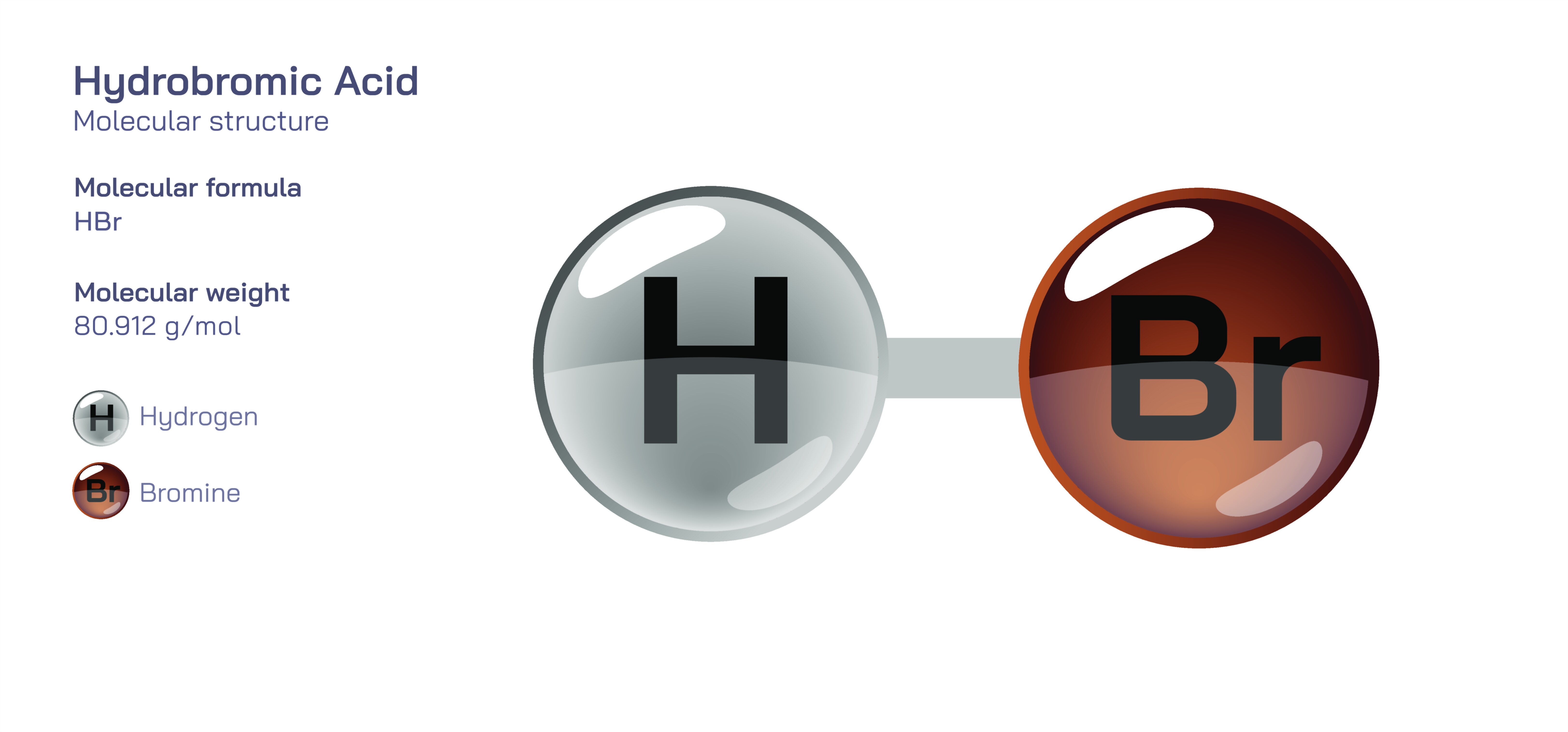
Hydrobromic acid is one of the most powerful mineral acids used in chemistry and industry, and although many people recognize it simply as a corrosive liquid, its true character can only be understood by examining its chemical structure, reactivity, dissociation behavior, and biological hazards. At its core, hydrobromic acid is the aqueous form of hydrogen bromide (HBr), a compound consisting of a hydrogen atom bonded to a bromine atom through a polar covalent bond. In its pure gaseous state, HBr remains intact as a hydrogen–bromine molecule, but when dissolved in water, it undergoes nearly complete dissociation into hydronium ions (H₃O⁺) and bromide ions (Br⁻), creating a solution with extremely high acidity. This dissociation is what makes hydrobromic acid one of the strongest known binary acids, surpassed mainly by hydroiodic acid. The molecular behavior of this dissociation reflects the unique relationship between hydrogen and bromine atoms: the large size of the bromine atom and the weakness of the H–Br bond compared with similar hydrogen halides allows water to pull the molecule apart almost instantly, releasing free protons into solution. It is this ability to donate protons so efficiently that defines hydrobromic acid as a superlative strong acid, far stronger than hydrochloric acid and vastly more reactive than organic or weak inorganic acids.
The chemistry of hydrobromic acid is rooted in its ability to produce an aggressive proton source and a highly nucleophilic bromide ion. As a strong acid, hydrobromic acid participates extensively in protonation reactions and can drive chemical transformations that weaker acids cannot. The availability of free H⁺ ions allows it to rapidly break down metal oxides, carbonates, and hydroxides, producing soluble bromide salts while releasing water and sometimes gas byproducts. The bromide ion that remains after dissociation is chemically valuable as well; it is a strong nucleophile capable of attacking electrophilic carbon centers, making hydrobromic acid useful in converting alcohols into alkyl bromides — key intermediates in pharmaceuticals, organic synthesis, and industrial chemical manufacturing. Because bromide is more nucleophilic than chloride, hydrobromic acid is often chosen when reactivity or substitution efficiency must exceed what hydrochloric acid can provide. In addition to organic synthesis, hydrobromic acid plays roles in catalyst production, polymer chemistry, metal refining, chemical etching, and laboratory research, illustrating how a simple two-atom molecule can serve as a foundational reagent for countless applications.
However, the very mechanism that makes hydrobromic acid synthetically valuable — its ability to dissociate completely and supply protons freely — also makes it profoundly corrosive to biological tissues. When hydrobromic acid contacts skin, eyes, or mucous membranes, the free hydrogen ions begin to destroy tissue by breaking chemical bonds within proteins, lipids, and cell membranes. Tissue damage is rapid and progressive because acidity disrupts cell structure on a molecular level rather than through thermal or mechanical means. Inhalation of hydrobromic acid vapor or hydrogen bromide gas can severely injure the respiratory system by dissolving in moisture in the airways and forming the acid in situ, causing acute inflammation, coughing, bronchospasm, pulmonary edema, and potentially fatal respiratory failure. Ingestion produces immediate burns to the mouth, throat, esophagus, and stomach. Chronic exposure, even at low levels, may produce systemic effects owing to irritation of mucus membranes, dental decay, chronic coughing, and persistent respiratory sensitivity.
The corrosive nature of hydrobromic acid extends far beyond biological systems to materials and industrial environments. Concentrated hydrobromic acid can corrode metals, degrade polymers, and weaken construction materials if containment is not properly designed. Even laboratory-grade glassware can be attacked under certain concentrations or temperatures, which is why hydrobromic acid is stored in specialized containers typically made of high-resistance plastics. The fumes themselves can be dangerous because hydrogen bromide gas reacts with moisture in the air to form a corrosive aerosol that attacks metal surfaces and respiratory tissue simultaneously. These characteristics mean that hydrobromic acid cannot be stored casually and must always be kept in tightly sealed, corrosion-resistant vessels located in well-ventilated areas protected from incompatible chemicals.
Working safely with hydrobromic acid requires methods that anticipate both its physical and health hazards. Personal protective equipment must include acid-resistant gloves, laboratory coats, splash-proof goggles, face shields, and respiratory protection when fumes may be present. Handling procedures should take place in fume hoods so that vapors cannot accumulate. Because hydrobromic acid reacts violently with bases, oxidizers, alkali metals, and certain organic compounds, incompatible substances must be strictly segregated. Even diluted solutions must be treated with care, as they retain strong acidity and the potential to cause burns. In the event of accidental contact with skin or eyes, immediate rinsing with copious amounts of water is critical, followed by medical attention. Spills require neutralizing agents such as sodium carbonate or sodium bicarbonate, followed by appropriate disposal under hazardous waste protocols to prevent environmental contamination.
Environmental exposure to hydrobromic acid is also a matter of concern. If released into waterways, hydrobromic acid can alter pH dramatically and harm aquatic ecosystems by damaging gill membranes, interfering with cellular function, and disrupting biological buffering systems. While bromide ions themselves are less toxic than the acid form, their high concentration can still produce ecological imbalance. For this reason, disposal of hydrobromic acid must always be carried out according to chemical waste regulations, never through direct drainage or uncontrolled release.
Although its reactivity makes hydrobromic acid dangerous, it also makes the compound indispensable to modern science and industry. The challenge is not to replace the molecule entirely but to use it with engineering foresight, proper equipment, trained personnel, and well-defined safety systems. Hydrobromic acid represents a profound illustration of how chemical power depends on context: in one setting, it enables the synthesis of lifesaving pharmaceuticals and vital industrial compounds; in another, without proper controls, it becomes an agent of tissue destruction, environmental harm, and structural corrosion. The molecule does not change — only the conditions in which humans engage with it do.
In this sense, hydrobromic acid embodies the duality at the heart of modern chemistry. The same dissociation behavior that makes it a cornerstone reagent is also the source of its threat. Appreciating hydrobromic acid means acknowledging both sides: its structural ability to release protons rapidly, its industrial value in synthesis and manufacturing, and its biological danger when that reactivity is directed at tissue rather than controlled chemical systems. When respected and managed correctly, hydrobromic acid remains an essential tool in the advancement of science and technology. When misunderstood or mishandled, its strength becomes destructive. Understanding the structure, properties, and safety measures of hydrobromic acid therefore becomes not only a scientific necessity but a practical responsibility in any environment where chemistry meets the real world.