Hair Types — Straight, Wavy, Curly, and Coily Hair Structure Explained
Human hair presents a remarkable range of textures and growth patterns that appear on the surface to be stylistic variations, yet underneath these visible differences lies a deep biological system shaped by anatomy, genetics, biochemistry, and follicular geometry. The distinguishing characteristics that separate straight, wavy, curly, and coily hair are not random or cosmetic in origin; rather, they are created inside the follicle itself long before the hair emerges from the scalp. Each texture is defined primarily by the physical shape of the follicle, the angle at which the fiber exits the skin, and the internal distribution of keratin proteins inside the cortex. As a strand begins to form deep in the follicle, keratin fibers are arranged and hardened in a pattern dictated by the follicle’s geometry. Because this structural pattern remains consistent along the entire growing length, the visible texture of the hair we see every day on the surface represents a direct reflection of the follicle’s shape beneath the skin. Understanding hair types in this scientific way reveals why some textures remain naturally sleek, why others form gentle waves, why still others spiral into curls, and why the tightest coils form a springlike zigzag configuration. Hair type is therefore not a superficial label but a biological blueprint that influences everything from appearance to moisture behavior to strength, elasticity, and styling response throughout an individual’s lifetime.
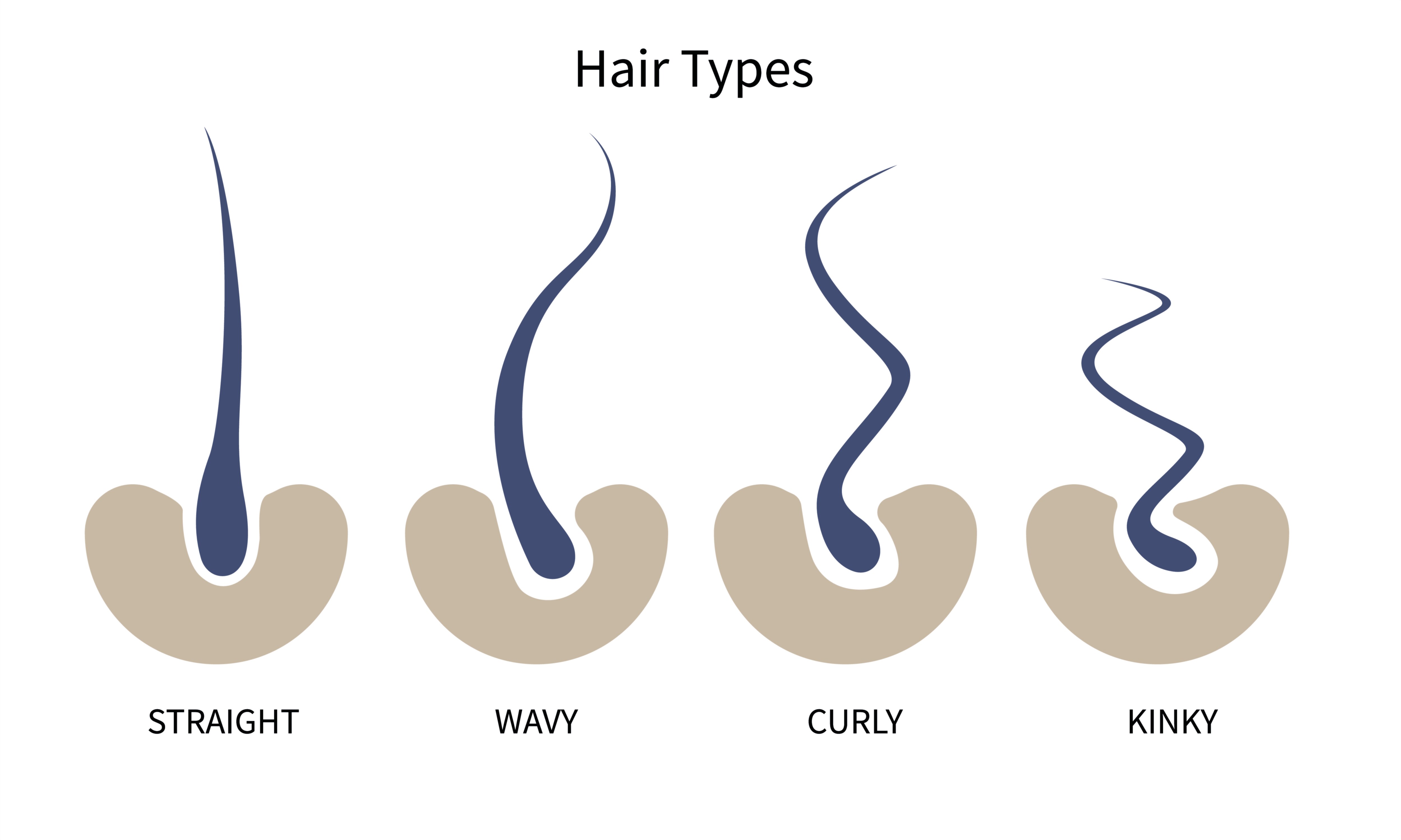
Straight hair is formed by follicles that are nearly perfectly round in cross-section and positioned more or less vertically within the scalp. This anatomical combination enables keratin to be distributed evenly throughout the hair shaft, causing the fiber to harden into a smooth cylindrical shape with no pressure toward bending in any particular direction. As the shaft grows outward, it travels a relatively straight path because the keratin bundles within the cortex align symmetrically without tension differences that would cause curving. The result is a texture that appears sleek, reflective, and highly uniform from root to tip. One of the most notable consequences of this symmetry is that sebum produced by the sebaceous glands moves very efficiently down the hair shaft, giving straight hair strong natural lubrication but also causing it to become oily more quickly near the roots. The surface cuticle of straight hair lies relatively flat, enhancing smoothness and shine, yet this very smoothness also reduces natural friction and volume, making straight hair more likely to fall close to the scalp. Its mechanical strength is typically high because the absence of bends or twists limits points of structural stress, and its styling behavior is largely influenced by humidity, weight, and oil distribution rather than fragility.
Wavy hair develops under slightly different structural conditions within the follicle. Here, the follicle cross-section is not perfectly round but subtly oval, and the angle at which the hair emerges from the scalp is somewhat diagonal rather than vertical. These two effects combine to produce an arrangement of keratin within the cortex that is only slightly asymmetrical, leading to moderate internal tension that bends the fiber into a gentle S-shaped pattern rather than a straight line. The pattern becomes more noticeable as the hair grows longer, and its expression can fluctuate significantly depending on styling, humidity, and moisture content. Unlike straight strands where sebum spreads easily from root to tip, wavy hair slows this distribution slightly, often resulting in roots that are not overly dry while lengths and ends may require additional hydration to maintain smoothness. The structure of wavy hair gives it more natural volume than straight hair, yet the bends create surface irregularities where hydrogen bonds respond intensely to atmospheric moisture. This explains why wavy strands may look sleek and defined in dry conditions but expand and frizz when exposed to humidity. The wave pattern represents a biological midpoint, behaving sometimes like straight hair and sometimes like curly, depending on environmental and mechanical factors.
Curly hair arises from a more dramatically oval follicle with a notably pronounced angle of emergence from the scalp. These structural differences impose a stronger asymmetry on keratin alignment, with the cortex developing alternating zones of tension and compression that create a spiral configuration along the length of the fiber. Each loop of a curl contains an outer arc that is stretched and an inner arc that is compressed, and this alternating pattern repeats continuously from root to tip. The visible curl pattern reflects this internal spiral geometry rather than being imposed from the outside. Because each bend exposes the cuticle slightly, curly hair is naturally more vulnerable to friction, breakage, and dryness than straight or wavy textures. Sebum travel from root to ends is restricted by the curvature, contributing to dryness in the mid-lengths and ends and increasing susceptibility to frizz and tangling when environmental humidity interacts with hydrogen bonds in the cortex. Curly hair contains internal elasticity that produces bounce, volume, and a dynamic silhouette, but this same elasticity requires careful handling, moisture retention, and protective friction control to maintain structure and prevent damage. It is this combination of spring-like mechanical energy and biological vulnerability that gives curly hair its distinctive beauty and its need for supportive care.
Coily hair, also known as tightly curled or kinky hair, is shaped by even greater follicular curvature, with the follicle producing a sharply angled, hooklike path and an extremely elliptical cross-section. The keratin bundles inside the cortex follow an alternating alignment that reverses rapidly and repeatedly, leading to an exceptionally tight curl pattern that can form corkscrews, zigzags, spirals, or springlike coils. Each directional change subjects different parts of the shaft to alternating compression and tension forces, creating a pattern that coils upon itself with extraordinary density. Coily strands shrink dramatically compared with their true length because their geometry pulls the fiber inward as it emerges, forming compact curls that produce significant volume even when individual strands are fine in diameter. Sebum distribution is minimal because the hair’s tight bends form barriers to downward oil movement, making coily textures the driest of all hair types. In spite of the internal softness of the keratin, the frequent bends create external stress points that make coily hair the most delicate mechanically. It responds best to gentle handling, consistent lubrication, moisture sealing, and tension-reducing methods that protect the architecture of the coils. The high elasticity of coily hair allows remarkable stretching and retraction, but overly aggressive manipulation can easily exceed its tolerance and lead to breakage.
Although all four hair types share the same basic biological ingredients—keratin proteins, pigment molecules, lipids, and structural bonds—the way these elements organize during hair formation determines texture, strength, elasticity, moisture balance, and visible pattern. Straight hair embodies symmetry, efficient lubrication, and surface reflectivity with minimal shrinkage. Wavy hair represents moderated curvature with variable response to environment and styling. Curly hair reflects strong spiral architecture, high visual volume, and reduced oil flow that increases dryness and sensitivity to humidity. Coily hair demonstrates the most complex geometry, with dense shrinkage, extraordinary pattern definition, and heightened fragility that requires dedicated care focused on friction control and moisture retention. None of these textures is inherently superior or inferior; each demonstrates a different biological solution created by follicle shape and keratin structure, and each carries unique strengths, behaviors, and beauty.
Seeing hair types through the lens of follicle structure fosters appreciation for the individuality of texture and explains why different hair types require different forms of care, styling approaches, and product composition. Instead of perceiving texture as a cosmetic trait that can be “corrected,” scientific understanding reveals it as a genetically encoded architectural identity that deserves respect and specialized support. Straight hair thrives with lightweight moisture and oil balance because of its efficient sebum travel. Wavy hair benefits from moderate hydration and humidity control to prevent frizz without weighing down the wave pattern. Curly hair responds best to deep moisture infusion, controlled handling, and film-forming lipids that reinforce the curl pattern. Coily hair flourishes with rich emollients, protective styling strategies, minimal friction, and sealing techniques to preserve moisture and maintain the integrity of the coil geometry. When texture is approached as biology rather than preference, the uniqueness of straight, wavy, curly, and coily hair becomes not a comparison but a celebration of diversity encoded in the follicle itself.