Hess’s Law — Thermochemical Energy Relationship Explained
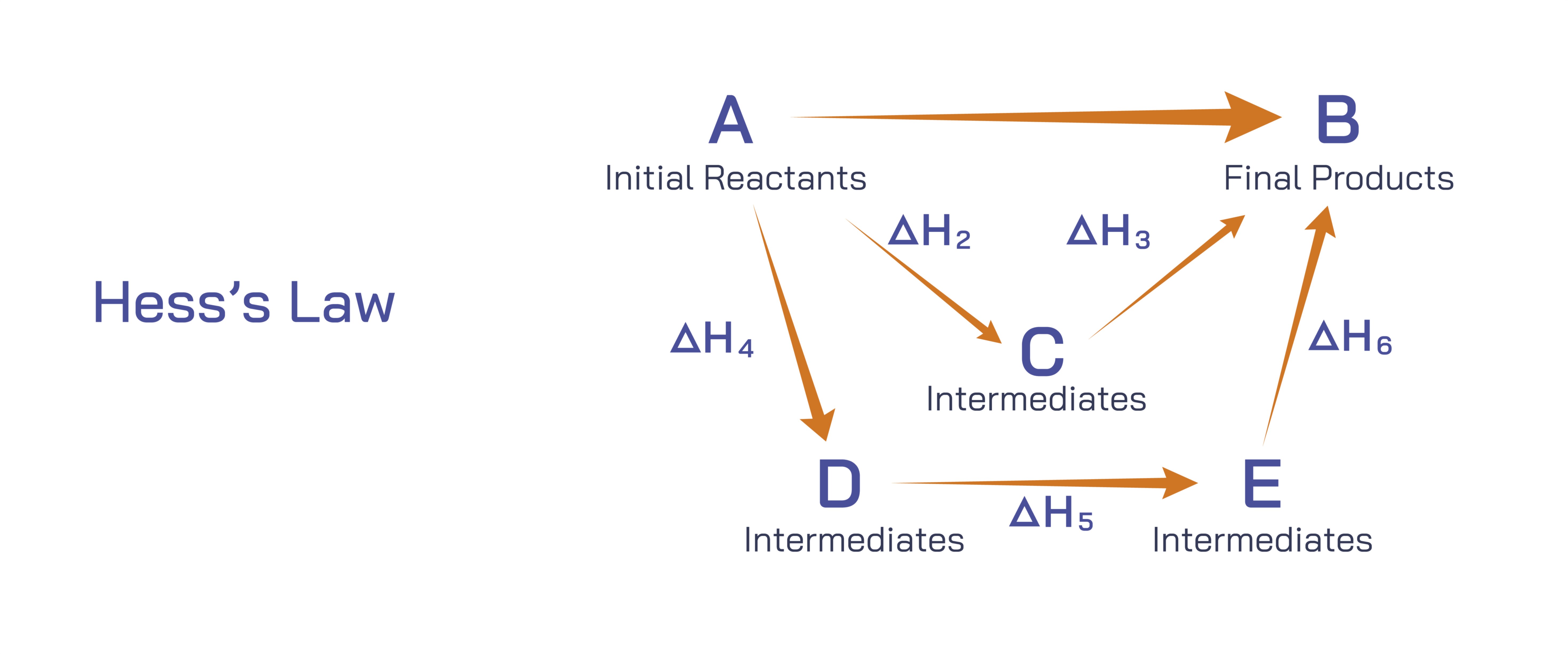
Hess’s Law stands as one of the most powerful conceptual principles in thermochemistry because it reveals a remarkable truth about energy in chemical reactions: the total heat change of a reaction depends only on the starting substances and the final products, not on the path taken to get from one to the other. Although chemistry often appears to involve complicated mechanisms, sequences of intermediate products, and multiple transformation steps, Hess’s Law dramatically simplifies the energetic viewpoint by showing that energy behaves like a conserved quantity, similar to money flowing through an account. Whether a chemical reaction proceeds in one single step or through a chain of smaller reactions, the total enthalpy change remains the same as long as the starting and ending states are identical. This concept acts as a thermodynamic compass, allowing chemists to determine heat changes that are difficult or impossible to measure directly by breaking reactions into easier indirect pathways and adding their corresponding enthalpy changes.
To understand Hess’s Law conceptually, imagine that energy stored in chemical bonds behaves like stored potential. When bonds break, energy must be supplied; when new bonds form, energy is released. The enthalpy change of a reaction represents the balance between the energy absorbed to break initial bonds and the energy released when new bonds are created in the products. The remarkable aspect uncovered by Hess’s Law is that this balance does not depend on how a reaction unfolds step by step. It depends only on the energies of the initial and final molecular arrangements. In other words, enthalpy functions like a state property — a value determined solely by the current state of a system, rather than by the route taken to reach that state. Temperature, pressure, and internal energy behave the same way; they depend only on initial and final conditions, not on the path in between. Hess’s Law is an energetic reflection of this state-property nature of enthalpy.
A useful way to visualize Hess’s Law is to imagine traveling between two cities. Whether you take a direct highway, a series of winding rural roads, or a flight with multiple layovers, your overall change in altitude between the starting and ending cities remains the same. The altitude doesn’t remember whether the journey was simple or complicated; only your starting elevation and destination elevation matter. Chemical reactions behave the same way in terms of energy. Two substances may transform into products through one direct reaction or through several small reactions, but the overall enthalpy change is invariant. This principle allows chemists to add or subtract enthalpy changes from multiple related reactions to determine the heat of a reaction that cannot be measured directly.
In practical chemistry, this becomes useful because many reactions cannot be observed in clean, isolated form. For example, some substances do not burn directly in oxygen at measurable rates, or some unstable compounds cannot be studied independently without decomposing. Rather than trying to force direct measurement under impractical conditions, Hess’s Law allows scientists to determine thermochemical data using alternative reaction pathways that are easier to control. If each intermediate step releases or absorbs a known amount of heat, the total can be combined to obtain the heat of the overall reaction of interest. Thus, Hess’s Law transforms thermochemical energy from an experimentally difficult measurement into a solvable energetic accounting system.
One of the most famous applications of Hess’s Law involves determining enthalpies of formation and combustion. If the enthalpy change of forming a compound from its elements cannot be directly measured, chemists can combine the enthalpies of combustion of the compound and the relevant elements to derive the formation enthalpy indirectly. Similarly, calculating enthalpy changes for reactions in solution uses Hess’s Law in combination with dissolution enthalpies, precipitation enthalpies, or neutralization enthalpies to build a complete energetic pathway. In this way, Hess’s Law becomes a foundational tool in constructing thermodynamic tables, allowing scientists to determine extensive catalogs of enthalpy values without performing every reaction directly.
Hess’s Law also plays a central role in understanding energy storage in fuels. The energetic value of gasoline, coal, natural gas, hydrogen, propane, and other fuels depends on the enthalpy released when they react with oxygen. Many fuels do not burn under controlled laboratory conditions in ways that allow direct measurement of heat output, but their combustion enthalpies can be derived indirectly by breaking the reaction into smaller steps that can be measured experimentally. This information allows industries to quantify energy capacity, compare different fuel types, optimize combustion efficiency, and evaluate the energetic impact of renewable fuels. Without Hess’s Law, such comparisons would require direct measurement of every combustion process, which would be time-consuming, unsafe, and often impractical.
Another deep implication of Hess’s Law emerges in biochemical and metabolic reactions. Energy stored in food is not calibrated through calorimetry on living organisms. Instead, scientists use Hess’s Law to determine the enthalpy changes for metabolic breakdown of carbohydrates, proteins, and fats by combining data from multiple separate reactions. The total energy the body can obtain from nutrients ultimately comes from the rearrangement of chemical bonds, and Hess’s Law enables scientists to quantify this energy based on known enthalpies of formation and combustion for biomolecules. In this way, the law bridges human nutrition, biochemistry, and thermodynamics.
The conceptual power of Hess’s Law extends beyond laboratory applications into environmental science. When atmospheric CO₂ reacts with seawater, when minerals undergo weathering, or when industrial emissions interact with the environment, direct heat changes are not always measurable. However, by decomposing complex chemical processes into foundational steps whose enthalpies are known, researchers can determine the overall energetic effect of large-scale natural change. These calculations become essential in understanding climate feedback mechanisms, geochemical transformations, and energy cycles across ecosystems.
What makes Hess’s Law elegant is that it reflects a universal constraint in physical science: energy conservation. Since energy cannot be created or destroyed in chemical reactions, the total enthalpy change depends only on where the system starts and where it ends. A multi-step pathway simply spreads the same energy transformation across multiple stages instead of one. This truth allows chemists to manipulate equations algebraically — reactions can be reversed by changing the sign of their enthalpy, multiplied by coefficients when scaled, or added together when combined chemically. Each manipulation mirrors a conceptual transformation of the reaction pathway while leaving the overall conservation of energy intact.
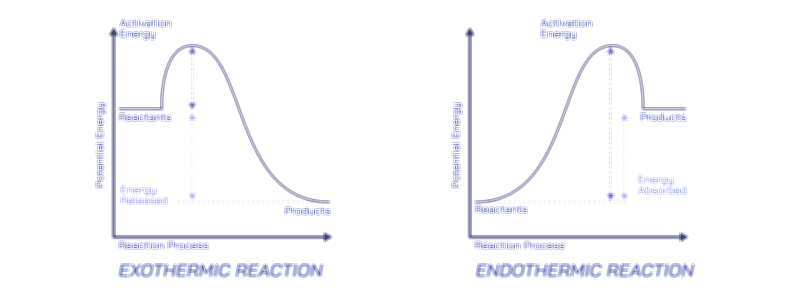
Hess’s Law also intersects with the deeper conceptual world of potential energy surfaces. Each molecule’s structure corresponds to a particular potential energy level, and chemical reactions shift systems between those energy levels. If the initial and final levels are known, the exact route between them becomes irrelevant for determining total change. Understanding Hess’s Law this way reveals why it is more than a computational tool — it is evidence that chemical energy is governed by physical thermodynamic laws that transcend individual reaction mechanisms.
By exploring Hess’s Law in this deep, narrative way, one sees that the principle is not merely a rule for summing equations. It is a reflection of the fundamental nature of energy in chemistry: enthalpy depends on states, not paths. It frees chemists from the need to track each microscopic step and instead allows them to interpret energetic change through beginning and end conditions alone. This principle fuels advances in chemistry, engineering, fuels, environmental science, nutrition, and material research, demonstrating that the abstract nature of thermodynamics has vast real-world implications.
Hess’s Law shows that even though chemical reactions may unfold through different mechanisms, the energetic truth remains constant. It brings order to the complexity of chemical transformations, turns difficult measurements into solvable energetic puzzles, and anchors thermochemistry in the wider physical law of energy conservation. Through it, we learn that behind the apparent variety of reaction pathways lies a unified thermodynamic logic — a reminder that the physical world remains deeply consistent, no matter how many routes nature may take to get from one state to another.