Hair Loss Stages — Baldness Progression and Follicle Degeneration Explained
Hair loss is often perceived only as the gradual thinning of strands on the scalp, but biologically it is a complex and deeply structured process driven by changes occurring inside the hair follicle long before the reduction in visible hair becomes noticeable. Every human hair grows from a microscopic follicle embedded in the skin, and when hair loss progresses toward baldness, it is not the hair fiber that weakens first, but the follicle that undergoes structural and functional decline. This happens gradually across distinct physiological stages, during which follicles shrink, shorten their growth cycle, produce thinner and weaker strands, and eventually stop generating hair altogether. Understanding these stages requires examining how follicles function normally and how degeneration alters their behavior over time. Such knowledge reveals that hair loss is not a sudden event but a slow biological shift, one tightly linked to hormones, genetics, inflammation, stress signaling, aging, and cellular metabolism.
A healthy hair follicle operates according to a cyclical pattern consisting of anagen, catagen, and telogen phases. In anagen, the growth phase, the follicle is fully active and produces a thick, pigmented hair fiber through intense cellular division in the hair bulb. This phase can last years, which allows long strands to form. Eventually the follicle transitions to the short catagen phase, in which division slows and the follicle detaches from the blood-rich dermal papilla, preparing the bulb for a period of rest. In telogen, the follicle enters dormancy, no new fiber grows, and the hair remains anchored until it sheds. Once shedding occurs, a new anagen phase begins, and the follicle creates another strand. This continuous renewal happens in millions of follicles out of synchrony, ensuring that shedding is normally gradual and balanced rather than producing patches of baldness. However, when biological changes disrupt this cycle, follicles undergo degeneration, and this degeneration lies at the heart of progressive baldness.
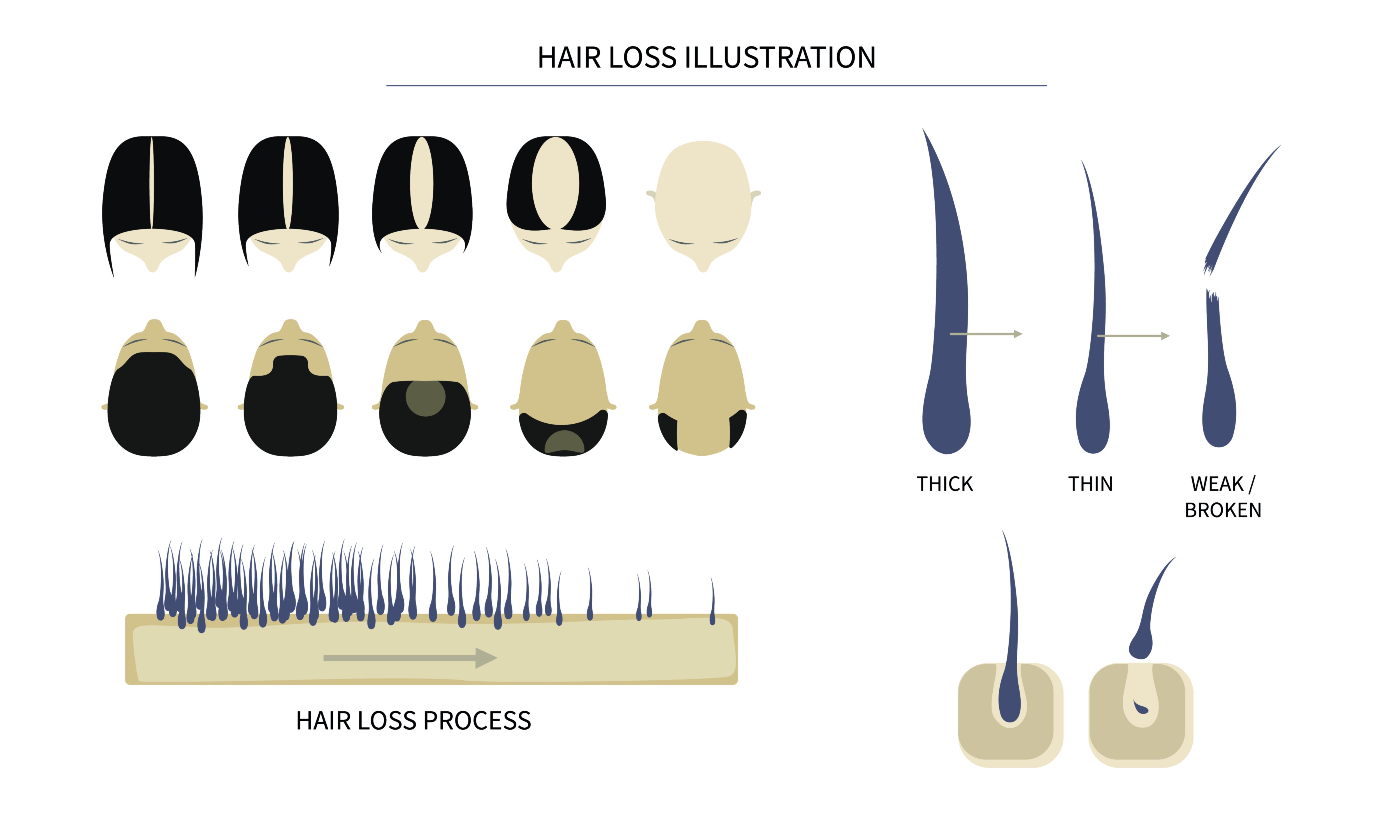
The earliest stage of hair loss occurs when follicles begin to shorten their anagen phase. The shortening may be subtle initially, yet it drastically changes the follicle’s output over time because when anagen becomes brief, the hair shaft grows for a much shorter duration. The visible result is slower growth and shorter strands. Many individuals first notice that their hair is not reaching the lengths it once did, even though shedding might not yet seem unusual. Inside the follicle, however, the shift is already significant: the matrix cells divide less vigorously, the dermal papilla receives less metabolic stimulation, and the follicle prepares to enter the resting phase prematurely. The cycle becomes progressively imbalanced as more follicles adopt shorter anagen phases, producing shorter hairs that are replaced more frequently, while fewer follicles maintain strong and prolonged growth.
As the process continues, a later stage emerges characterized by miniaturization, a hallmark of pattern baldness. Miniaturization means the physical shrinking of the follicle structure, including the bulb, the dermal papilla, and the connective tissues that guide hair formation. The follicle becomes smaller, and consequently the strand it produces becomes thinner and finer with every cycle. What was once a thick, pigmented hair becomes a smaller version of itself, followed eventually by the production of vellus-like hairs that resemble baby hair in softness, color, and diameter. These microscopic fibers are not capable of creating visible coverage, and although the follicle technically remains alive, its productivity has been drastically reduced. This stage is often visible at the temples, crown, and frontal scalp in men and along the parting line and top of the scalp in women. To the naked eye, it appears as thinning, but the deeper truth is that the follicle is shrinking and losing structural power.
Hormonal signaling plays a major role in this miniaturization stage, particularly in androgenetic alopecia, the most common form of hereditary thinning. Dihydrotestosterone, a potent androgen derived from testosterone, binds to receptors in susceptible follicles and triggers a cascade that reduces nutrient supply, shrinks the dermal papilla, and constricts the follicle’s growth potential. Not all follicles respond to this hormone in the same way, which is why baldness follows predictable patterns rather than affecting the entire scalp uniformly. The follicles genetically sensitive to DHT undergo gradual miniaturization, while others remain unaffected and continue to grow strong fibers. This genetic sensitivity explains why hair on the sides and back of the scalp frequently remains full even when the top and front experience loss. Other causes of hair loss, such as stress, inflammation, autoimmune disorders, illness, and nutrient deficiency, may also shift follicles toward degeneration, but the mechanisms differ in detail while still converging on the shared outcome of reduced follicle activity.
As degeneration advances, the scalp enters a late stage where many follicles spend most of their time in telogen rather than anagen. The resting phase becomes the dominant state, and hair production becomes intermittent rather than continuous. Shedding increases and regrowth weakens. The hair that does grow remains thin and fragile, and often the color fades as melanocytes decrease their function alongside the weakening of the follicle. In this stage, visible baldness becomes noticeable even if follicles are technically still alive. A person experiencing late-stage loss may notice widening parts, visible scalp through hair, decreased density, and reduced tensile strength. However, because follicles are not yet dead, they still retain the biological capacity to recover under the right conditions. Treatments that stimulate circulation, inhibit hormonal attack, reduce inflammation, or rekindle cellular division may revive miniaturized follicles during this stage, although not all follicles respond equally and time plays a major factor in recovery potential.
The final stage of baldness occurs when follicle degeneration progresses to the point at which the follicle becomes permanently inactive. At this stage the follicle is no longer capable of initiating an anagen phase and cannot produce new hair fibers. The dermal papilla atrophies significantly, and the matrix cell population that once built the hair shaft becomes insufficient or disappears entirely. The visible scalp becomes smooth over time as remaining vellus-like fibers shed and are not replaced. Once a follicle reaches full dormancy and tissue collapse, natural regrowth becomes biologically impossible, and any form of recovery requires surgical relocation of healthy follicles from areas that are genetically resistant to degeneration, such as those found on the back and sides of the scalp. This progression explains why early intervention is essential for anyone who wishes to preserve existing follicles; restoration is always easier and biologically more realistic when a follicle is declining rather than when it has already shut down permanently.
Throughout this progression, hair loss reflects not only visible thinning but a complete shift in follicular identity from a strong, metabolically active organ to an exhausted, miniaturized, or dormant one. Baldness therefore represents a biological sequence, not an abrupt event. Genetics may determine the susceptibility, hormones may regulate the pace, lifestyle and health may influence the severity, and the passage of time may govern the final outcome. Every stage alters how the follicle metabolizes nutrients, how long it remains in anagen, how thick the shaft becomes, how much pigmentation persists, and whether the follicle has the capacity to continue functioning at all.
Understanding the stages of hair loss is not merely an academic exercise; it is an essential framework for recognizing what is happening beneath the scalp before it becomes irreversible. When people observe that their hair is shedding, slowing in growth, becoming finer, or failing to reclaim previous density, these surface changes signal the stage of follicular degeneration within. The earlier that biological decline is recognized, the greater the chance of preserving follicular vitality, because follicles in a degenerating stage may still recover under the right biological influences. Conversely, follicles that have completely ceased function cannot be revived from inactivity because the structural foundation required for hair production no longer exists. What appears externally as a change in coverage is internally a transformation in follicular health and regenerative capacity.
Hair loss stages therefore represent a spectrum of biological transformation, beginning with shortened growth cycles, progressing through follicle miniaturization, transitioning toward dominance of the resting phase, and finally culminating in permanent follicle dormancy. Through this continuum, baldness reveals itself as a gradual weakening of a formerly productive mini-organ. When viewed scientifically, hair loss is not a matter of hair disappearing but of the follicle transforming through stages of decline until it no longer sustains the creation of a strand. Recognizing this deepens our understanding of hair biology and highlights that the visible fiber we see is simply the outward expression of the internal condition of the follicle itself, whose fate ultimately determines whether hair continues to grow or slowly disappears forever.