Different Follicle Shapes and Hair Types — Texture, Structure, and Growth Pattern Explained
Human hair is a product of an extraordinarily organized biological structure, and while the visible fiber might appear simple on the surface, its natural texture, curl pattern, thickness, and growth behavior are determined long before it emerges from the scalp. One of the most fascinating principles in trichology is that the shape of the hair follicle dictates the texture of the hair shaft, meaning that straight, wavy, curly, and coily hair are not merely stylistic or cultural variations but anatomical outcomes of follicular geometry and the way keratin is arranged during growth. Each follicle acts like a microscopic mold that shapes the hair as it forms, and this structural shaping is consistently preserved along the entire strand. Understanding the different follicle shapes and how they influence hair types opens a deeper view into why hair behaves the way it does, why certain textures respond differently to humidity or friction, and why care practices must vary from one hair type to another. The follicle is not simply an anchor that holds hair in the scalp—it is the biological architect responsible for shaping every characteristic of the hair fiber.
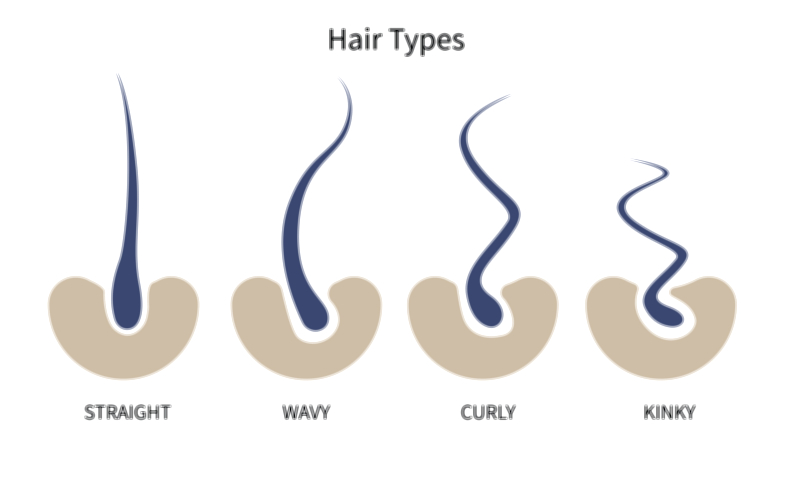
In straight hair, the follicle begins with a nearly round cross-sectional shape, and the follicle orientation is generally vertical, emerging straight out of the scalp. This layout creates a balanced distribution of keratin around the cortex, producing a uniform cylindrical fiber that grows smoothly and reflects light easily. The symmetrical distribution helps the natural oils from the sebaceous glands travel down the shaft with little resistance, making straight hair naturally more lubricated and often more prone to looking oily at the roots. The smooth path and uniform diameter also make straight hair appear shinier because its flat cuticle can reflect light evenly. Straight fibers can vary in diameter from fine to coarse, but regardless of thickness, the central structural principle remains the same: a round follicle produces a straight fiber because the keratin bundles inside the cortex align without directional bias, forming a consistent linear structure.
Wavy hair develops from follicles that are oval instead of round, and the follicle emerges from the scalp at a slight angle rather than vertically. This combination influences the internal distribution of keratin so that the fiber forms a subtle S-pattern along its length instead of remaining rigidly straight. The oval cross-section produces varying tension inside the cortex, creating bends that result in a wave pattern that becomes more or less pronounced depending on genetics and environmental factors. Wavy hair is known for variability—it can behave similarly to straight hair when wet or well-conditioned, but it can also transform into loose curls or frizz in humid conditions because moisture disrupts hydrogen bonds inside the cortex, encouraging more curvature. Sebum also has a moderately efficient path down the hair, although not as direct as in straight textures, which can result in a balance between dryness on the lengths and oiliness near the scalp.
Curly hair forms when the follicle shape becomes more elliptical, and the angle at which the follicle sits within the scalp becomes more pronounced. This geometry results in greater asymmetry in keratin distribution, forcing the cortex to build a spiral rather than an S-shape. The curvature begins at the root and continues along the entire strand in repeating loops, which vary in tightness depending on the degree of follicular curvature and biochemical cross-linking inside the cortex. Curly hair grows outward rather than downward in a spring-like form, and although visually voluminous, it is often physically more fragile because the bends create stress points where the cuticle is more exposed. The spiral formation impedes the even travel of natural oils, causing the lengths and ends of curly hair to experience dryness, frizz, and breakage if moisture and lipids are not replenished externally. This fragility is not a flaw—it is an inherent consequence of the geometry that creates the curl pattern.
Coily or tightly curled hair originates from follicles that are highly curved or hook-shaped, creating an intensely elliptical cross-section and a sharply angled growth path. These follicles produce hair that forms tight coils, zigzags, corkscrews, or spring-like ringlets with significant contraction relative to length. The innermost keratin bundles follow highly asymmetrical paths, which create a structure where the inner side of every twist experiences compression while the outer side experiences tension. This complex architecture makes coily hair appear densely compact even though its actual length may be two or three times its visible size because of shrinkage. The tight pattern slows the downward movement of sebum almost completely, making this hair type the driest and most delicate of all textures. Despite extraordinary softness at the microscopic level, coily hair requires protective handling because the sharp bends in the cortex create points where the cuticle is more vulnerable to friction, stretching, and breakage. The density and volume of coily hair are among the most striking in human biology, formed not by thickness of individual strands but by the compactness and spring pattern of thousands of narrow coils.
Beyond curl patterns, follicle shape also affects strand thickness and tensile strength. A perfectly round follicle often produces thicker fibers because keratin can distribute more uniformly along a larger circumference, while flatter elliptical follicles distribute keratin differently, leading to narrower fibers that allow for tighter curvature. In addition, growth direction is influenced directly by follicle angling. Straight hair grows outward vertically, while curly and coily hair grows in a curved path along the scalp before extending outward in loops or spirals. This is why different hair textures create distinct silhouettes, shapes, and volume patterns without any manipulation—the foundation is anatomical, not cosmetic.
The relationship between follicle structure and hair texture also influences how hair responds to environmental factors such as humidity, heat, water, and mechanical manipulation. Every hair type contains hydrogen bonds and disulfide bonds that determine its shape. Hydrogen bonds break easily in the presence of water and reform as the hair dries, which explains why wavy, curly, and coily hair change dramatically when water is introduced. Disulfide bonds, on the other hand, maintain the fundamental curl or straightness and can be modified only through strong chemical processes like relaxing or perming. The more elliptical the follicle, the more complex and asymmetrical the network of internal bonds, and the more noticeable texture becomes in response to atmospheric moisture. Conversely, heat styling directly targets hydrogen bonding and temporarily smooths the internal structure, but the follicle’s geometry ensures that the natural texture returns once water or humidity is reintroduced.
Follicle shape also affects patterns of density and distribution across the scalp. People with naturally straight hair often perceive lower apparent volume even with many strands, because the hair lies close to the scalp. Wavy hair shows moderate lift from the scalp but still tends to follow gravity. Curly hair expands laterally, creating fullness and lift that distinguish its volume. Coily hair expands the most, forming multidirectional density and height that can take on many shapes depending on styling. These patterns arise not from manipulation but from the combined effects of fiber curvature, sebum travel, strand alignment, and frictional support between neighboring coils or curls.
Understanding follicle-driven texture at a biological level also clarifies why different hair types require different care principles. Straight hair benefits most from oil regulation and lightweight moisture because sebum spreads rapidly. Wavy hair requires balance, avoiding heaviness but supporting hydration to prevent frizz. Curly hair needs enhanced moisture retention, cuticle protection, and friction management to maintain elasticity and shape. Coily hair thrives when treated with lipid-rich moisture, protective styling, low manipulation, and controlled detangling to protect the delicate spring architecture. None of these needs arises from culture or fashion—they are grounded in anatomy and microscopic structure.
The deeper scientific message behind follicle shapes and hair types is that texture is biologically engineered, not cosmetically accidental. The follicle molds the fiber; the fiber expresses the follicle’s geometry; and the natural growth pattern reflects the balance of mechanical forces inside the cortex. Whether straight, wavy, curly, or coily, every hair type is the result of a deliberate arrangement of keratin, disulfide linkages, follicular curvature, pigmentation, and tissue orientation that evolved to support both physical function and adaptive identity across human populations. By understanding this connection, hair care, styling, cultural expression, and self-perception can shift away from comparison and toward appreciation of biological individuality. Each hair type is not a deviation from a standard—it is a structural expression of diversity encoded in the follicle itself, shaped deeply by ancestry, genetics, physiology, and evolution.