Hexamine — Chemical Structure, Properties, and Industrial Uses Explained
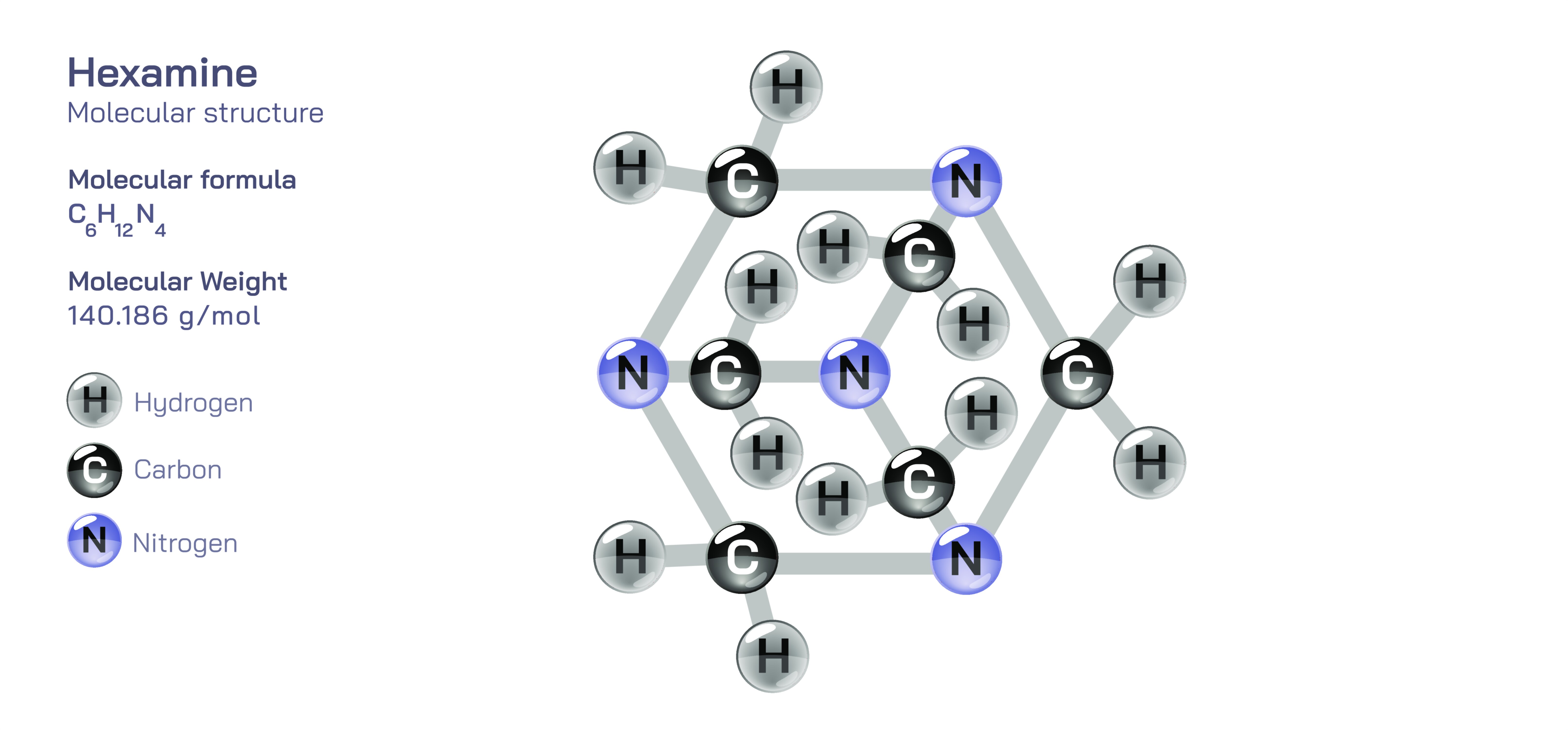
Hexamine, also known as hexamethylenetetramine or methenamine, is an organic compound whose chemical structure, physical properties, and industrial applications reveal a fascinating relationship between molecular geometry and practical functionality. Although its formula appears simple at first glance, written as C₆H₁₂N₄, the arrangement of its atoms forms an unusual cage-like framework that makes the compound both chemically stable and highly versatile. Hexamine is synthesized by combining formaldehyde and ammonia, and what results is a perfectly symmetrical heterocyclic cage structure built from interconnected carbon and nitrogen atoms. This cage arrangement is not merely aesthetically interesting but deeply influential in determining how hexamine behaves in chemical reactions, how it dissolves in solvents, and why it serves many roles in industry, medicine, polymer chemistry, and manufacturing.
The molecular structure of hexamine resembles a three-dimensional tetrahedral cage, where four nitrogen atoms occupy the corners and six methylene (–CH₂–) bridges connect them, forming a rigid and compact network. This architecture makes hexamine unusually stable for an organic compound containing multiple nitrogen atoms. The nitrogen atoms provide electron-rich centers, while the methylene bridges reinforce the structure into a geometric framework that resists structural collapse under heat and pressure more effectively than many simpler organic molecules. This structural rigidity explains why hexamine has a relatively high sublimation point, why it can persist as a crystalline solid without rapid degradation, and why it can be incorporated in polymer synthesis and thermosetting resin production. Unlike flexible molecules that twist or rotate freely, hexamine maintains a fixed spatial orientation that allows it to act as a building block in materials with specific mechanical, thermal, or chemical performance requirements.
Hexamine crystals are white, odorless, and highly soluble in water and polar solvents, although the way the molecule interacts with water reveals another aspect of its structure. In neutral or slightly basic solutions, hexamine remains stable and intact, but in acidic environments, the cage opens and decomposes to release formaldehyde. This property becomes especially meaningful when examining hexamine’s pharmaceutical use. Certain medications rely on the ability of hexamine to break down only under acidic conditions inside the urinary tract. When used in medicine, hexamine acts as a urinary antiseptic because the acidic pH of urine triggers the slow release of formaldehyde, which destroys bacteria locally without exposing the entire body to high levels of antimicrobial chemicals. This targeted-release behavior—stable at neutral pH and reactive in acidic pH—makes hexamine one of the most intelligently deployable molecules in medicinal chemistry, offering therapeutic value while minimizing systemic toxicity.
Another influential characteristic of hexamine lies in its reactivity with phenol and formaldehyde, which enables the synthesis of phenolic resins. When hexamine is incorporated into phenol–formaldehyde resin mixtures, it functions as a curing and crosslinking agent, transforming liquid resin into a hard thermoset polymer. This reaction gives rise to Bakelite-type plastics, which were among the first synthetic plastics ever developed and remain in use for their electrical insulation, mechanical strength, and heat resistance. The ability of hexamine to crosslink polymer chains appears directly traceable to its cage structure: the multiple nitrogen centers allow it to connect polymeric sites, producing a dense, rigid network that resists melting and deformation. These resins are used in electrical components, brake linings, bonding agents, laminates, molded parts, and coatings—applications where thermal durability and structural stability are essential.
Hexamine also plays an iconic role as a solid fuel, commonly known as hexamine fuel tablets. These lightweight blocks, when ignited, burn with a smokeless, high-temperature flame that produces minimal residue. Because hexamine sublimes rather than melts, the fuel does not liquefy during combustion, which is crucial for clean and controlled burning. This makes hexamine tablets indispensable for military rations, outdoor camping stoves, emergency survival kits, and expedition equipment. The high energy density of the molecule allows a small tablet to sustain a steady flame for a long duration, reflecting how the cage-like internal structure contributes to gradual controlled breakdown during combustion rather than explosive energy release. Its portability, long shelf life, and resistance to environmental moisture have made it one of the most reliable solid fuels ever developed.
In industrial chemical synthesis, hexamine serves as a precursor for explosives, most notably RDX (cyclotrimethylenetrinitramine), a powerful military explosive extensively used in modern ordnance. In this role, the nitrogen-rich cage structure becomes valuable, as it provides an atomic arrangement that can be converted into a dense, high-energy compound under appropriate nitration processes. While hexamine itself is not an explosive, its conversion into RDX illustrates how modifying the structure of a nitrogen-containing organic framework can rearrange stored chemical energy into an energetic material. This transformation highlights a deeper theme in chemistry: identical base elements arranged differently can yield substances with dramatically different properties, and hexamine sits at the crossroads of both benign and highly reactive applications depending on how its cage structure is utilized.
Beyond explosive precursors and solid fuel, hexamine is essential in the manufacture of rubber additives, corrosion-resistant coatings, and flame retardants. In rubber vulcanization, hexamine reacts with resorcinol to create adhesives that give tires strong bonding between rubber and reinforcing materials such as steel or fabric. In corrosion protection, hexamine is used as part of anti-rust formulations because nitrogen atoms enable adsorption on metal surfaces while resisting oxidative breakdown. In flame-retardant chemistry, hexamine contributes to nitrogen-based fire-suppression mechanisms, helping slow the spread of flames in textiles, foams, and industrial materials. In each of these applications, the molecular features—rigidity, nitrogen availability, and controlled reactivity—allow hexamine to anchor itself to complex chemical systems while delivering specific performance benefits.
Another important industrial application lies in the production of molding powders and adhesives, where hexamine stabilizes mixtures until heat is applied. When heated in the presence of appropriate agents, the compound triggers polymeric crosslinking reactions that convert powdered materials into dense molded parts. This heat-triggered functionality parallels the pH-triggered decomposition that occurs in medicinal use: both reflect a molecule designed to change behavior only under controlled stimulus, whether temperature or acidity. The strategic deployment of hexamine in responsive systems demonstrates how chemical structure becomes a tool for controlling when and where reactions must occur.
The compound’s stability in pure crystalline form also allows it to serve as a long-term storage form of formaldehyde, which is otherwise volatile and difficult to transport safely. Through the hexamine synthesis process, the reactive and gaseous formaldehyde becomes trapped inside a solid cage. When later exposed to an acidic or decomposition-inducing environment, the cage opens and releases formaldehyde for use in manufacturing or chemical processing. This ability to function as a protected formaldehyde reservoir shows how molecular structure provides solutions to storage and safety challenges beyond basic reactivity considerations.
Understanding hexamine through this deep structural and functional perspective reveals a unifying theme: a single molecular architecture enables an array of physical and chemical behaviors depending on the conditions applied. Its cage structure provides stability under normal conditions, reactivity when triggered, controlled decomposition in medical contexts, and dense energy storage for solid fuel and explosive precursors. In industry, its rigid geometry and nitrogen-rich network support adhesive systems, polymer crosslinking, thermoset formation, and surface protection. In every role, hexamine demonstrates how the precision of atomic arrangement translates into diverse real-world benefits.
Hexamine therefore stands not only as a chemical compound but as a case study in how molecular design shapes application. Its behavior is neither accidental nor coincidental — it emerges directly from how carbon, hydrogen, and nitrogen atoms are organized in three-dimensional space. By examining hexamine through atomic structure, physical properties, and industrial usage, one sees how chemistry can transform fundamental structural principles into practical solutions across medicine, polymer science, manufacturing, energy, survival technology, adhesives, and defense materials.