First Law of Thermodynamics — Energy Conservation and the Relationship Between Heat and Work Explained in Physics
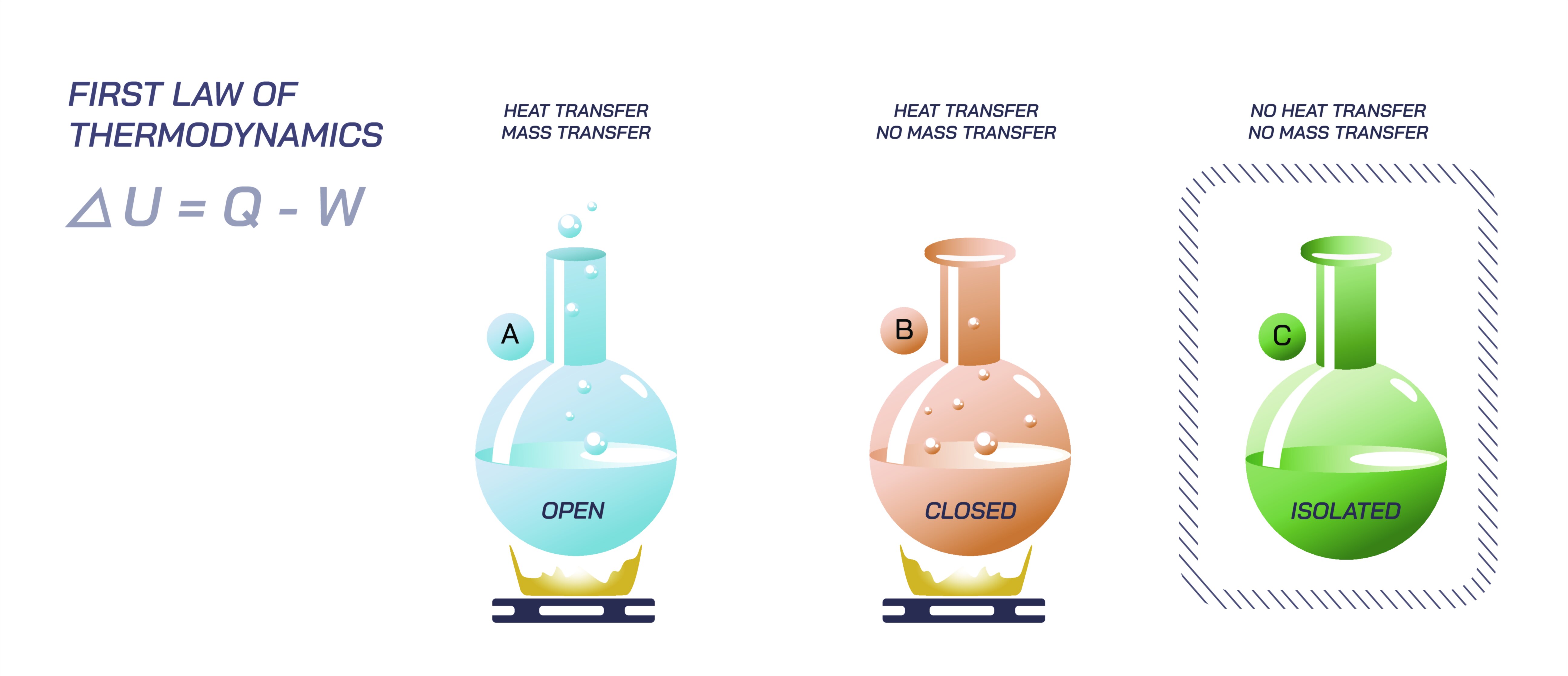
The First Law of Thermodynamics stands as one of the most fundamental and far-reaching principles in all of physical science, forming the conceptual backbone for understanding how energy behaves in every natural process, technological system, biological organism, and cosmic structure. Although introductory diagrams and vector illustrations typically depict the law through simple arrows showing heat entering or leaving a system, pistons doing work, or energy flowing across boundaries, the true depth of the First Law far exceeds these visual summaries. It represents nothing less than the universal conservation of energy, the statement that energy can neither be created nor destroyed, only transformed or transferred. Through a richly descriptive exploration, the First Law becomes a profound lens through which one can understand how engines operate, how living organisms survive, how planets radiate heat, how stars evolve, and how even the smallest physical interactions result from exchanges of energy between different forms. This law unifies diverse phenomena into a single, elegant narrative of energy continuity, revealing that all physical change is governed by the movement, conversion, and redistribution of energy.
At its core, the First Law states that a system’s change in internal energy depends solely on the heat added to the system and the work done by or on the system. Internal energy refers to the total microscopic energy of the particles composing the system—an immense reservoir of kinetic, potential, vibrational, and rotational energies at the atomic and molecular scale. Although this internal energy cannot be directly observed in everyday experiences, its effects are felt through temperature, pressure, and the system’s overall behavior. When heat enters a system, the internal particles gain energy, moving more rapidly or occupying higher energy configurations. When the system performs work on the surroundings, such as pushing against a piston, lifting a weight, or expanding against atmospheric pressure, it uses some of its internal energy to do so. These transfers and transformations ensure that the total energy remains constant, although its form may change from internal motion to mechanical work, from stored potential energy to thermal agitation, or from chemical energy to radiant heat.
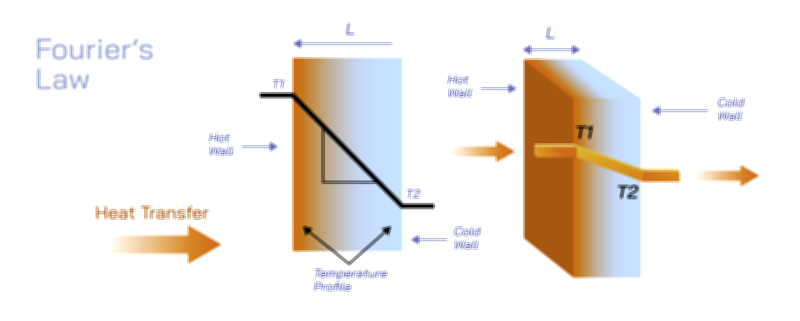
Understanding the First Law requires appreciating the concept of a system and its boundaries. A system may be as simple as a gas trapped in a sealed container or as complex as a living cell, a steam engine, a climate zone, or a star. The boundary defines what counts as “inside” and “outside,” and determines the paths through which energy can cross. Heat crosses the boundary due to temperature differences, moving from hotter surroundings to cooler systems unless external work reverses this natural direction. Work crosses the boundary through mechanical interactions such as expansion, contraction, rotation, or deformation. The sum of these exchanges determines whether the system gains or loses energy. The First Law emphasizes that in every case, the total energy is accounted for—nothing vanishes or appears spontaneously. Energy is redistributed among different forms, maintaining a perfect balance throughout every transformation.
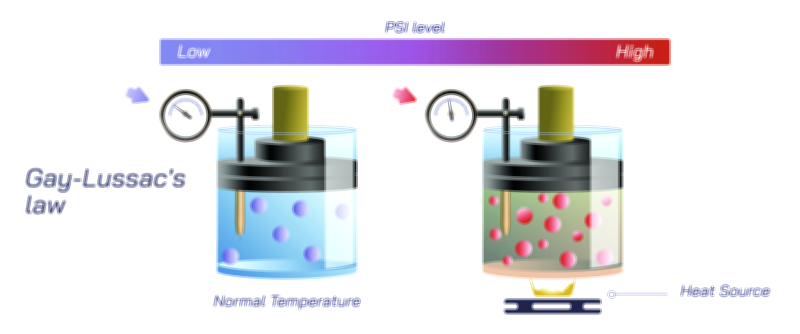
One of the most intuitive examples of the First Law is the expansion of a gas inside a cylinder fitted with a movable piston. When heat is applied to the gas, its molecules move more vigorously, increasing both temperature and internal pressure. This increased pressure pushes against the piston, causing it to rise. As the piston moves, the gas does work on the surroundings by lifting the piston’s weight or compressing an external spring. If the gas expands freely without doing any useful work, then all the heat contributes to raising its internal energy. If the expansion occurs against a resisting force, some of the heat energy becomes mechanical work. The First Law provides a framework for analyzing these situations, showing how heat input and mechanical output relate to internal energy changes. Even in this simple system, the law reveals the governing principle behind countless real-world machines, including internal combustion engines, steam turbines, refrigeration cycles, and rocket propulsion systems.
Beyond mechanical devices, the First Law governs natural processes at every scale. In Earth’s atmosphere, for example, heat from the Sun warms air parcels, causing them to expand and rise. As they rise to regions of lower atmospheric pressure, they expand further, performing work on their surroundings. This expansion cools the rising air because some of its internal energy is used to do work rather than raise temperature. Such processes are central to cloud formation, weather dynamics, and atmospheric circulation. The First Law provides the conceptual foundation for meteorology, explaining why air cools as it rises, why storms form under certain thermal conditions, and how energy transfers shape global climate patterns.
In biological systems, the First Law illuminates how living organisms manage energy. A living cell absorbs chemical energy from nutrients, transforms this energy into useful forms such as mechanical motion or biochemical work, and releases waste heat into the environment. At every stage, energy is conserved. When a muscle contracts, chemical energy stored in molecular bonds converts into mechanical work and heat. When the human body maintains temperature, it releases or retains heat to regulate internal energy. The First Law shows that metabolism is not a mysterious, spontaneous process but a vast network of energy conversions guided by the same rules governing engines and physical systems. Whether energy comes from food, sunlight, or chemical gradients, it flows through organisms in a strictly conserved manner, ensuring that life processes align with universal physical law.
The First Law also governs thermodynamic processes in astrophysical systems. Stars radiate enormous amounts of energy into space, but they maintain structural integrity by balancing internal energy sources against gravitational forces. Nuclear fusion in the core of a star converts mass into energy, heating the plasma and pushing outward against gravitational collapse. As long as fusion continues, the star remains stable, and its internal energy remains sufficient to oppose gravity. When fusion decreases, gravitational contraction reduces the star’s volume, doing work on the internal plasma and raising its temperature. This gravitational work becomes an energy source in its own right, demonstrating how work and internal energy interplay over cosmic timescales. Whether in stellar birth, main-sequence life, or collapse into white dwarfs, neutron stars, and black holes, the First Law governs how energy redistributes, transforms, and flows within the immense engines of the universe.
Another essential aspect of the First Law is that it does not specify how energy moves, only that the total balance must remain constant. This contrasts with the Second Law of Thermodynamics, which governs the direction of energy flow and introduces the concept of irreversibility. The First Law simply states that every joule of energy has a traceable origin and destination. If heat enters a system, it must raise internal energy or perform work. If the system does work, that energy must come from somewhere within the system. In a perfectly insulated environment, internal energy cannot change unless work is performed. In an environment with no external pressure, expansion does not require work, so all heat raises internal energy. These relationships allow thermodynamic systems to be analyzed with precision, providing engineers and scientists with the tools to design efficient engines, cooling systems, energy harvesters, and power plants.
The First Law also guides the understanding of energy storage. Batteries store energy chemically, and when current flows, chemical reactions convert internal energy into electrical work. Capacitors store energy in electric fields and release it through circuits. Springs store mechanical energy when compressed and return it as work when released. Even in these varied systems, the First Law ensures that energy transitions remain conserved. No system produces energy from nothing, and no system loses energy to nothingness. Energy always shifts form—chemical to electrical, electrical to thermal, mechanical to potential—but never disappears. This universal principle ensures that all energy-based technologies operate according to predictable, analyzable rules.
In practical terms, the First Law provides the basis for calculating energy requirements and outputs. Engineers designing heating systems analyze how much heat must be added to raise the internal energy of a building. Those designing refrigeration units calculate how much work is needed to remove heat from a confined space. Power plant designers use the First Law to determine how much heat must be supplied to boilers to produce steam capable of performing work in turbines. Chemical engineers study how heat and work transfer affect reaction vessels, distillation columns, and energy balances. In each of these cases, the First Law serves as the foundational tool that ensures accuracy, safety, and efficiency.
Despite its simplicity, the First Law has profound implications for energy policy, resource management, and sustainability. Because energy cannot be created, societies must consider how to transform existing energy into usable forms without excessive waste or environmental harm. The First Law makes clear that all energy consumption ultimately results in heat output, often released into the environment. Understanding how energy flows through technological systems allows for more responsible energy use, improved efficiency, and reduced environmental impact. Whether analyzing renewable energy systems, transportation technologies, or industrial processes, the First Law anchors discussions around what is physically possible and what transformations must occur to meet societal needs.
On a conceptual level, the First Law provides philosophical insight into the physical world. It tells us that every action, every reaction, and every change involves an exchange or transformation of energy. There is no creation from nothing and no loss into nothingness; the universe maintains perfect stewardship of its energy. From stirring air currents to dancing flames, from swirling galaxies to firing neurons, all events manifest through energy in motion. The law reveals a universe governed by continuity, order, and conservation at the deepest level. It ties together phenomena that seem unrelated—mechanical movement, thermal changes, chemical reactions, electrical currents—and shows that they are all expressions of the same underlying principle.
Ultimately, the First Law of Thermodynamics stands as one of the most elegant and powerful statements in all of physics. It defines the boundaries of what is possible, ensures consistency across all physical processes, and unites diverse forms of energy into a single, conserved whole. By understanding this law not as a simple formula but as a richly interconnected framework, one gains the ability to interpret machines, natural processes, biological systems, and cosmic phenomena through the unifying idea of energy conservation. In doing so, one sees the physical world more clearly, appreciating how every transformation of heat and work obeys the timeless balance that the First Law so beautifully expresses.