Fourier’s Law of Heat Conduction — Fundamental Principles of Thermal Energy Transfer Explained
Fourier’s Law of Heat Conduction stands as one of the most foundational principles in the study of thermal physics, governing how heat moves through solids and shaping our understanding of energy transport in natural environments, engineered systems, and everyday materials. Although the law is often illustrated in vector-style diagrams that show arrows representing heat flow from a hot region to a cold region, such images capture only a small part of the law’s deeper conceptual richness. When explored through an extended, detailed narrative, Fourier’s Law becomes more than a definition of heat flow; it becomes a comprehensive framework for understanding why temperature differences drive thermal motion, how energy spreads through matter at the microscopic level, and why conduction behaves with remarkable consistency across metals, rocks, biological tissues, ceramics, and countless other materials. Beyond simply describing how heat moves, Fourier’s Law provides a unified foundation for engineering, climate science, materials science, and countless technological applications, revealing that heat conduction is a universal process arising from the very structure and motion of matter itself.
At the heart of Fourier’s Law lies the idea that heat conduction occurs because thermal energy in a material is not uniformly distributed, and regions of higher temperature possess more energetic microscopic motion than regions of lower temperature. In solids, particles cannot freely roam as they do in gases or liquids, but they vibrate around fixed positions. When one region of a solid is heated, the particles in that region vibrate more vigorously, and these vibrations interact with neighboring particles, gradually transferring energy. This microscopic collision-driven process produces a net flow of heat from warmer regions toward cooler ones. Fourier recognized that this flow of heat is not random or unpredictable, but instead behaves in a remarkably ordered way: the rate at which heat moves depends directly on how steeply the temperature changes from one place to another. In essence, heat spreads faster where temperature differences are large and more slowly where temperature differences are shallow. This simple but powerful concept defines the basis of Fourier’s Law and reveals why conduction is such a predictable phenomenon.
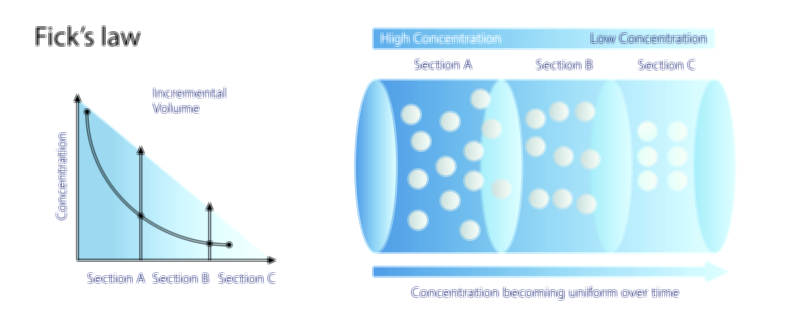
Fourier’s law can be understood as a statement that heat naturally attempts to eliminate temperature differences. Whenever a gradient exists—meaning the temperature varies from one point to another—the system responds by transferring thermal energy in such a way that the disparity is reduced. As heat flows, the gradient becomes smaller, gradually leading toward thermal equilibrium where temperature is uniform throughout the material. That equilibrium state represents a balance in which no net heat flow occurs because all regions possess the same thermal energy. The journey toward this equilibrium, shaped by the temperature gradient and the material’s internal structure, is precisely what Fourier’s Law describes. It establishes heat conduction not as a mysterious or arbitrary process but as a natural, spontaneous response of particles seeking to redistribute energy.
A key insight embedded in Fourier’s Law is that each material possesses an intrinsic property governing how effectively it conducts heat. This property, known conceptually as thermal conductivity, determines how readily energy can travel through the material. Substances such as metals have very high thermal conductivities because they contain free electrons that move rapidly and can transport thermal energy efficiently, allowing heat to spread quickly. In contrast, materials such as wood, plastic, wool, or rubber have low thermal conductivities because their structures impede the movement of vibrational energy, causing heat to travel slowly. This fundamental difference explains why touching a metal surface can feel much colder than touching a plastic surface at the same temperature. The metal rapidly draws heat away from your skin, while the plastic does so sluggishly. Fourier’s Law encapsulates the behavior of both efficient and inefficient conductors by linking the flow of heat to the material-specific ability to transmit energy.
However, the law is not merely about the speed or intensity of heat flow; it also describes the directional nature of conduction. Heat always flows from higher temperature to lower temperature, never the reverse, unless energy is supplied from an external source. This directional preference arises from the inherent asymmetry of microscopic energy interactions. Highly energized particles lose energy more easily to less-energized neighbors than the other way around, creating a net transfer that aligns with the gradient. This fundamental thermodynamic truth forms the basis of technological devices such as heat sinks, cooling systems, thermal insulation, and industrial furnaces. Engineers design these systems with an understanding that heat follows temperature gradients and that the rate of transfer can be shaped by controlling the material selection, thickness, geometry, and environmental conditions—all governed by the conceptual framework of Fourier’s Law.
Fourier’s Law also plays a major role in understanding natural phenomena. In Earth science and geology, heat conduction governs the movement of thermal energy from Earth’s hot interior toward the cooler surface. The slow but steady conduction of heat through layers of rock influences tectonic processes, geothermal gradients, and volcanic activity. In planetary science, conduction helps determine how planets cool over billions of years, influencing crust formation, internal convection, and magnetic field generation. Even in climate science, conduction plays a role in how heat moves through soil, ice, and ocean sediments, shaping temperature profiles that affect ecosystems and environmental stability. In all these contexts, Fourier’s Law provides a unifying lens that shows how temperature gradients drive thermal motion across vast scales.
In biological systems, conduction is essential for maintaining stable body temperatures. Heat moves from warmer regions, such as metabolically active organs, to cooler regions of skin or extremities. Conduction also governs heat exchange between living organisms and their environments. When a person touches a cold object, conduction transfers heat from the skin to the object, producing a sensation of cold. When touching something hot, conduction rapidly transfers heat into the skin, potentially leading to burns. These interactions highlight how closely human experience aligns with the underlying physics described by Fourier’s Law. In medical science, understanding conduction is vital for designing prosthetics, thermal therapeutic devices, incubators, and diagnostic tools that rely on controlled heat exchange.
In engineering, Fourier’s Law forms the foundation of thermal analysis for nearly every type of system. Heat exchangers rely on maximizing conduction across thin walls to transfer energy between fluids. Buildings depend on insulating materials with low thermal conductivity to reduce unwanted heat loss or heat gain. Electronics require heat sinks and thermal pathways to prevent overheating, ensuring that devices function safely and efficiently. In manufacturing, processes such as welding, casting, forging, and additive manufacturing depend on controlled heat flow to achieve desired material properties and structural integrity. Fourier’s Law allows engineers to compute, predict, and regulate heat conduction under a wide range of operating conditions, helping to design systems that perform reliably even when subjected to large temperature differences.
One of the most profound insights of Fourier’s Law is how it reveals the microscopic origins of macroscopic heat flow. At the atomic scale, solids consist of atoms arranged in lattices, vibrating and interacting due to their thermal energy. Heat conduction arises when these vibrations propagate as waves or when electrons carry thermal energy through the material. In metals, electrons dominate this process, allowing heat to move quickly. In nonmetals, lattice vibrations play a larger role. The structure, bonding, and arrangement of atoms influence how readily vibrations spread, shaping the macroscopic thermal properties that Fourier’s Law captures at a larger scale. This connection between microscopic structure and macroscopic behavior highlights the law’s deep physical significance.
Fourier’s Law also plays a central role in materials science, where developing new materials with controlled thermal properties is essential for advanced technologies. High-conductivity materials are sought for heat spreaders, energy systems, and electronics. Low-conductivity materials are essential for insulation, aerospace applications, and cryogenic environments. Nanomaterials, composites, and engineered surfaces can manipulate heat conduction in unprecedented ways, allowing researchers to tailor how energy flows at micro- and nanoscale dimensions. Although the details of conduction change at extremely small scales, the conceptual essence of Fourier’s Law continues to guide research by showing how heat moves in response to structure and gradients.
In environmental and energy systems, Fourier’s Law helps engineers design sustainable solutions. Solar thermal systems rely on conduction to transfer energy from collectors to storage systems. Geothermal heating and cooling systems depend on the slow but steady conduction of heat through soil and rock. Energy-efficient buildings use materials with carefully chosen thermal conductivities to minimize heat loss in winter and heat gain in summer. All these applications depend on understanding how heat flows naturally and how human-designed systems can either enhance or impede that flow for beneficial outcomes.
Beyond practical applications, Fourier’s Law carries conceptual clarity that helps explain why conduction feels intuitive even without formal training. Everyone has experienced heat moving from objects at different temperatures, whether by touching a warm cup, stepping barefoot onto a cold floor, or noticing how a metal handle becomes hot when near a heat source. These experiences reflect the fundamental truth that heat spreads from high-temperature regions to low-temperature regions until balance is achieved. Fourier’s Law formalizes this intuitive behavior and provides the conceptual structure that allows scientists and engineers to quantify, predict, and manipulate conduction in all its forms.
Ultimately, Fourier’s Law of Heat Conduction is far more than a statement about heat flow. It is a profound expression of nature’s tendency to distribute energy evenly, linking microscopic interactions with macroscopic behavior and unifying countless processes under a single physical principle. By examining this law through a detailed and richly descriptive narrative, one can appreciate the elegance of thermal conduction, the universality of temperature-driven energy flow, and the vast range of scientific, environmental, technological, and biological phenomena shaped by this foundational rule of heat transfer.