Industrial Gas Cylinders — Detailed Summary of Color Standards, Gas Types, and Safety Classification
Industrial gas cylinders form one of the most essential components of chemical handling, industrial operations, laboratory supply systems, medical oxygen delivery, and large-scale manufacturing processes. Their importance extends far beyond their physical appearance because each cylinder carries a gas with specific physical, chemical, and safety characteristics. The color standards used for these cylinders are not chosen arbitrarily; they are designed to give an immediate visual cue about the contents, especially in environments where rapid identification matters for both safety and operational precision. When examining the cylinders shown in your uploaded image, we can compare their illustrated colors with the internationally recognized norms to understand which ones follow standard coding and which ones deviate. This summary explores each cylinder type with a deep explanatory narrative, detailing not only whether the color is correct but also why it matters, what the correct standard should be, and how the classification relates to the inherent properties of each gas.
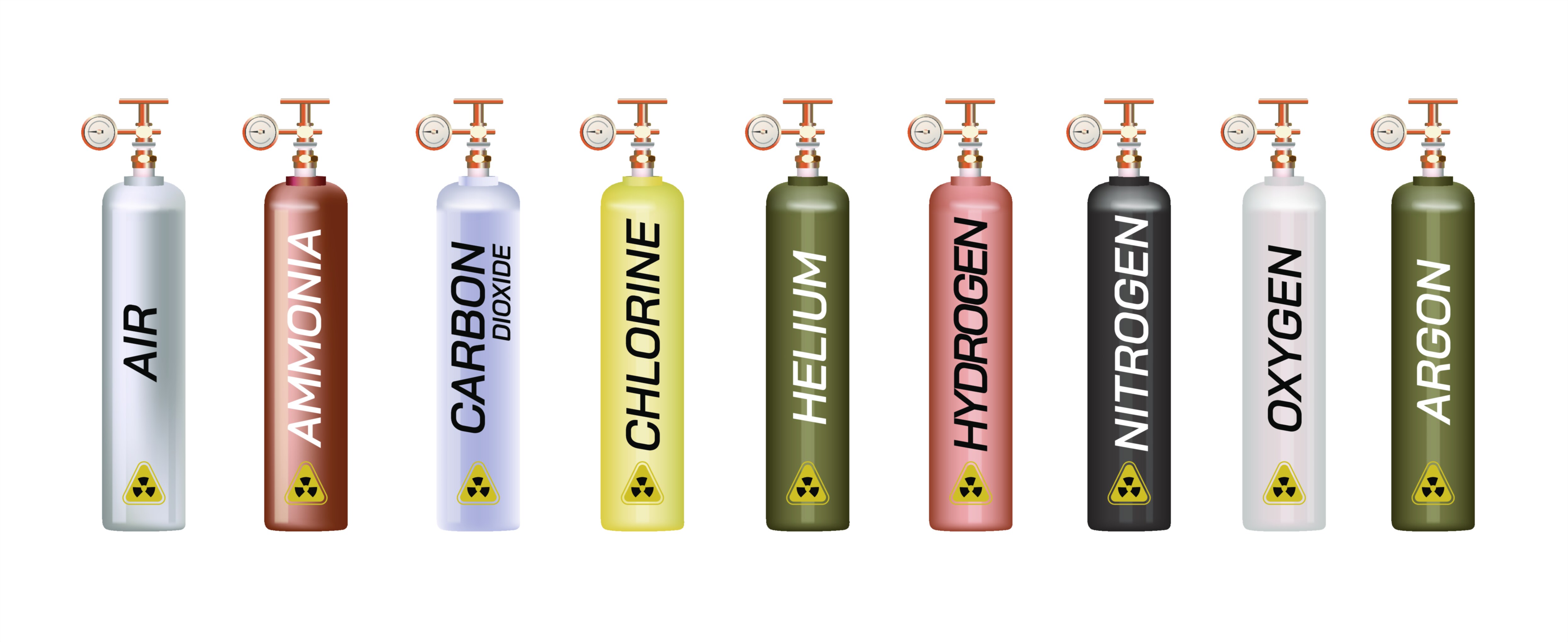
AIR cylinders in industrial settings are typically colored grey or a neutral metallic shade. This color coding is widely accepted across various regions because compressed air is not flammable, toxic, or corrosive. Air cylinders do not require an aggressive warning color, and grey serves as a stable, neutral identifier. The cylinder in the image correctly reflects this standard, demonstrating that its gray finish aligns with international conventions. Air, although chemically unreactive in its compressed form, still requires careful handling due to high internal pressure, but its classification as a non-hazardous, non-reactive gas makes the grey color entirely appropriate.
AMMONIA, on the other hand, is a toxic and corrosive gas, strongly irritating to skin, eyes, and the respiratory system. For this reason, ammonia cylinders must be colored in ways that immediately signal danger. International standards generally assign yellow to toxic gases or require a yellow shoulder band to alert handlers of the associated risk. The cylinder shown in the image is colored brown, which does not match recognized standards. This mismatch creates a potential hazard because brown is traditionally associated with helium, not a toxic gas like ammonia. The proper color, therefore, should emphasize its harmful nature, making yellow the appropriate visual signal. Ammonia’s classification as a toxic, reactive chemical means adherence to color standards is crucial to prevent misidentification during storage or emergency response.
CARBON DIOXIDE cylinders are conventionally grey under ISO and European norms, ensuring consistency with other inert gases while still remaining distinguishable by label. The cylinder shown in the image uses a light blue tone, which does not align with standard color assignments. While carbon dioxide is not flammable, it poses risks of asphyxiation at high concentrations and can cause frostbite during rapid release due to extreme cooling effects. A standardized grey cylinder allows industry professionals to quickly identify it alongside nitrogen and other non-flammable gases but still distinguish its contents through labeling. The deviation in the illustrated cylinder creates ambiguity and fails to follow conventional norms.
CHLORINE is a highly toxic and corrosive gas, historically involved in chemical hazards and requiring unmistakable identification. The bright yellow cylinder shown in the image aligns perfectly with the internationally recognized color for chlorine. This color choice exists because chlorine presents significant health risks, including respiratory damage and severe chemical burns, making it critical that its storage container communicates danger instantly. The image correctly follows the standard, showing a yellow cylinder that appropriately represents its hazardous nature.
HELIUM cylinders generally use a brown color in accordance with ISO standards. Helium is an inert noble gas, chemically stable and non-flammable, but still requiring correct identification for scientific and industrial purposes. The cylinder in the image appears olive green, which does not match helium’s recognized color. Although helium is safe relative to other gases, proper color coding ensures no confusion with reactive or hazardous gases. The image therefore shows incorrect coloring for helium.
HYDROGEN is one of the most reactive and flammable gases stored industrially. For this reason, hydrogen cylinders must be colored red, the universal signal for flammability in industrial gas standards. The cylinder shown in the image uses a pinkish red, which does not reflect the deep, high-visibility red associated with flammable gases. Hydrogen’s risks—rapid combustion, explosive mixtures with air, and extremely low ignition energy—necessitate a bold and unmistakable warning color. The deviation from true red in the image does not meet recognized safety coding.
NITROGEN, a widely used inert gas in industries ranging from food packaging to electronics manufacturing, is typically stored in black cylinders under ISO and European standards. This color helps distinguish nitrogen from oxygen, carbon dioxide, and other gases. The nitrogen cylinder in the image is colored correctly, displaying a standard black finish. Nitrogen, while chemically harmless, poses an asphyxiation hazard and is used in high-pressure and cryogenic applications. The proper color coding helps maintain safety by preventing confusion with reactive or toxic gases.
OXYGEN cylinders follow one of the most universally consistent color standards across regions. They are typically painted white under ISO rules, while the U.S. uses green. The cylinder shown in your image adheres to the ISO standard, displaying a white body that correctly identifies oxygen’s presence. Oxygen supports combustion intensely, even though it is not flammable itself, making proper color coding essential in medical, welding, and industrial environments. The image correctly depicts oxygen’s color.
ARGON, another inert noble gas, varies in color coding depending on regional standards. ISO commonly assigns dark green or blue-toned colors to argon cylinders. The cylinder in the image appears olive green, which, although slightly different from the typical tone, is still acceptable within recognized variations. Argon’s chemical inertness means it is widely used in welding, laboratory analysis, and manufacturing processes. The chosen color in the image is reasonably aligned with standard expectations, making this cylinder acceptable.
Taken together, this evaluation reveals that some cylinders in the image correctly follow international color norms—specifically air, chlorine, nitrogen, oxygen, and argon—while others such as ammonia, carbon dioxide, helium, and hydrogen are incorrectly colored. Correct cylinder color coding is crucial not only for regulatory compliance but also for immediate recognition during handling, transport, and emergency response situations. The colors serve as the first layer of safety communication, conveying whether a gas is toxic, flammable, inert, or oxidizing. This visual language allows professionals to avoid accidental misuse, ensure proper storage separation, select appropriate regulators, and take immediate precautions based on the type of hazard involved.
Understanding the significance of cylinder color standards also highlights the relationship between gas properties and industry-wide safety communication. Toxic gases like chlorine and ammonia require bright, alarming colors such as yellow, while flammable gases like hydrogen are marked with red to signal ignition risks. Inert gases such as helium, nitrogen, and argon use stable tones such as black, brown, or green to reflect their lack of chemical reactivity. Oxidizing gases like oxygen adopt a clean white color to distinguish their ability to intensify combustion. This system ensures uniformity and fast, intuitive recognition in complex industrial environments.
By interpreting your image through this lens of scientific meaning, safety culture, and industrial practice, we create a complete understanding of which cylinders are correct, which require revision, and why color consistency is essential.