Components of the Universe — Dark Matter, Dark Energy, and Cosmic Structure Explained
The universe presents itself as an immense, interconnected system composed of enigmatic forces, invisible substances, luminous matter, and vast structures stretching across unimaginable distances. When we try to understand what the universe is made of, we quickly discover that the familiar matter forming stars, planets, and living beings represents only a tiny fraction of the total cosmic inventory. The rest consists of elusive components that do not behave like ordinary matter, cannot be touched or seen directly, and yet exert profound influence over the evolution, structure, and ultimate fate of the cosmos. The concept of the universe’s components emerges from decades of observational astronomy, theoretical physics, and cosmology, revealing a universe where the visible parts are only surface features of a deeper, far more complex reality. A detailed exploration of these components—dark matter, dark energy, and ordinary matter—reveals an intricate cosmic tapestry shaped by forces that often surpass intuition, yet define everything from galaxy formation to cosmic expansion. Understanding these elements conceptually opens a window into the architecture of the universe and illuminates the subtle interactions that shape cosmic evolution.
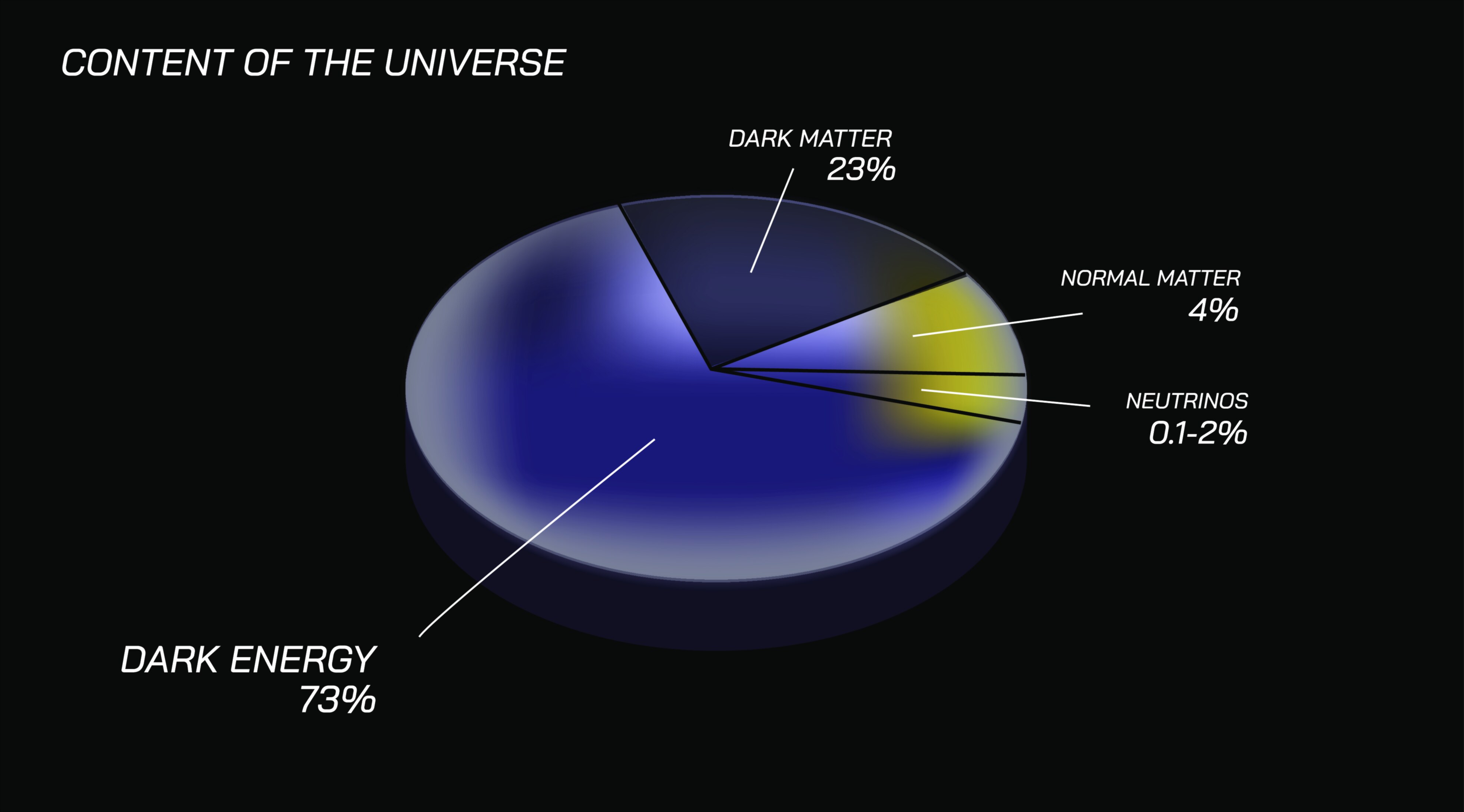
The most familiar part of the universe is ordinary, or baryonic, matter. This is the matter composed of atoms, protons, neutrons, and electrons—the substances that form stars, planets, gas clouds, dust grains, and all life. Despite being the only kind of matter humans can observe directly, this ordinary material makes up a surprisingly small portion of the cosmic total. It contributes only a minor fraction to the mass–energy budget of the universe. Even within this category, most ordinary matter is not found in dense forms like planets or stellar surfaces but exists as diffuse gas spread across interstellar and intergalactic space. The stars that light up galaxies account for only a small portion of the ordinary matter content. Much of this matter is so thinly distributed that a cubic meter of intergalactic space may contain only a few atoms. Yet, despite its relative scarcity, ordinary matter remains deeply important because it interacts with electromagnetic radiation, making it visible through telescopes and allowing astronomers to map cosmic structures. Ordinary matter also follows the familiar physical laws that govern atomic interactions, chemical bonding, thermodynamics, and nuclear reactions, influencing the internal life cycles of stars and the formation of complex structures like planets and organisms.
Even though ordinary matter provides the luminous skeleton of the universe, it is far from sufficient to explain the gravitational behavior observed in galaxies and galaxy clusters. Measurements of how galaxies rotate reveal that their outer stars move far faster than expected based solely on the amount of visible matter present. Similarly, galaxy clusters, which are vast families of galaxies held together by gravity, contain too much internal motion to remain bound unless an unseen gravitational source holds them together. These and other observations point to the existence of dark matter, an invisible component that interacts primarily through gravity. Dark matter does not emit light, absorb light, or reflect light, making it completely invisible to telescopes. Yet its gravitational presence is undeniable. It forms massive, extended halos around galaxies, shaping their rotation curves and stabilizing their structure. Without this unseen matter, galaxies like the Milky Way would not hold together; their visible components would simply scatter apart due to centrifugal forces.
The nature of dark matter remains one of the greatest mysteries in modern science. It is thought to consist of non-baryonic particles that do not interact through electromagnetic forces, meaning they do not form atoms or conventional chemical structures. Instead, they pass through ordinary matter with barely any interaction. Theoretical candidates for dark matter particles include weakly interacting massive particles, lighter particles with exotic properties, or other possibilities arising from extensions of known physics. Regardless of their true identity, dark matter’s role in cosmic structure formation is profound. During the early stages of the universe, tiny fluctuations in the distribution of dark matter acted as gravitational seeds around which ordinary matter gathered. These seeds gradually accumulated gas, eventually giving rise to the first stars and galaxies. The growth of cosmic structure—from small clumps of matter to galaxy clusters and larger cosmic filaments—reflects the underlying distribution of dark matter, which creates a vast, invisible scaffolding for the visible universe to assemble upon. Without dark matter, the cosmos would not contain the complex web of galaxies observed today, and the universe would appear far more uniform, lacking the rich variety of structures that define its character.
Yet even dark matter does not represent the dominant component of the universe. The largest share of the cosmic budget belongs to dark energy, a mysterious and pervasive phenomenon that drives the accelerated expansion of the universe. The discovery of dark energy emerged from observations of distant exploding stars known as supernovae. These supernovae serve as cosmic markers, allowing astronomers to measure distances and expansion rates with high precision. When researchers compared the expected rate of cosmic expansion with the observed data, they found that the universe was not slowing down as anticipated, but accelerating. This unexpected acceleration suggests the presence of a repulsive form of energy permeating all of space. Unlike gravity, which pulls matter together, dark energy pushes space itself outward, stretching the fabric of the cosmos. This continuous expansion affects everything on the largest scales, gradually increasing the distances between galaxies and shaping the universe’s long-term future.
Dark energy cannot be seen or measured directly, yet its effects dominate cosmic dynamics. One conceptual way to understand it is to consider it as a property of space itself. As space expands, the influence of dark energy remains constant or even increases, driving further expansion. This behavior stands in contrast to matter, whether ordinary or dark, which becomes less dense as the universe expands. Dark energy’s persistent, uniform presence ensures that its influence grows over time. Observations indicate that dark energy accounts for the majority of the universe’s total energy content. This immense dominance means that the fate of the cosmos hinges more on dark energy than on anything else. If dark energy maintains its current behavior, the universe will continue expanding indefinitely in a scenario often described as the “cold, dark future,” where galaxies drift apart until they become effectively isolated, and star formation gradually declines to nothing. If dark energy’s properties change, other possibilities arise, but in every case, this component plays the central role in shaping the cosmic trajectory.
The interplay between ordinary matter, dark matter, and dark energy forms the structural and dynamical framework of the universe. Ordinary matter responds to gravitational forces shaped by dark matter, settling into galaxies and clusters embedded within massive halos of invisible material. These galaxies are not scattered randomly but arranged along an intricate web of filaments, walls, and voids, often described as the cosmic web. Dark matter provides the gravitational backbone for this web, drawing matter into long strands and dense nodes where galaxy clusters form. The empty regions—vast cosmic voids—contain little matter of any kind, creating immense contrasts between the dense and sparse regions of the universe. Dark energy, acting on the largest scales, gradually stretches this cosmic web, widening the voids and increasing the distances between galaxy clusters, subtly reshaping the universe’s overall geometry.
Light traveling across the universe offers further evidence of this intricate structure. As light passes near massive concentrations of mass, it bends due to gravity in a process known as gravitational lensing. This bending of light not only creates distorted images of distant galaxies but also reveals the distribution of invisible dark matter. Through gravitational lensing, astronomers can map dark matter’s presence across cosmic scales, even though it emits no light. These maps demonstrate that dark matter dominates the mass content of all major cosmic structures, acting as the gravitational glue that binds galaxies and clusters together.
Meanwhile, the cosmic microwave background—the faint afterglow of the early universe—provides a snapshot of the universe when it was still very young. Subtle temperature variations in this ancient radiation reveal the distribution of matter and energy when the universe was only a few hundred thousand years old. These variations serve as the earliest seeds of cosmic structure, and analysis of this pattern confirms the proportions of ordinary matter, dark matter, and dark energy. The consistency between these early signatures and modern observations reinforces the idea that the universe’s composition has remained governed by these same components throughout its evolution.
Yet despite all these observations, the true nature of the universe’s dominant components remains elusive. Dark matter’s composition is still unknown, and dark energy remains even more puzzling. Scientists understand how these components behave but not what they fundamentally are. This duality—deep understanding of effects but deep mystery about causes—characterizes much of modern cosmology. The fact that the universe is composed mostly of invisible substances and unknown forces challenges our understanding of physics and pushes research toward new frontiers. Future discoveries may reveal that these components are manifestations of deeper physical principles, perhaps tied to quantum fields, modifications of gravity, or entirely unknown interactions.
The complexity of the universe’s components also reflects a deeper theme: what is visible is only a small part of what exists. Stars, nebulae, galaxies, and planets may dominate astronomical imagery, but they float within a vast cosmic framework shaped primarily by dark matter and governed by dark energy. Ordinary matter forms the familiar but minor structural surface, decorating a universe built from enigmas. The interplay between these components creates the cosmic drama unfolding over billions of years, determining how galaxies form, how they evolve, and how the universe itself expands.
Understanding the universe’s components provides not only scientific insight but also philosophical depth. It shows that the universe is far more than what can be seen, that reality contains layers beyond direct observation, and that science continually uncovers deeper structures beneath the surface. These discoveries challenge assumptions, expand knowledge, and inspire new ways of thinking about space, time, matter, and energy.
In the grand vision of cosmology, the universe emerges as a vast, dynamic entity shaped by the collaboration of the visible and invisible, the known and unknown. Dark matter constructs the scaffolding, ordinary matter fills in the luminous details, and dark energy guides the cosmic expansion. Together, they form a universe that is both mathematically elegant and profoundly mysterious, inviting continuous exploration and offering insight into the fundamental workings of reality itself.