Expansion of the Universe — Cosmic Growth, Space-Time, and Galaxy Movement Explained
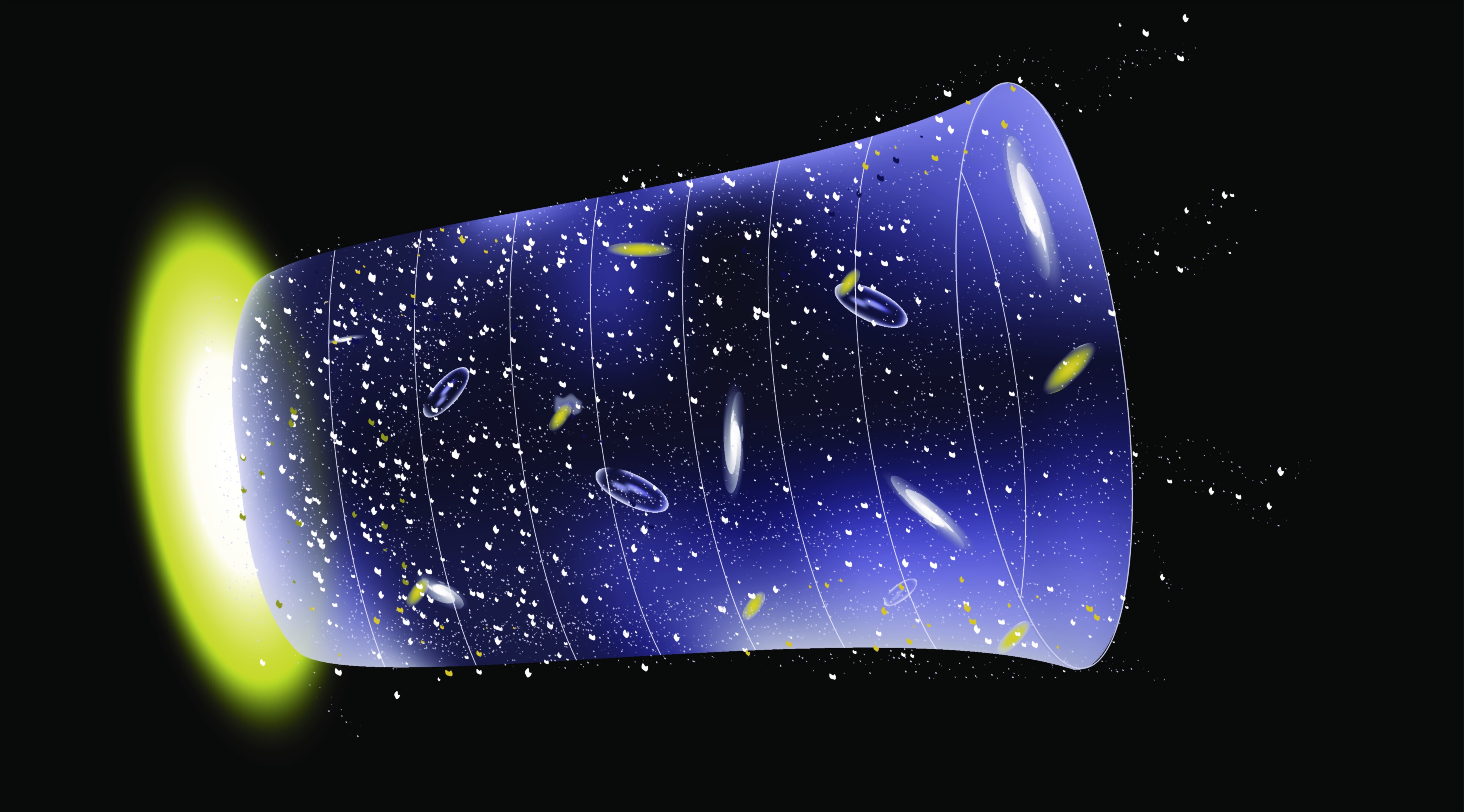
The expansion of the universe stands as one of the most extraordinary, transformative discoveries in modern science, revealing that the cosmos is not a static stage where galaxies sit motionless in an unchanging void, but a dynamic, evolving tapestry whose very fabric stretches, flows, and transforms over billions of years. When astronomers describe the expansion of the universe, they are not suggesting that galaxies are rushing outward into pre-existing space like fragments of an explosion; instead, they are describing a far more subtle and profound phenomenon in which space itself expands, carrying galaxies along as passengers on an ever-stretching cosmic ocean. This understanding rewrites the way we imagine the universe from its earliest moments to its distant future, showing that cosmic history is deeply tied to the behavior of space-time, the distribution of matter and energy, and the mysterious forces driving the acceleration of this expansion. A conceptual description of this process, even without equations or diagrams, brings to life the idea of cosmic growth and paints a vivid picture of a universe in constant motion.
The idea of an expanding universe first emerged when astronomers observed that distant galaxies appear to be moving away from us, their light stretched into longer wavelengths in a phenomenon known as redshift. The farther the galaxy, the more pronounced the redshift, implying not only motion but a systematic pattern that suggests expansion on the largest scales. This discovery, originally interpreted as galaxies fleeing through space, eventually led to a deeper realization: galaxies are not moving away because of explosive force, but because the space between them is increasing. The expansion is uniform, not centered around any particular point, meaning every galaxy sees every other galaxy receding. This revelation shattered earlier assumptions of a static cosmos and replaced them with the picture of a universe that has been expanding since its earliest moments, with all of space participating in a stretching that defines the geometry and evolution of the cosmos.
The expansion of space is not like the stretching of a rubber band or the blowing up of a balloon in a physical environment. Instead, space itself is the medium of expansion, and galaxies are embedded within it without needing to travel through it. As space expands, distances increase, and light traveling across those distances becomes stretched. This stretching of light provides cosmologists with a powerful observational tool for measuring how the universe has changed over time. When we observe distant galaxies, we effectively look back into cosmic history, because their light has traveled for billions of years to reach us. The redshift encoded in this light acts like a historical record, revealing how the expansion rate has evolved from the early universe to the present day. The cosmos thus becomes not just a spatial structure but a temporal narrative, unfolding through the movement of galaxies, the stretching of space, and the imprint of ancient light.
One of the most remarkable features of the universe's expansion is that it is not uniform in its effects on all scales. On very large scales—distances between galaxy clusters, superclusters, and cosmic filaments—the expansion dominates, steadily increasing the gaps between these immense structures. On smaller scales, however, gravitational forces overwhelm expansion. Galaxies remain gravitationally bound, and stars within a galaxy orbit the galactic center without drifting apart from expansion. Even smaller systems like planetary systems, moons, and atoms remain unaffected. This layered behavior illustrates how cosmic expansion operates as a large-scale phenomenon while leaving local structures intact. Expansion does not tear matter apart, because gravity and electromagnetic forces hold local systems together with far greater strength than the gentle stretching of the universe. Thus, while galaxies drift apart across millions of light-years, the Milky Way, the Solar System, and the atoms composing everyday matter remain stable amidst cosmic growth.
The concept of space-time plays a central role in understanding expansion. Space and time are not separate entities but are woven into a single fabric whose curvature and evolution depend on the distribution of matter and energy. This interconnected fabric shapes the movement of galaxies and determines the large-scale geometry of the universe. As space expands, so does time’s unfolding rate depend on cosmic conditions. In the early universe, space expanded rapidly during a period known as cosmic inflation, when growth accelerated at an astonishing pace. This inflationary epoch smoothed out the density irregularities in the universe and set the stage for the slower, more structured expansion that followed. After inflation, the universe continued to expand but at a rate influenced by the interactions of matter, radiation, and dark energy. Over billions of years, the relative influence of these components shifted, gradually changing the rate of expansion. This interplay writes the cosmic story in which space-time evolves from a simple, nearly uniform early state into a richly structured universe filled with galaxies, clusters, and cosmic filaments.
A key aspect of the universe’s expansion is that it is not only continuing but accelerating. The discovery of this acceleration marked a revolutionary turning point in cosmology. For decades, scientists assumed that gravity, which attracts matter, would slow the expansion over time. Yet observations of distant supernovae revealed something astonishing: the universe is expanding faster now than it was in the past. This implies the presence of a mysterious, repulsive force permeating space, often referred to as dark energy. Unlike matter, dark matter, or radiation, dark energy does not clump or compress; instead, it appears to act uniformly across the universe, pushing galaxies apart more forcefully as space expands. Its influence grows over time because, unlike matter which becomes more dilute with expansion, dark energy remains constant in density or may even increase depending on its precise nature. Thus, as the universe grows, dark energy takes on a greater role in its dynamics, driving the expansion faster and faster. Although dark energy remains one of the most profound mysteries in physics, its effect on cosmic expansion is unmistakable.
The accelerated expansion of the universe also influences its large-scale future. Because galaxies are moving away from each other at increasing speeds, the cosmic web of matter stretches gradually into a more diffuse network. Over immense timescales, galaxies outside our local group will recede so far and so quickly that their light will never reach us again, making the observable universe shrink even as the universe itself expands. Stars will age, galaxies will evolve, and the cosmic landscape will grow increasingly isolated. The far future of the universe may become a cold, dim place where matter is spread thinly and large-scale interactions diminish. This projection, often called the “long dark era,” reflects how deeply expansion shapes cosmic destiny. The universe’s growth is not just a physical process but a temporal journey that influences how much of the cosmos we can observe and how much cosmological structure survives into the distant future.
Despite the large-scale nature of expansion, it has subtle local effects that inform our understanding of cosmic history. The cosmic microwave background (CMB), the faint afterglow of the early universe, contains tiny temperature fluctuations that encode the imprint of expansion. The pattern of these fluctuations reveals how fast the early universe expanded, how matter and radiation interacted, and how dark matter shaped the formation of the first structures. The CMB provides a kind of fossil record of expansion, offering precise measurements of the universe’s age, composition, and geometry. Through these observations, scientists have developed an extraordinarily detailed picture of the universe’s growth from its earliest moments to the present day, showing how expansion has always been a defining property of cosmic evolution.
The notion of galaxies “moving away” in expansion is often misunderstood. In reality, galaxies behave more like stationary points within a stretchy fabric. If the fabric expands, the points separate even though they do not actively travel across its surface. This analogy highlights that expansion is not motion through space but the creation of more space between objects. As more space forms, light traveling across the universe takes longer to reach its destination, and its wavelength becomes stretched. This stretching produces the redshift cosmologists measure in distant galaxies. Thus, light itself becomes a witness to cosmic expansion, carrying the imprint of space-time stretching across billions of years and billions of light-years. Every photon we detect from distant galaxies is a messenger from a younger universe, delivering evidence of how space has grown in the time it took to traverse cosmic distances.
At cosmic scales, the expansion of the universe produces a vast network of structures known as the cosmic web, a pattern formed by the interplay of dark matter, ordinary matter, and gravitational forces. This web displays long filaments of galaxies separated by immense voids, and it reveals how expansion, while stretching space, has not erased structure but allowed it to grow. The cosmic web is not static; it evolves as the universe expands, with galaxies moving along filaments, clusters growing through gravitational attraction, and voids widening as dark energy drives the expansion forward. This cosmic architecture shows how the universe can expand and preserve structure simultaneously, guided by the balance between gravitational attraction and the stretching of space.
Understanding the expansion of the universe also requires grasping that it is uniform on the largest scales, meaning there is no center or edge to this growth. Every region of space expands in the same way when averaged over great distances. This uniformity is one of the most remarkable features of cosmology, emphasizing that no place in the universe is privileged. An observer in any galaxy would perceive all others as receding. This universality arises naturally from the idea that expansion is not an explosion from a central point but a stretching of the entire fabric of space. This realization reshapes the metaphors used to understand the universe, replacing explosion-based imagery with geometric and fabric-like interpretations that better match the behavior of space-time.
Ultimately, the expansion of the universe—driven first by cosmic inflation, later shaped by matter and radiation, and now dominated by dark energy—forms the backbone of cosmic evolution. It determines how galaxies form and move, how space stretches light, how cosmic structures emerge, and how the future of the universe unfolds. Expansion transforms the universe from a dense, hot early state into the vast, structured cosmos we observe today. Through this ongoing process, the universe continues to grow in scale, complexity, and diversity, revealing a reality where space and time are not static backgrounds but active participants in the cosmic story.
By understanding expansion not as simple outward motion but as the dynamic growth of space-time itself, one gains a deeper appreciation of the remarkable processes shaping the cosmos. The movement of galaxies, the pattern of cosmic structures, the transmission of ancient light, and the influence of dark energy all become interconnected aspects of a universe in perpetual transformation. Through this lens, expansion emerges as one of the most profound and beautiful ideas in cosmology—a living, evolving expression of the universe’s fundamental nature.