Kepler’s First Law of Planetary Motion — Elliptical Orbits and the Sun at One Focus
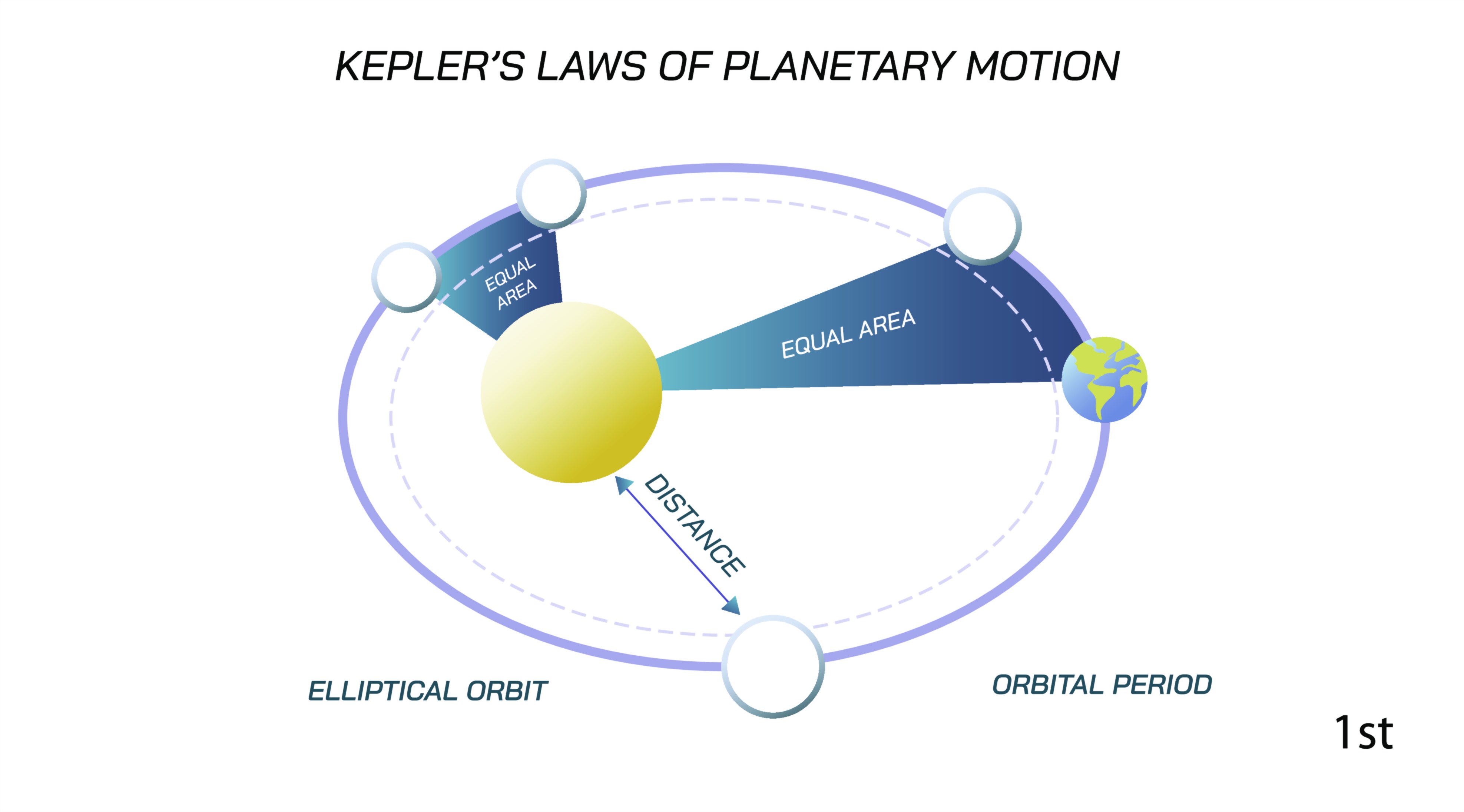
Kepler’s first law of planetary motion states that every planet moves around the Sun in an elliptical orbit with the Sun positioned at one of the two foci, and this concept completely reshaped humanity’s understanding of how celestial bodies travel through space. Before Kepler, the dominant belief was that planets followed perfect circular paths, an idea that persisted for centuries because circles were considered symbols of heavenly perfection. However, observational data collected by Tycho Brahe did not match the predictions of circular orbits, and Kepler, after years of complex mathematical analysis, realized that only ellipses — not circles — could explain the motion of planets accurately. A vector illustration of this law typically shows an elongated closed curve representing an ellipse, with the Sun placed off-center at one focus, helping learners instantly understand that planets do not orbit with the Sun at the geometric center but instead follow a stretched and asymmetrical path governed by gravitational attraction and geometric balance.
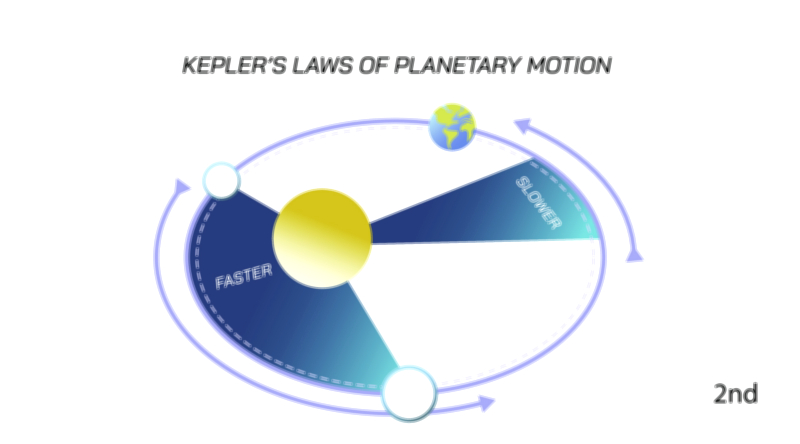
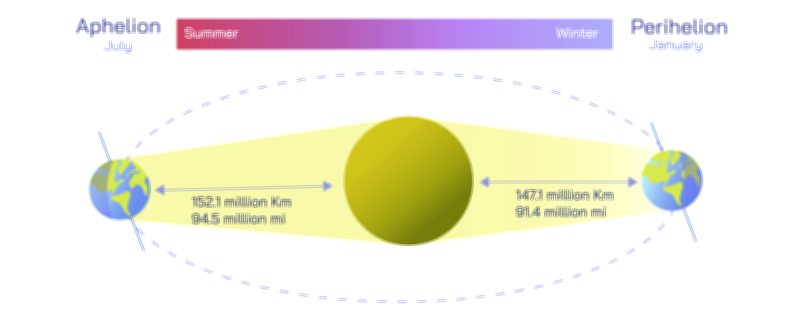
The elliptical nature of orbits means that the distance between a planet and the Sun changes continuously as the planet travels along its path. When the planet is at the point in its orbit closest to the Sun, known as perihelion, gravitational attraction is strongest and the planet experiences increased orbital speed. When the planet reaches the farthest point, called aphelion, gravitational attraction weakens and the planet travels more slowly. This shifting distance and changing speed do not break the stability of the orbit; instead, they are part of a precise geometric and dynamical pattern that ensures the planet remains bound to the Sun. The vector illustration of Kepler’s first law reflects this relationship by using arrows of varying lengths to show faster and slower motion along the ellipse, giving learners a visual pathway into understanding how gravitational forces influence movement without requiring mathematical equations.
Kepler’s first law also introduced a revolutionary notion about the structure of the universe: the Sun, rather than Earth or any other body, occupies the dominant gravitational position in the solar system. The shift from Earth-centered (geocentric) thinking to Sun-centered (heliocentric) thinking was more than philosophical — it marked a transformation in how scientific truth was understood. The placement of the Sun at one focus rather than at the exact center of the orbital shape demonstrated that the solar system is governed not by mystical perfection but by physical laws expressed through geometry. Even though an ellipse may appear only slightly elongated for many planetary orbits, the difference between a circular path and an elliptical path is essential to accurately predict planetary positions. When educational diagrams display the Sun off to one side in the elliptical orbit rather than in the middle, they visually dismantle the old circular model that dominated astronomy for centuries.
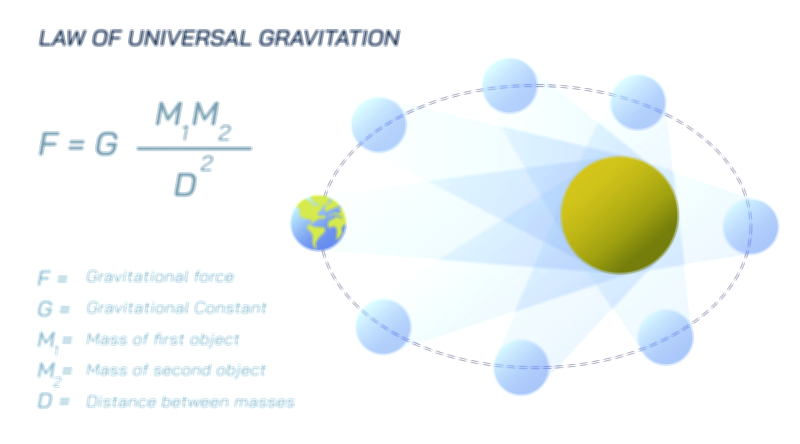
The elegance of Kepler’s first law lies not only in its descriptive truth but also in its predictive power. Once the elliptical nature of orbits was understood, astronomers could predict the position of planets more accurately than ever before, resolving timing inconsistencies that had frustrated astronomers for generations. The law demonstrated that the heavens are governed by consistent principles rather than unpredictable wandering. This predictability later inspired Isaac Newton to formulate the law of universal gravitation, recognizing that the elliptical shape of orbits is a direct consequence of the gravitational force between the Sun and each planet. In a very real sense, Kepler’s first law opened the doorway to gravity-based physics, as Newton built on the law’s geometric truth to explain the cause behind the shape of orbits rather than merely describing the shape itself.
Beyond the solar system, Kepler’s first law extends to moons orbiting planets, dwarf planets such as Pluto, asteroids traveling through the inner and outer solar system, and exoplanets orbiting distant stars. Modern astrophysics uses this principle to identify planets around other stars by measuring how the stars move in response to orbiting bodies. The elliptical model plays a key role in space exploration as well: spacecraft do not travel in circles but in ellipses when moving from one orbital distance to another. Engineers planning satellite deployment, gravity-assist maneuvers, and interplanetary missions rely on the geometry expressed in Kepler’s law. Whenever a spacecraft transitions between planets or enters an orbit, it traces an ellipse shaped by gravitational fields — the same geometry that guides natural planetary motion.
In terms of astronomy education, Kepler’s first law helps students connect orbital motion with the forces of nature rather than imagining planets sliding around the Sun in idealized rings. Vector illustrations that clearly label the long axis (major axis), the short axis (minor axis), the Sun at one focus, and the orbital path give students powerful structural clarity, helping them see that orbit shapes are purposeful and not arbitrary. For example, while Earth’s orbit is only mildly elliptical and visually close to circular, Mars and Mercury show more noticeable ellipticity, and many exoplanets have ellipses with dramatic stretching. Representing this varying eccentricity in diagrams shows learners that orbital shapes differ widely across the universe and that circular orbits are actually the exception rather than the rule.
Kepler’s discovery also alters how we perceive the harmony of space. The elliptical orbit is not imperfect — it is the natural expression of how a body behaves when pulled continuously toward a single attracting center while moving tangentially at speed. The stretch of the ellipse represents the balance between inertia and gravitational pull, and the planet remains in a graceful, predictable cycle as a result. When the orbit is drawn visually, it transforms celestial motion from an abstract idea into an elegant pattern: a closed, stable curve in which distance changes but overall equilibrium remains intact. This pattern emphasizes that orbital stability comes not from static positioning but from dynamic exchange between speed and gravitational influence.
Ultimately, Kepler’s first law marks the beginning of scientific orbital mechanics, transforming astronomy from descriptive sky-watching into a physics-driven study of motion. It reveals that celestial bodies move not randomly but according to geometry shaped by natural forces. When rendered through a vector illustration, the law becomes clearer than words alone could express, because it allows learners to see the Sun at one focus, the elongated orbital path, and the varying distance that defines the motion. It builds intuition about how planets travel, why they do not drift away into space, and why they do not fall into the Sun. When students understand this law visually, they unlock the foundation for deeper comprehension of gravity, motion, time, and the cosmic order that governs the solar system and the universe beyond.