Flight Wing Types — Aircraft Wing Designs and Aerodynamic Efficiency
Understanding the Importance of Wing Types in Aircraft Design
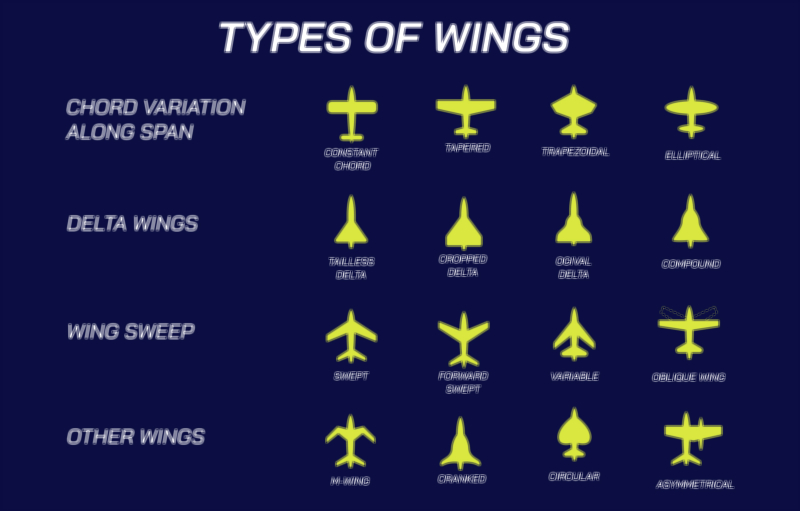
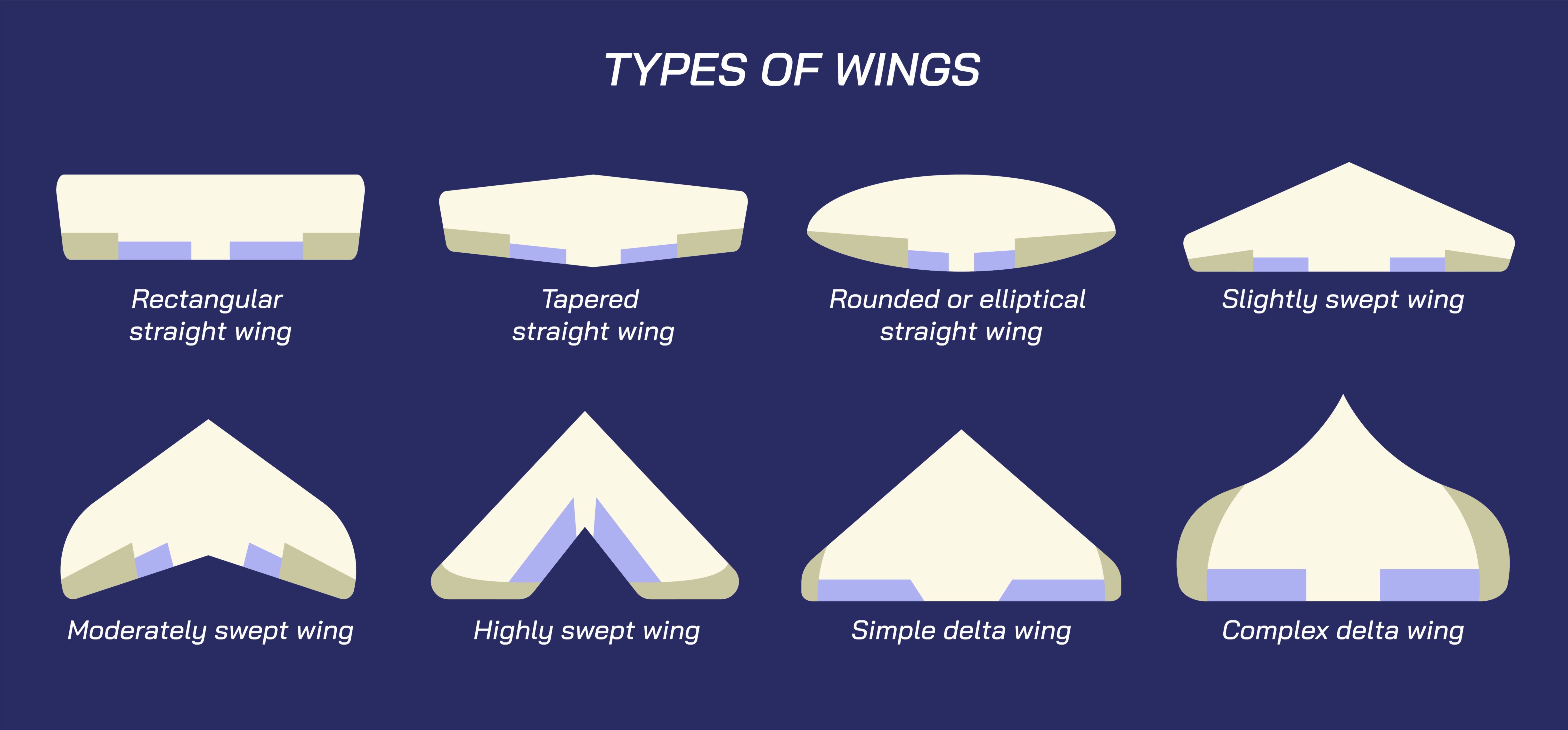
Aircraft wings are engineered with one primary goal: to manipulate airflow in a way that generates lift efficiently while minimizing drag and maintaining stability. Every wing design reflects a series of aerodynamic compromises and optimizations tailored to the aircraft’s mission, whether that mission involves slow and steady gliding, supersonic speeds, extreme maneuverability, or long-endurance cruising. Wing types evolve not only from aerodynamic theory but also from structural engineering, materials science, and operational requirements. As a result, the world of aviation features a rich variety of wing geometries—each optimized for specific flight conditions. A vector illustration depicting flight wing types often shows these shapes side by side, allowing viewers to compare their aerodynamic characteristics visually. Understanding these wing types reveals how aircraft achieve the right balance between lift, drag, weight, and control, demonstrating the refined engineering that makes modern aviation possible.
Straight Wings — Best for Low-Speed Flight and Stability
Straight wings extend outward from the fuselage at little or no sweep angle, and they are among the earliest and most practical wing shapes. Their broad, rectangular or slightly tapered surfaces generate considerable lift at low speeds, making them ideal for training aircraft, bush planes, gliders, and small private planes. Straight wings provide gentle stall characteristics and maintain stable airflow even at modest angles of attack, giving pilots predictable and forgiving handling. They also support short takeoff and landing capabilities because they do not require high speed to generate sufficient lift. However, these benefits come at the cost of higher drag at high speeds, limiting their use in modern commercial jets or military aircraft designed for rapid travel. Vector illustrations often depict straight wings with airflow lines that gently curve over their surfaces, highlighting their slow-flight efficiency and simplicity.
Swept Wings — Engineered for High-Speed and Transonic Efficiency
Swept wings lean backward from the fuselage, reducing the effective airflow velocity across the wing and delaying the formation of shockwaves as the aircraft approaches transonic and supersonic speeds. This design reduces wave drag—one of the most significant forms of resistance at high velocity—and allows commercial jets and fighters to cruise smoothly near or above the speed of sound. Swept wings enhance high-speed performance but require advanced aerodynamic features at lower speeds, such as flaps, slats, and spoilers, to generate sufficient lift during takeoff and landing. Their handling at low speed is more demanding, but their efficiency at altitude makes them indispensable for high-performance aircraft. In vector diagrams, swept wings usually appear angled backward, with airflow vectors showing how the wing geometry helps moderate compressibility effects.
Delta Wings — Strong, Versatile, and Ideal for Supersonic Flight
Delta wings, shaped like broad triangles with wide root chords and swept leading edges, are designed for stability, structural strength, and efficient supersonic performance. Their geometry distributes aerodynamic loads across a large surface area, making them highly resistant to the tremendous pressures experienced at high Mach numbers. Delta wings are favored in aircraft like the Concorde and multiple generations of fighter jets because they generate robust lift through powerful leading-edge vortices—spiraling airflow patterns that enhance stability during steep climbs or high angles of attack. At lower speeds, delta wings tend to produce more drag and require higher landing speeds, but their agility, strength, and supersonic capability make them invaluable for high-performance aviation. A vector illustration often highlights the triangular planform and vortex formation patterns characteristic of delta wings.
Tapered and Elliptical Wings — Designed for Efficiency and Reduced Drag
Tapered wings reduce gradually from root to tip, lowering induced drag and improving cruise efficiency. They offer a balanced blend of performance, structural simplicity, and aerodynamic smoothness, making them popular in general aviation aircraft, business jets, and smaller commercial planes. Elliptical wings, by contrast, offer near-perfect lift distribution and minimal turbulence at the wingtips, giving them unmatched aerodynamic efficiency. However, elliptical wings are challenging and expensive to manufacture due to their continuous curves, limiting their appearance mainly to iconic aircraft such as the World War II-era Spitfire. In vector illustrations, these wings are depicted with smooth, narrowing outlines that visually express their drag-reduction characteristics.
High-Aspect-Ratio Wings — Maximizing Lift and Endurance
High-aspect-ratio wings, which are long and slender, excel in reducing induced drag and improving glide efficiency. They appear on gliders, high-altitude research planes, long-endurance drones, and solar-powered aircraft. Their extended span enables them to generate ample lift with minimal power consumption, making them essential for missions that require exceptional fuel efficiency or extended loiter time. However, their long wingspans subject them to high structural bending loads, requiring advanced materials and internal reinforcement. Vector diagrams typically depict high-aspect-ratio wings as elongated and narrow, showing how airflow remains smooth and energy-efficient across their length.
Low-Aspect-Ratio Wings — Compact, Strong, and Highly Maneuverable
Low-aspect-ratio wings are wide and short, giving them high structural strength and rapid roll capability. These qualities make them ideal for aerobatic aircraft, fighter jets, and supersonic designs where maneuverability and durability are more important than low-speed efficiency. Because of their compact shape, they produce higher induced drag at low speeds, but their superior handling at high speeds compensates for this limitation. These wings allow aircraft to make sharp turns, withstand heavy G-forces, and maintain agility in tight aerial maneuvers. In vector illustrations, low-aspect-ratio wings appear bold and compact, symbolizing their strength and maneuvering capability.
Wing Position Variations — High-Wing, Mid-Wing, and Low-Wing Configurations
The vertical placement of wings on the fuselage profoundly affects aircraft stability and handling. High-wing aircraft provide excellent inherent stability and downward visibility, making them suitable for transport aircraft, bush planes, and cargo platforms. Low-wing aircraft, more common in modern commercial and private aviation, offer improved roll control, streamlined aerodynamics, and easier landing gear design. Mid-wing configurations place the wings exactly at the aircraft’s centerline, balancing maneuverability and aerodynamic symmetry, especially in aerobatic and military aircraft. Vector illustrations frequently place these wing positions on simplified fuselage diagrams to show how location influences performance characteristics.
Advanced Wing Concepts — Forward-Swept Wings, Variable-Sweep Wings, and Canard Designs
Forward-swept wings provide exceptional control and maintain airflow attachment even at high angles of attack, though they require advanced materials to resist twisting forces. Variable-sweep wings, or swing wings, allow aircraft to change their geometry in flight—extending for low-speed lift and sweeping back for high-speed efficiency. These wings highlight remarkable engineering ingenuity, enabling aircraft to perform diverse missions with optimal aerodynamics. Canard wings, located ahead of the main wing, help reduce stall risk and improve pitch control by generating lift at the front of the aircraft. These advanced designs represent the cutting-edge of aerodynamic innovation and often appear in vector diagrams to illustrate their unique and futuristic geometry.
Illustrating Wing Types and Aerodynamic Efficiency Through Vector Graphics
A vector illustration comparing different aircraft wing types typically presents each wing shape with clean, simplified outlines accompanied by airflow lines that show how lift and drag behave across the surface. These illustrations make it easy to distinguish between shapes, understand aerodynamic performance differences, and appreciate the engineering behind wing placement and geometry. Such visuals serve as powerful educational tools, translating complex aerodynamic theory into intuitive, accessible graphics that showcase the science of flight.