Amdahl’s Law — Parallel Computing and Speedup Limitation Explained
Understanding the Foundation of Amdahl’s Law in Parallel Computing
Amdahl’s Law is a fundamental principle in computer science and high-performance computing that explains why parallel processing, despite its tremendous potential, cannot provide unlimited speedup. Formulated by Gene Amdahl in 1967, the law establishes a relationship between the fraction of a program that can be parallelized and the maximum improvement one can achieve by adding more processors. At its core lies an elegant but sometimes sobering insight: every computational task contains portions that are inherently sequential—steps that must be executed one after another without the possibility of parallel execution. No matter how many processors or computational units are added, these sequential sections limit the program’s maximum speedup. Amdahl’s Law therefore reveals that parallel computing is ultimately constrained by the smallest non-parallelizable components, and even with infinite processors, overall performance can never exceed the ceiling imposed by these serial parts. This law underpins the design of modern multicore systems, distributed computing frameworks, and supercomputing architectures, reminding engineers that efficiency depends not only on raw hardware power but also on the structure and inherent parallelism of the algorithms themselves.
Sequential and Parallel Fractions of a Program and How They Shape Speedup
To understand Amdahl’s Law in depth, one must examine how a program’s total execution time can be divided into two distinct components: the portion that can run concurrently across multiple processors and the portion that must remain strictly sequential. The sequential part often consists of initialization phases, shared resource access, dependent operations, and algorithmic steps that require results from earlier computations. The parallel part encompasses tasks that can run independently, such as processing different data chunks, performing identical operations across distributed elements, or splitting large workloads among multiple nodes. Amdahl’s Law highlights that even if the parallel section is large, the sequential part becomes the unavoidable performance bottleneck. As processors increase, the execution time of the parallel section shrinks, but the sequential component remains unchanged, dominating the program’s runtime and preventing further speedup. This dynamic explains why real-world applications often experience diminishing returns as parallelism increases, especially when synchronization, memory access conflicts, and communication overheads reduce the effective parallelizable fraction. Amdahl’s Law therefore teaches that improving the serial portion of code is just as important as adding more processors to accelerate the parallel portion.
The Concept of Speedup and the Fundamental Limitation Described by Amdahl
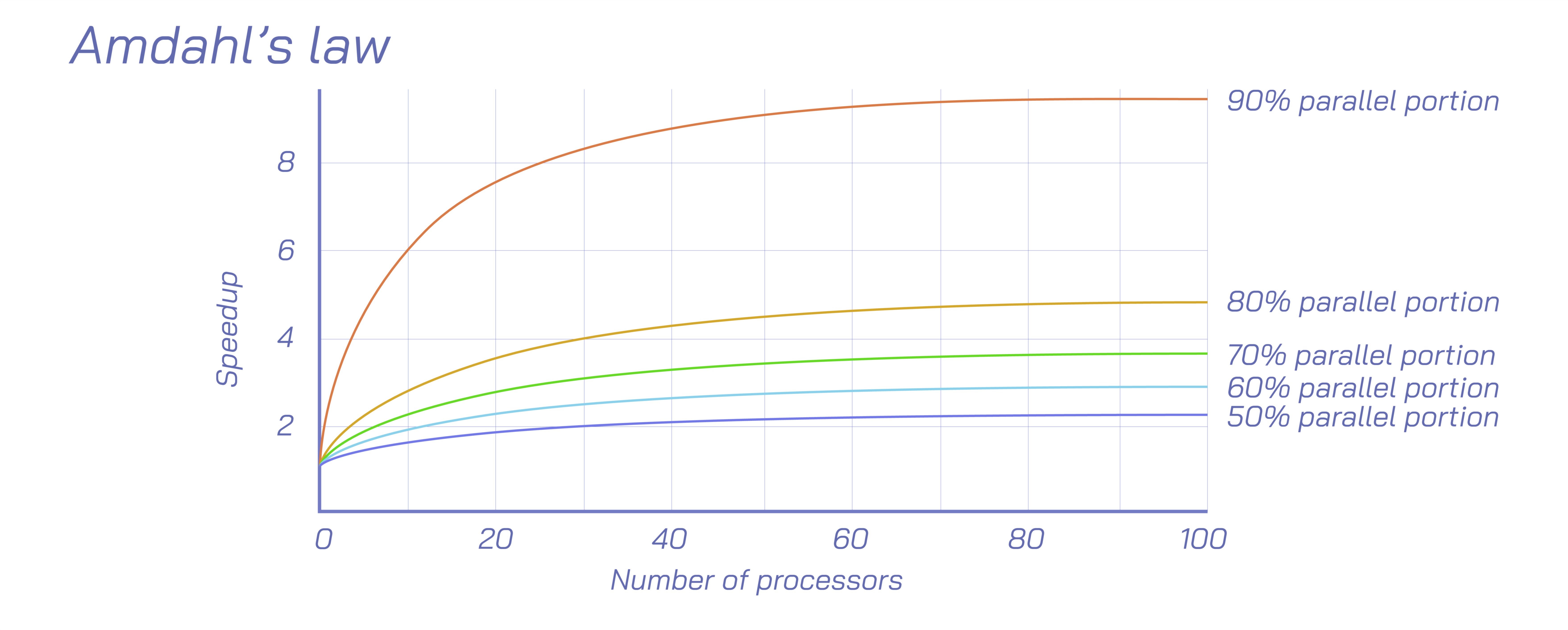
The idea of “speedup” in parallel computing refers to how much faster a program runs on multiple processors compared to a single processor. Ideally, one might expect that doubling the number of processors would double performance, or that a hundred processors would yield a hundredfold acceleration. But Amdahl’s Law shows that such linear speedup is nearly impossible in practice because the sequential section of the program forms a hard limit. If, for example, ten percent of a program is sequential, then no matter how many processors are added, the speedup cannot exceed a tenfold improvement because that ten percent will always require the same execution time. As the parallel part becomes increasingly fast, the sequential part begins to dominate the runtime, creating diminishing returns that flatten the speedup curve. Parallel computing performance charts often illustrate this gradual plateau, showing how speedup rises sharply with a small number of processors but then slowly tapers off into near-horizontal asymptotes. These curves visually express the central message of Amdahl’s Law—that parallel computing has a practical ceiling determined not by hardware power but by the structure of the computation itself.
Impact on Multicore, Distributed Systems, and High-Performance Computing
Amdahl’s Law plays an influential role in shaping modern computing system design, from personal devices with multicore processors to large-scale supercomputers operating with tens of thousands of nodes. As hardware manufacturers continue increasing the number of cores, the law highlights that software must evolve to exploit this parallelism effectively. If programs cannot be parallelized sufficiently, additional cores provide little improvement. This insight drives research into parallel algorithms, concurrent data structures, lock-free programming, and task decomposition strategies that minimize sequential bottlenecks. In distributed computing environments—such as clusters, cloud platforms, and massively parallel systems—Amdahl’s Law emphasizes the need to reduce synchronization barriers, communication delays, and serialized administrative operations. Load balancing, data partitioning, and minimizing inter-node dependencies become essential to achieving meaningful speedup. For supercomputing, where workloads often involve massive data processing or scientific simulations, Amdahl’s Law reminds architects that system-wide speed depends as much on removing serial elements—such as shared memory access delays or communication bottlenecks—as on adding more compute nodes.
Complementary Perspectives: Amdahl Versus Gustafson and Scalability Insights
Although Amdahl’s Law describes limitations in strong scaling—running the same problem on more processors—it is not the only perspective in parallel computing. In practice, many large-scale computations increase problem size as more processors become available, producing the conditions for Gustafson’s Law, which suggests that speedup can grow with workload size. Amdahl’s Law remains crucial, however, because it addresses theoretical maximum speedup for fixed-size tasks and exposes the sequential bottlenecks that restrict performance regardless of problem scaling. By combining both viewpoints, engineers gain a fuller understanding of parallel computing behavior: Amdahl reveals the upper limit for fixed workloads, while Gustafson explains how larger workloads can effectively utilize greater computational power. Together, they shape realistic expectations about scalability, performance engineering, and algorithm design.
Visualization of Amdahl’s Law Through Vector Illustration
A vector illustration of Amdahl’s Law typically includes a graph showing speedup on the vertical axis and number of processors on the horizontal axis. The curve rises quickly at first and then gradually levels off, illustrating diminishing returns as processors increase. Diagrams often highlight different fractions of parallelizable code—for example, 50%, 75%, 90%, or 95%—each producing a distinct speedup curve with its own asymptotic limit. Additional visual elements may show how the sequential portion acts as a horizontal barrier that even infinite processors cannot surpass. Some diagrams illustrate the program’s composition with colored segments representing parallel and sequential fractions, visually demonstrating how the sequential slice constrains total performance. These illustrations help viewers connect abstract mathematical principles to intuitive, easy-to-grasp visual patterns that reveal why parallel computing faces inherent limits.