Types of Flight Wings — Aircraft Wing Designs and Aerodynamics Explained
Understanding the Purpose of Aircraft Wing Designs in Aerodynamics
Aircraft wings are the defining structures that allow airplanes to generate lift and sustain controlled flight. Although the basic principle of lift remains the same—that air moving faster over the wing creates lower pressure compared to the slower-moving air below—different wing designs manipulate airflow in unique ways to serve distinct aerodynamic goals. Throughout aviation history, engineers have developed a wide variety of wing shapes, angles, surface contours, and structural layouts to optimize different forms of flying, from slow gliding to high-speed jet travel and extreme maneuverability. Each wing type reflects trade-offs between lift, drag, stability, fuel efficiency, and structural weight, meaning there is no universally perfect wing design; instead, designers choose configurations based on mission needs, performance requirements, and environmental conditions. Understanding these wing types reveals how aerodynamics shapes modern aviation and how subtle changes in geometry can profoundly influence aircraft behavior in the sky.
Straight Wings and Their Role in Low-Speed Stability
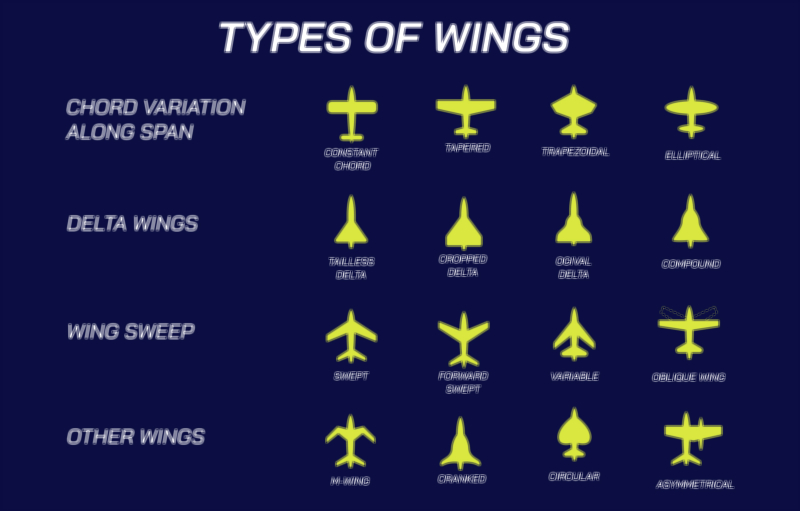
One of the most common and historically earliest wing designs is the straight wing, found in general aviation aircraft, gliders, and early commercial planes. These wings extend out perpendicular or nearly perpendicular to the aircraft’s fuselage, providing excellent lift at low speeds and remarkable stability during takeoff, landing, and slow maneuvering. Straight wings encourage smooth airflow and maintain lift even at low angles of attack, making them well-suited for small private planes, training aircraft, and bush planes that must take off or land on short runways. While straight wings excel in low-speed efficiency, they generate significant drag at higher speeds due to increased air resistance along the wing’s leading edge. As a result, they are prized for simplicity and predictable handling but less suited for high-performance or high-speed flight demands.
Swept Wings and Their Influence on High-Speed Aerodynamics
Swept wings are angled backward from the fuselage, creating a distinctive streamlined shape essential for high-speed jet aircraft. This sweeping motion delays the onset of shockwaves that occur as aircraft approach transonic or supersonic speeds, effectively reducing wave drag. By sweeping the wings, the airflow over the wing encounters a reduced effective velocity, allowing planes to fly faster before reaching aerodynamic limits. Commercial jets, fighter planes, and high-altitude aircraft commonly use swept wings to balance lift, drag, and maneuverability. While swept wings improve performance at high speeds, they can reduce stability at low speeds, requiring high-lift devices like flaps and slats during takeoff and landing. Swept wings represent a compromise that enables modern jets to reach high velocities efficiently while maintaining controlled aerodynamic performance.
Delta Wings and Their Power in Supersonic Flight
Delta wings, shaped like large triangular surfaces, are iconic in supersonic aircraft such as the Concorde and various fighter jets. Their broad, swept-back design spreads the pressure distribution over a large area, which is crucial for maintaining stability and lift when traveling faster than sound. At high speeds, delta wings produce strong leading-edge vortices—spiral airflow structures that enhance lift during sharp maneuvers or steep angles of attack. These wings are structurally strong and capable of handling extreme aerodynamic loads without requiring complex mechanisms. However, delta wings typically require higher landing speeds and may experience reduced efficiency during low-speed flight. Their design reflects a specialized aerodynamic strategy that prioritizes strength, stability, and high-speed lift generation over low-speed performance.
Elliptical and Tapered Wings for Efficiency and Reduced Drag
Elliptical wings, once famously used on aircraft like the Supermarine Spitfire, are designed so that lift distribution along the wingspan matches the ideal theoretical shape, minimizing induced drag. Their smooth, rounded wingtips create highly efficient airflow patterns that reduce turbulence and improve fuel efficiency. Tapered wings, more practical for modern construction, maintain a wider chord at the root and narrower chord at the tip, approximating the aerodynamic benefits of elliptical wings while simplifying manufacturing. Both designs improve climb rates, maneuverability, and drag characteristics, making them popular for sport aircraft, gliders, and efficiency-optimized military planes. These wing shapes demonstrate how subtle geometric refinements can achieve near-ideal aerodynamic performance without relying on high-speed design principles.
Variable-Sweep (Swing) Wings for Multi-Mode Flight Capabilities
Variable-sweep wings, also known as swing wings, are engineering marvels that allow pilots to adjust the wing’s angle mid-flight. Aircraft such as the F-14 Tomcat and the B-1 Lancer use this system to adapt to multiple flight regimes. When flying at low speeds, the wings extend outward, resembling straight wings to provide maximum lift and stability. At high speeds, the wings sweep back sharply to reduce drag and support supersonic performance. This adaptability allows a single aircraft to excel in diverse missions, from tight carrier landings to high-speed intercept maneuvers. Although complex and mechanically heavy, swing wings represent aerodynamics at its most flexible and innovative, blending low-speed and high-speed capabilities into one dynamic system.
High-Lift Wings Designed for Specialized Conditions
Aircraft operating in unique environments often rely on specialized high-lift wings. STOL (Short Takeoff and Landing) aircraft use wings with large surface areas, advanced flaps, and slats to generate massive lift during low-speed operations, ideal for mountainous regions, remote airstrips, and rescue missions. High-aspect-ratio wings, long and narrow in shape, enhance aerodynamic efficiency by reducing induced drag—making them ideal for gliders, solar-powered aircraft, and long-endurance drones. Canard configurations, where smaller forward wings assist with lift and stability, shift aerodynamic pressure in beneficial ways, allowing for stall-resistant designs. These adaptations demonstrate how wing geometry can be tailored to specific aerodynamic goals beyond conventional flight parameters.
Applications of Wing Design in Modern Engineering and Aviation
Wing design affects nearly every aspect of an aircraft’s performance—fuel consumption, cruising speed, agility, climb rate, and safety. Commercial aviation relies heavily on swept wings to balance speed and efficiency for long-distance travel. Military aircraft benefit from delta, canard, or variable-sweep designs that enhance maneuverability and stability during intense operations. Experimental and research aircraft frequently use high-aspect-ratio or blended-wing-body designs to push the limits of efficiency and environmental performance. Even unmanned aerial vehicles—ranging from small hobby drones to sophisticated surveillance systems—apply specialized wing configurations optimized for endurance, stealth, or rapid response. Across every sector, wing design remains a defining engineering decision that shapes the aircraft’s capabilities from takeoff to landing.
Illustrating Aircraft Wing Types Through Vector Graphics
A vector illustration of wing types typically showcases multiple wing shapes in comparison—straight wings, swept wings, delta wings, tapered wings, elliptical wings, and swing wings—each displayed with simplified aerodynamic outlines. Visuals may include airflow patterns depicting lift generation, vortex behavior on delta wings, or drag reduction on tapered shapes. Additional diagrams often show how wing angle changes in variable-sweep aircraft, or how leading-edge devices extend on high-lift wings. These clear, stylized illustrations help viewers understand how geometry, angle, and design intent directly influence aerodynamic performance, making the complex science of flight more intuitive and visually accessible.