Zeroth Law of Thermodynamics — Principle of Thermal Equilibrium
Understanding the Foundational Meaning of the Zeroth Law
The Zeroth Law of Thermodynamics stands as one of the most fundamental and intuitive principles in physics, establishing the very basis for how temperature is defined, measured, and compared across different systems. Although it was named after the First and Second Laws had already been formalized, scientists later realized that this principle was even more foundational and should logically precede the others. The Zeroth Law states that if two systems are each in thermal equilibrium with a third system, then they must also be in thermal equilibrium with each other. This simple yet profound statement provides the logical structure upon which the entire concept of temperature measurement is built. Without the Zeroth Law, thermometers would have no scientific legitimacy because we could not assume that matching temperatures imply mutual equilibrium. By establishing that temperature is a transitive property, the law ensures that thermal states can be compared, standardized, and applied universally across scientific, industrial, and natural processes. This foundational unity allows thermal physics to function consistently, enabling everything from energy transfer studies to practical temperature measurements in everyday life.
Thermal Equilibrium and the Nature of Temperature
Thermal equilibrium is the state in which two or more systems, when placed in contact, exchange no net heat energy because they share the same temperature. The Zeroth Law formalizes this intuitive idea by asserting that temperature is the determining factor controlling the direction of heat flow. If two bodies are at different temperatures, heat naturally flows from the hotter to the cooler one until equilibrium is reached. But if both bodies are independently balanced with a third system—often interpreted as an ideal thermometer—then we know with certainty that all three share the same thermal state, regardless of their composition or internal energy distributions. This reveals an essential insight: temperature is not an arbitrary property but a measurable, universal indicator of thermal condition. It correlates not only with heat exchange but with deeper microscopic behaviors such as molecular motion, kinetic energy distribution, and the statistical mechanics underlying matter. The Zeroth Law thus validates temperature as a meaningful physical quantity, giving it structure and reliability across all domains of thermodynamics.
The Transitive Property of Temperature and Its Logical Implications
At its core, the Zeroth Law highlights the transitive nature of temperature relationships. In mathematics, a transitive relationship means that if A equals C and B equals C, then A must equal B. The Zeroth Law applies this exact logic to thermodynamic systems: if system A is in thermal equilibrium with system C, and system B is also in thermal equilibrium with system C, then A and B must share the same temperature. This transitivity is not merely a mathematical convenience but a physical necessity. It ensures that temperature scales can be constructed consistently, that thermometers can function universally, and that thermal comparisons remain meaningful regardless of the substances or environments involved. It also provides a conceptual framework that allows engineers and scientists to rely on temperature measurements during experimentation, calibration, materials testing, and energy system design. Without this transitive property, temperature could not serve as a reliable thermodynamic variable, and many of the principles we take for granted—such as heat flow direction, thermal equilibrium, or even the definition of “hot” and “cold”—would lack physical certainty.
Role of the Zeroth Law in Temperature Measurement and Thermometer Calibration
One of the most important practical consequences of the Zeroth Law is its direct application in thermometer function. A thermometer acts as the “third system” in the law’s formulation, achieving thermal equilibrium with any body whose temperature is being measured. Because the Zeroth Law ensures that thermal equilibrium implies identical temperature, the thermometer becomes a universal reference tool. Whether it is a mercury thermometer, digital sensor, thermocouple, or infrared device, all types rely on the assumption that their measurable physical changes—such as expansion of liquid, voltage generation, resistance variation, or infrared emission—correspond reliably and consistently to the temperature of the system they contact or observe. The Zeroth Law guarantees that once a thermometer is calibrated using known fixed points, such as the freezing and boiling points of water, it can subsequently measure the temperature of any other object through mutual equilibrium. Without this law, thermometer calibration would be arbitrary, temperature scales like Celsius, Kelvin, and Fahrenheit could not be standardized, and each measuring device might behave inconsistently across different materials or environments.
Microscopic Interpretation and Molecular Behavior at Equilibrium
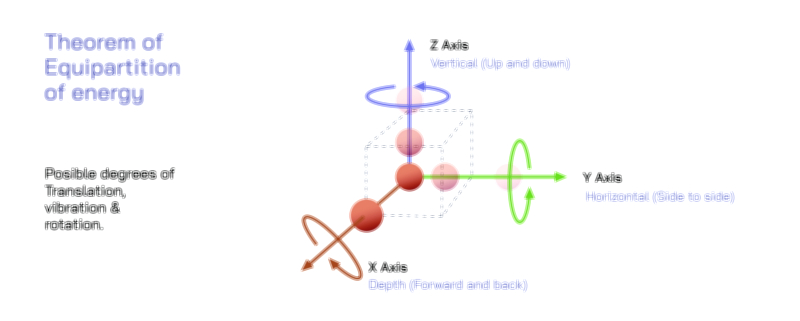
On a deeper level, the Zeroth Law can be understood through microscopic interactions and statistical mechanics. When two systems are placed in thermal contact, their molecules collide and exchange energy until their average kinetic energies reach a stable, balanced state. This uniformity of microscopic energy distribution is what we perceive macroscopically as equal temperature. The Zeroth Law asserts that this equality persists independently across multiple systems, creating a chain of thermal relationships in which all participating systems share the same average molecular behavior. This microscopic consistency forms the physical foundation for macroscopic equilibrium and validates the concept of temperature as the measurable manifestation of molecular kinetic activity. Consequently, temperature becomes not just a convenient indicator of thermal condition but a precise descriptor of the microscopic dynamics occurring within the system. The Zeroth Law thus bridges classical thermodynamics with molecular-level physics, ensuring that equilibrium principles align with statistical behavior.
Technological and Scientific Applications of the Zeroth Law
The influence of the Zeroth Law extends far beyond theoretical thermodynamics. It plays a foundational role in engineering systems, environmental control technologies, industrial processes, and even biological temperature regulation. Thermal management systems in electronics rely on equilibrium principles to maintain stable operating conditions and prevent overheating. Climate control technologies—from household HVAC systems to large-scale climate modeling—depend on thermal equilibrium concepts to evaluate heat distribution and environmental stability. In refrigeration and heat pump technologies, equilibrium principles guide the design of heat exchangers, radiators, and evaporator coils. Scientific instrumentation, such as calorimeters and thermal imaging systems, operates under the assumption that surfaces in equilibrium share equal temperature distributions. Even biological processes rely on principles consistent with the Zeroth Law: warm-blooded organisms regulate internal temperature by maintaining equilibrium between metabolic heat production and environmental heat exchange. Across these fields, the Zeroth Law ensures that temperature remains a universally meaningful and scientifically valid quantity.
Visualizing the Zeroth Law Through Vector Illustrations
A vector illustration of the Zeroth Law typically shows three systems—often labeled A, B, and C—connected through arrows or thermal contact symbols. The illustration usually depicts system A in equilibrium with system C, and system B in equilibrium with system C, with the conclusion that A and B share equal temperature. Visual representations often include identical thermometer readings, balanced heat flow diagrams, or energy exchange pathways to demonstrate the thermal relationships clearly. Some illustrations use color gradients or heat maps to show that when all three systems reach equilibrium, their thermal distributions become uniform. These visuals help solidify the law’s transitive logic and highlight how temperature becomes a reliable indicator of thermal state across multiple connected systems.