Center of Gravity — Physics Equilibrium and Balance
The center of gravity is one of the most fundamental ideas in the study of equilibrium and balance, shaping how every object behaves under the influence of gravity and determining whether a body remains stable, tilts, rotates, or collapses. Even though gravity acts on every particle of matter within an object, physics simplifies these countless microscopic forces into one single representative point known as the center of gravity. This point is not just a theoretical construct but a practical tool that governs real-world stability in everything from human posture and athletic performance to architectural design, vehicle safety, robotics, and natural biological adaptations. To understand equilibrium is to understand how the center of gravity aligns with the base of support, how it shifts in motion, how it interacts with external forces, and how mass distribution shapes stability. Whether examining the grace of a dancer, the stance of a construction crane, the buoyancy of a ship, or the balance of a toy figurine, the physics of equilibrium becomes clear only when the center of gravity is understood deeply and holistically.
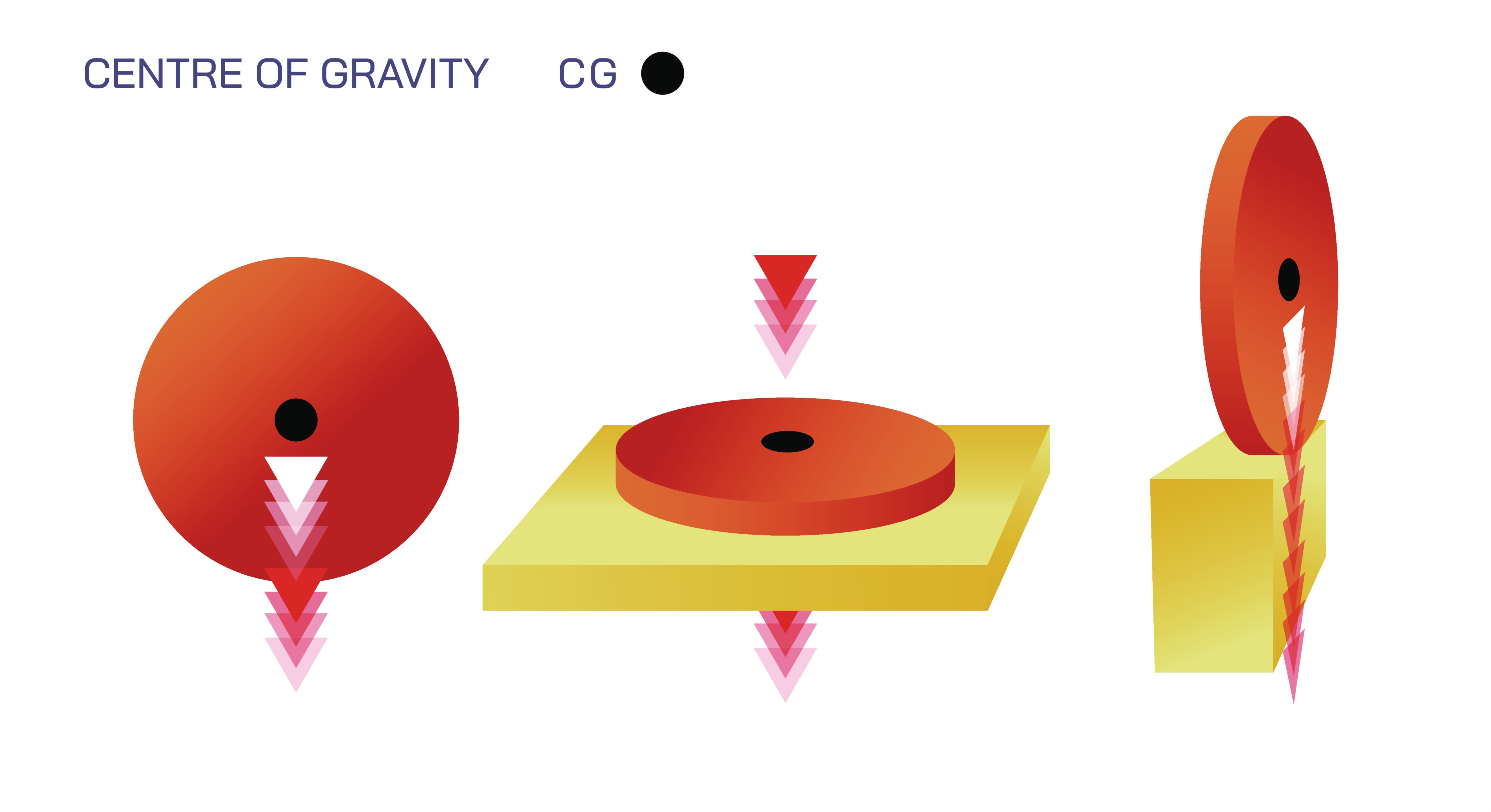
At its core, the center of gravity represents the average location of all the weight within an object. In perfectly uniform bodies such as a sphere or cube, this point lies exactly at the geometric center, reflecting an even distribution of mass in all directions. But in irregular shapes—like the human body, tools, furniture, or vehicles—the center of gravity may lie off-center, nearer to the heavier regions. A hammer feels heavier at the head because the center of gravity sits closer to that mass concentration. A person carrying a shoulder bag feels their balance shift because their center of gravity moves toward the weighted side. Even in simple movements like raising the arms, bending forward, or sitting down, the human center of gravity shifts continuously, showing that equilibrium in living beings is dynamic, not fixed. This ever-changing point is at the heart of balance—affecting how we walk, stand, jump, turn, and recover from disturbances.
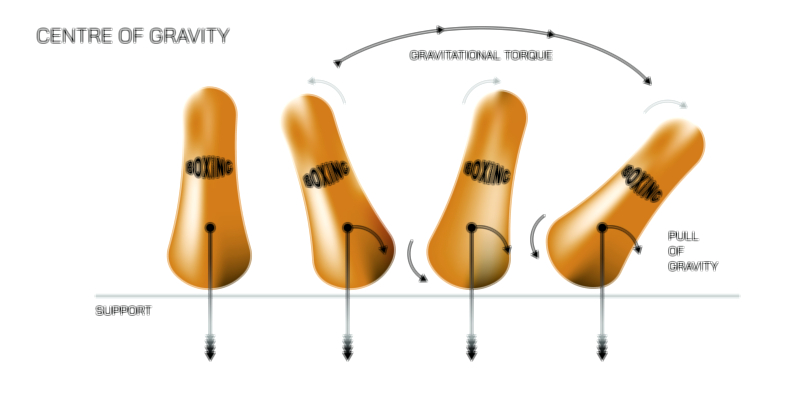
The relationship between the center of gravity and the base of support determines whether an object remains in equilibrium. An object is stable when the vertical projection of its center of gravity falls within its base of support. The wider this base and the lower the center of gravity, the greater the stability. This is why wide, low objects tend to be hard to tip over, while tall, narrow objects topple easily. When the center of gravity shifts outside the boundary of support—such as when a person leans too far forward or sideways—gravity produces a turning effect, or moment, that causes the body to rotate and fall. This principle is evident in daily life: a child learning to stand widens their stance instinctively; a person climbing a ladder must keep their torso close to the rungs to maintain equilibrium; and a worker lifting a heavy box is taught to bend their knees rather than their back to prevent the center of gravity from moving dangerously forward. In all these cases, stability comes from ensuring the center of gravity remains aligned with the support area.
Human equilibrium offers one of the most dynamic demonstrations of center-of-gravity physics. The body constantly makes micro-adjustments—some unconscious, some deliberate—to maintain balance. When walking, the center of gravity moves forward and oscillates slightly from side to side, creating a rhythmic exchange between controlled falling and catching oneself with each step. Running exaggerates these motions, requiring greater coordination. Standing still is also more complex than it appears; the body sways slightly as muscles make minute corrections to keep the center of gravity aligned. In activities such as ballet, gymnastics, martial arts, or acrobatics, mastery of equilibrium comes from understanding how to manipulate the center of gravity intentionally. A gymnast performing a handstand must align their center of gravity directly above their hands, while a ballet dancer maintains elegant control by positioning their mass with extraordinary precision. Martial artists lower their center of gravity during stances to improve stability and generate power, illustrating how deeply balance is connected to performance.
Engineering disciplines rely extensively on the principles of center-of-gravity physics to ensure stability and equilibrium in structures and mechanical systems. Architects design buildings with foundations broad enough to support even tall structures during strong winds or earthquakes. Bridges distribute their mass to prevent sway and structural failure. Cranes incorporate heavy counterweights at strategic points to balance lifted loads, preventing the center of gravity from shifting too far forward and causing collapse. Every aircraft must maintain a center-of-gravity range to ensure safe flight; shifting it too far forward causes the nose to dip dangerously, while shifting it too far backward makes the aircraft uncontrollable. Automobiles are engineered to keep their centers of gravity low, reducing rollover risks and improving handling during turns. Sports cars have extremely low centers of gravity for stability at high speeds, while larger vehicles such as buses or SUVs must employ careful weight distribution and wider wheelbases to maintain safety. These examples show that equilibrium is not just a natural phenomenon but a design objective deeply rooted in the physics of mass distribution.
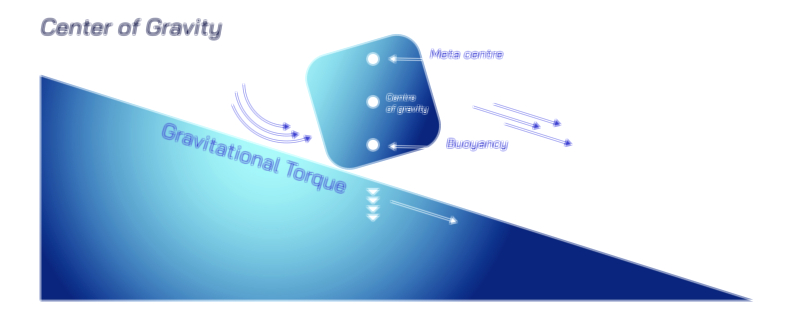
Ships and maritime structures provide a striking illustration of how the center of gravity interacts with buoyant forces to produce equilibrium on water. A vessel remains upright because its center of gravity is kept below or appropriately aligned with the center of buoyancy, which is the point where the upward buoyant force acts. When a ship tilts, buoyancy shifts, creating a restoring moment that returns the ship to an upright orientation—so long as the center of gravity has not been raised too far. Improper cargo loading, which elevates the ship’s center of gravity, can reduce stability dramatically and may lead to capsizing. Sailboats rely on heavy keels that lower the center of gravity, enabling them to resist strong sideways forces from the wind. Submarines carefully manage their ballast systems to adjust depth and equilibrium underwater. These maritime dynamics highlight the interplay between gravity, buoyancy, and stability in a fluid environment where equilibrium is constantly tested by motion, currents, and waves.
Beyond structural and biological systems, the center of gravity plays a crucial role in rotational stability. Objects thrown into the air rotate around their center of gravity, not around any external point. This behavior can be observed in everything from a gymnast performing aerial flips to a baton spinning during a performance. A diver initiates rotation by shifting the distribution of mass, controlling the spin rate by pulling limbs inward or extending them outward. Figure skaters exploit this principle dramatically, accelerating their spins by drawing arms close to the body, bringing mass inward toward the axis that passes through the center of gravity. Even inanimate objects such as spinning stones, falling tools, or tumbling debris follow predictable paths defined by the stable internal reference of their center of gravity.
Robotics further demonstrates the significance of the center of gravity in maintaining equilibrium. A humanoid robot must constantly analyze its orientation and adjust its joints to keep the center of gravity aligned over its feet. Quadrupedal robots, such as those used for exploration or search-and-rescue missions, coordinate limb movements to shift their center of gravity safely as they traverse uneven terrain. Advanced robots emulate human balance strategies by using sensors that detect tilt, acceleration, and force distribution, allowing them to recover from disturbances much like living organisms do. All of these systems rely on continuous feedback that keeps the center of gravity within a stable region, showing that equilibrium is a dynamic, intelligent process rather than a static one.
In nature, equilibrium strategies appear in countless forms. Birds shift their wings and tails to reposition their center of gravity during flight. Cats use their tails to counterbalance their bodies during leaps and mid-air rotations. Mountain goats maintain astonishing stability on steep cliffs by keeping their center of gravity directly over tiny footholds. Even trees distribute mass in ways that allow them to withstand strong winds; their root systems and trunk shapes help stabilize their center of gravity under environmental stresses. These adaptations demonstrate that the principles of equilibrium are woven deeply into the evolution of biological systems.
Art, performance, and creative disciplines also draw upon center-of-gravity physics. Sculptors create pieces that appear to defy gravity by carefully positioning their mass so the center of gravity stays above the base, even when forms extend dramatically in one direction. Dancers play with balance to create expressive movements that seem effortless but rely on subtle adjustments in the body’s internal weight distribution. Circus performers, acrobats, and tightrope walkers demonstrate extraordinary mastery of equilibrium, controlling their center of gravity with precise muscle coordination and intense bodily awareness.
Ultimately, the center of gravity unifies the study of equilibrium across all aspects of physical existence. Whether analyzing a skyscraper’s resistance to wind, a child learning to walk, an athlete performing a complex maneuver, a robot balancing on uneven ground, or a ship navigating rolling seas, the same fundamental principle applies: balance emerges when the center of gravity is aligned with the base of support, and equilibrium is maintained through controlled mass distribution. The concept reveals that stability is never an accident—it is the result of an intricate relationship between weight, support, geometry, and movement. By understanding the center of gravity, we gain insight into the mechanics that allow objects to stand, beings to move, structures to endure, and the natural world to maintain coherence amid constant force and motion.
Center of Gravity — Physics Equilibrium and Balance Vector Illustration
Center of gravity vector illustration showing mass distribution, torque, and stability principles in physics and mechanical engineering.
Summary
Related Images







File Details
File Type
-
EPS
File Size
-
5.35 MB
File Dimension
-
Scalable vector file
Your contribution helps us create more resources, but please support only if it's comfortable and affordable for you.❤️️
