Different Wing Shapes and Positions — Aircraft Design and Aerodynamic Types
Understanding the Diversity of Wing Designs in Aviation
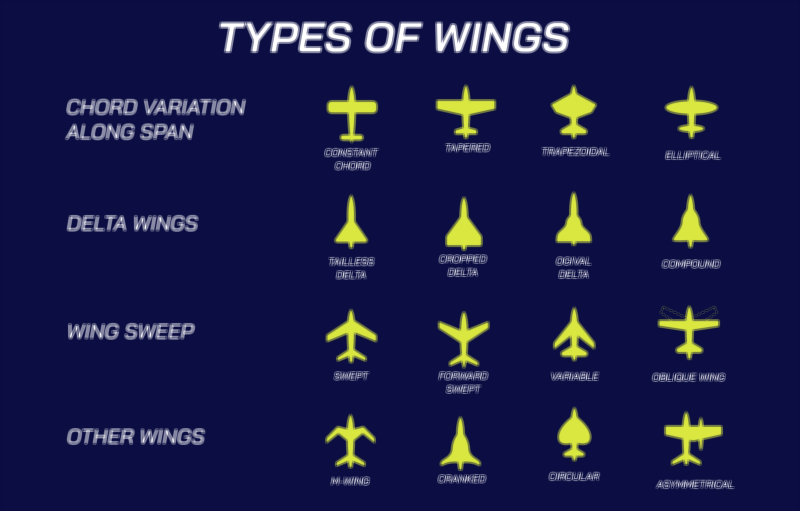
Aircraft wing shapes and positions represent some of the most fundamental engineering decisions in aviation, defining how an airplane interacts with airflow, manages aerodynamic forces, and performs under different flight conditions. Every wing design emerges from a distinct combination of performance requirements—speed, lift capacity, maneuverability, fuel efficiency, altitude capability, and mission type. Engineers tailor wing geometry, sweep, aspect ratio, and placement on the fuselage to maximize aerodynamic advantages while mitigating drag, turbulence, and structural loads. The result is an extraordinary variety of wing shapes and configurations that serve everything from high-speed fighter jets to long-endurance drones and commercial airliners. A vector illustration showing different wing shapes and positions often highlights these variations side by side, helping viewers understand how each geometry affects the flight characteristics of an aircraft. This diversity reflects decades of aerodynamic research and experimentation, culminating in designs optimized for specific performance envelopes and operational roles.
Straight Wings — Optimized for Low-Speed Lift and Stability
Straight wings extend directly from the fuselage at little to no sweep angle, forming the most traditional wing shape found in general aviation, gliders, early military aircraft, and small training airplanes. Their rectangular or mildly tapered form generates high lift at low speeds, maintaining stable airflow and predictable handling characteristics. Because straight wings stall gradually and recover easily, they are ideal for beginner pilots and aircraft operating from short runways. The aerodynamic efficiency at low speeds allows gliders to maximize lift from gentle updrafts, while bush planes benefit from excellent takeoff and landing performance. However, these wings produce significant drag at high speeds, limiting their suitability for fast, long-distance, or high-altitude flight. In vector illustrations, straight wings are often displayed with airflow lines that remain smooth and attached at modest angles of attack, symbolizing their efficiency in slow, controlled flight environments.
Swept Wings — Designed for High-Speed and Transonic Efficiency
Swept wings angle backward from the fuselage, reducing the effective airflow velocity over the wing and delaying the onset of shockwaves at high or transonic speeds. This makes them indispensable for modern jetliners, business jets, and nearly all military fighter aircraft. By sweeping the wing, the aircraft avoids sudden aerodynamic drag spikes associated with approaching the speed of sound. Swept wings enable higher cruising speeds, improved fuel economy at altitude, and smoother performance in high-speed flight regimes. Their trade-off, however, is reduced lift at low speeds, making them dependent on high-lift devices such as flaps and slats during takeoff and landing. Vector diagrams typically show swept wings with airflow lines that curve diagonally across the wing’s surface, illustrating how the backward sweep helps manage compressibility effects and aerodynamic drag at high speeds.
Delta Wings — Strength, Stability, and Supersonic Flight
Delta wings, characterized by their triangular shape and wide root chord, are synonymous with supersonic aircraft such as the Concorde, Mirage fighters, and modern experimental jets. Their broad, swept structure distributes aerodynamic loads efficiently, enabling them to withstand the intense heating and pressure changes associated with supersonic travel. Delta wings also generate powerful vortex lift at high angles of attack, allowing exceptional maneuverability and stability during sharp turns or rapid climb profiles. However, they can exhibit increased drag at low speeds and generally require higher landing velocities. A vector illustration of delta wings often highlights the pronounced leading-edge vortices that appear as spiral airflow patterns above the wing, showcasing the unique aerodynamic behavior that makes delta wings suitable for extreme performance conditions.
Elliptical and Tapered Wings — Ideal Lift Distribution and Reduced Drag
Elliptical wings—famous for their use on the Supermarine Spitfire—produce the most efficient lift distribution possible, reducing induced drag and improving overall flight performance. Their smooth, continuous curve minimizes airflow disturbances at the wingtips, supporting high maneuverability and fuel efficiency. Tapered wings, a more practical alternative, narrow smoothly toward the tips and approximate the aerodynamic advantages of the elliptical design while remaining easier to manufacture. These wings enhance climb rates, cruising efficiency, and stability, making them popular in high-performance general aviation aircraft, gliders, and military trainers. A vector illustration often contrasts elliptical, straight, and tapered shapes to demonstrate how subtle changes in geometry influence lift distribution and drag patterns.
High-Aspect-Ratio Wings — Maximizing Endurance and Efficiency
High-aspect-ratio wings, which are long and narrow, minimize induced drag and maximize aerodynamic efficiency. Found on gliders, long-endurance drones, and high-altitude research aircraft, these wings exploit the physics of slender, extended spans to reduce energy loss from wingtip vortices. Their shape enables sustained, efficient flight with minimal power consumption, making them ideal for long-duration missions and soaring. However, they require reinforced structure due to increased bending loads and are less suited for high-speed or high-maneuverability flight. In vector illustrations, these wings are often depicted with streamlined airflow patterns demonstrating reduced turbulence and smooth lift generation across the span.
Wing Position Variations — High-Wing, Mid-Wing, and Low-Wing Configurations
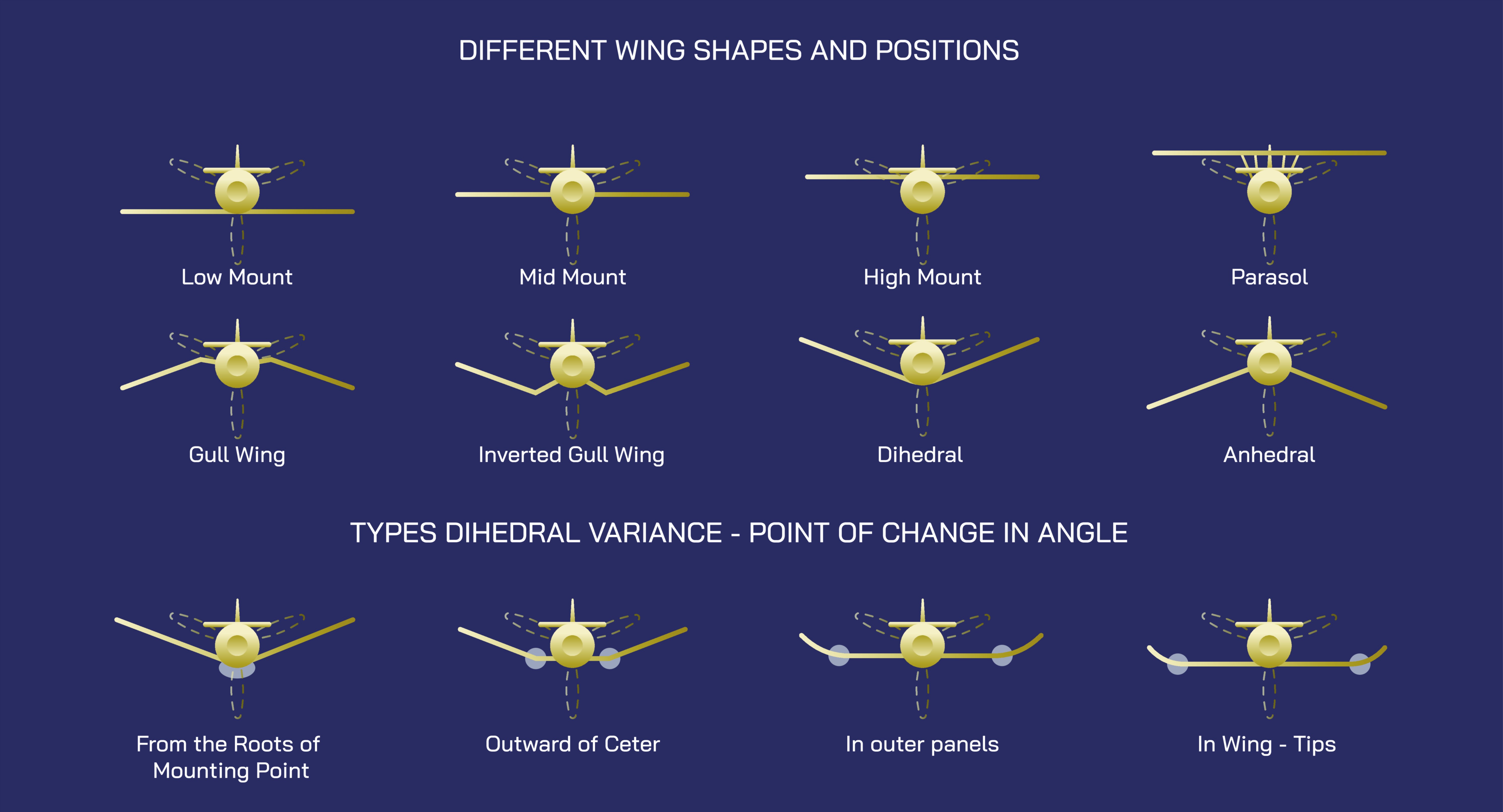
Beyond shape alone, the vertical position of wings on the fuselage dramatically affects an aircraft’s aerodynamic stability, ground handling, and operational role. High-wing aircraft, where wings sit atop the fuselage, offer exceptional visibility downward, inherent lateral stability, and improved ground clearance—features ideal for bush planes, transport aircraft, and cargo carriers. Low-wing planes place wings beneath the fuselage, enhancing roll control, enabling easier landing gear integration, and improving aerodynamic efficiency—common in commercial jets and general aviation trainers. Mid-wing configurations, most often seen in fighter jets and aerobatic aircraft, provide balanced aerodynamic forces and superior maneuverability by aligning the wing with the fuselage’s center of gravity. A vector illustration typically contrasts these positions, showing how wing height affects airflow distribution, stability, and aerodynamic behavior in different flight phases.
Forward-Swept and Variable-Sweep Wings — Advanced Aerodynamic Innovations
Forward-swept wings, though rare, offer remarkable maneuverability and stall resistance by keeping airflow attached at high angles of attack. They appear on experimental aircraft such as the X-29, but require advanced composites to overcome structural bending issues. Variable-sweep or swing wings offer dual aerodynamic advantages: extended wings for low-speed lift during takeoff and landing, and sharply swept wings for high-speed efficiency. Aircraft like the F-14 Tomcat and B-1 Lancer rely on this adaptability to perform in diverse flight regimes. In vector illustrations, these designs are often shown in multiple configurations, highlighting how changing wing angles alter aerodynamic characteristics.
Illustrating Wing Shapes and Positions Through Vector Graphics
A vector illustration of different wing shapes and positions typically arranges various designs side by side—straight wings, swept wings, delta wings, elliptical wings, tapered wings, and high-aspect-ratio wings—accompanied by airflow lines that demonstrate their aerodynamic behavior. Additional diagrams may show high-wing, mid-wing, and low-wing placements on simplified aircraft frames, making it easy to compare stability features and structural implications. These visuals help clarify how wing geometry and mounting position influence lift generation, drag reduction, maneuverability, and efficiency across flight regimes.