Seeing a glowing bulb through a plane mirror is one of the most common yet powerful demonstrations of how light behaves. This everyday observation reveals fundamental principles of optics and helps explain how mirrors form images. Although the process appears simple, it involves precise interaction between light rays, reflective surfaces, and the human eye. Understanding how a bulb is seen in a plane mirror provides clear insight into reflection, image formation, and visual perception.
A plane mirror is a flat, smooth reflective surface that reflects light in a predictable manner. When a bulb emits light, the light travels outward in straight lines in all directions. Some of these light rays strike the surface of the plane mirror. The smoothness of the mirror ensures that light reflects in an orderly way rather than scattering. This orderly reflection is essential for forming a clear image.
The reflection of light from a plane mirror follows a fundamental rule known as the law of reflection. According to this principle, the angle at which a light ray strikes the mirror surface is equal to the angle at which it reflects away from the surface. This relationship holds true for every ray of light that hits the mirror. Because of this consistency, the reflected rays maintain the structure of the original light pattern coming from the bulb.
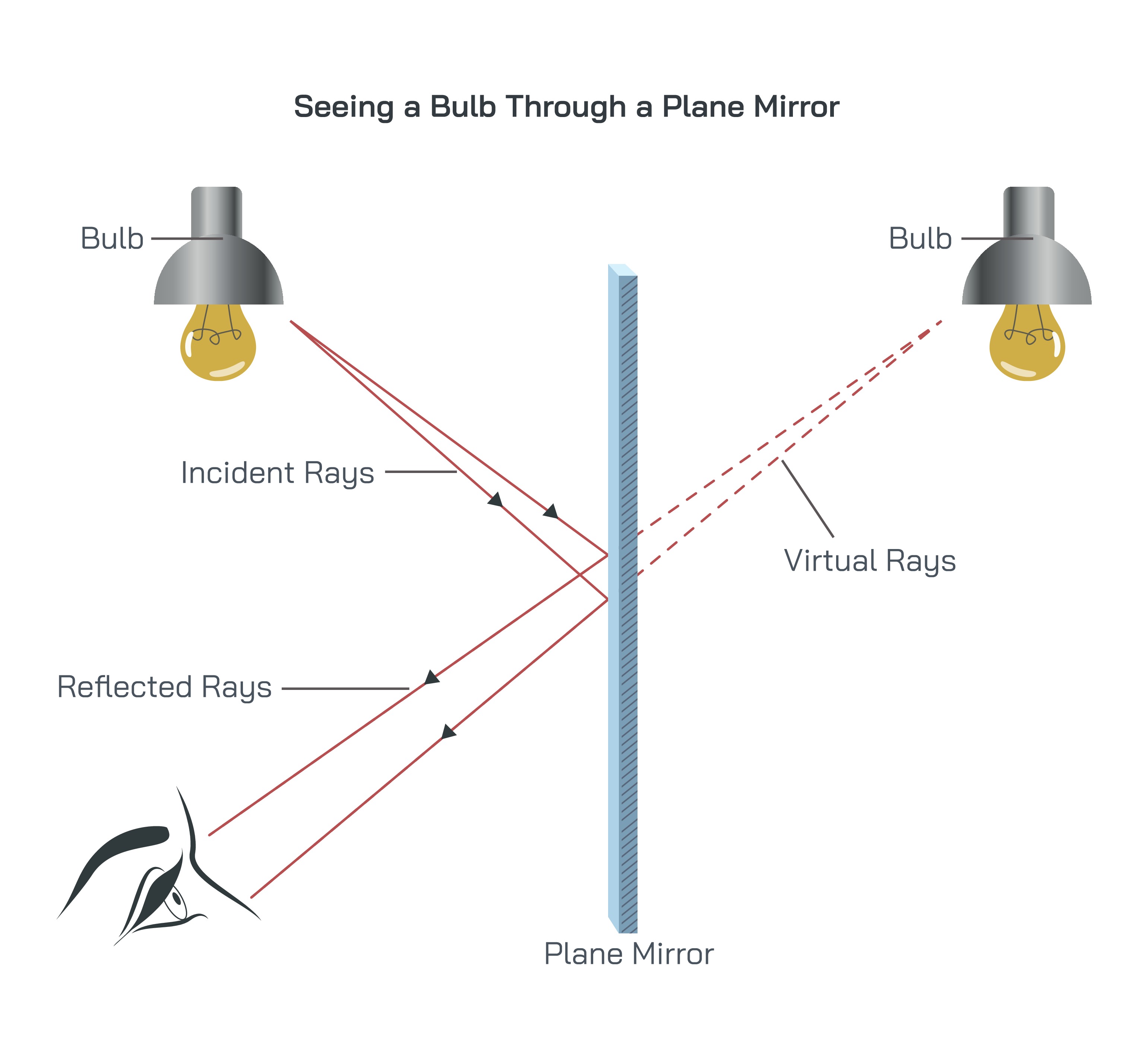
When the bulb is placed in front of a plane mirror, light rays from the bulb travel toward the mirror and reflect back into the surrounding space. These reflected rays enter the observer’s eyes. The human brain traces these rays backward in a straight line and assumes they originate from a point behind the mirror. This perceived point is where the image of the bulb appears to be located.
The image formed by a plane mirror is known as a virtual image. It is called virtual because the light rays do not actually meet at the point where the image appears to be. Instead, the image is an optical illusion created by the extension of reflected rays backward. Because the rays only appear to come from behind the mirror, the image cannot be projected onto a screen.
One important characteristic of seeing a bulb in a plane mirror is that the image appears at the same distance behind the mirror as the bulb is in front of it. If the bulb is placed a certain distance away from the mirror, the image will appear the same distance behind the mirror. This symmetry is a defining property of plane mirrors and helps explain why mirror images look realistic and correctly proportioned.
The size of the image formed by a plane mirror is another notable feature. The image of the bulb is the same size as the actual bulb. Plane mirrors do not magnify or reduce images. This occurs because the reflected rays preserve the spatial relationships between points on the object. As a result, the image retains the same height and width as the original source.
Orientation is also important when observing a bulb through a plane mirror. The image appears upright, meaning it is not inverted vertically. However, it does exhibit lateral inversion, where the left and right sides are reversed. While this effect is more noticeable with objects that have distinct left and right features, it still applies to any object reflected in a plane mirror.
The clarity of the bulb’s image depends on the quality of the mirror surface. A clean, smooth mirror produces a sharp and well-defined image because it reflects light uniformly. Any roughness or dirt on the mirror surface causes light to scatter, reducing image clarity. This is why polished glass mirrors are used in everyday applications.
The position of the observer also influences how the bulb is seen in the mirror. When the observer moves, the image appears to move as well. However, the image always remains directly opposite the bulb relative to the mirror surface. This behavior demonstrates that the image location depends on the object’s position rather than the observer’s location.
Ray diagrams are often used to explain how a bulb is seen in a plane mirror. In such diagrams, rays from the bulb are drawn toward the mirror, reflected according to the law of reflection, and then extended backward. The point where these extensions meet represents the virtual image. These diagrams provide a visual method for understanding reflection and image formation.
This simple observation has significant educational value. Seeing a bulb in a plane mirror is commonly used in classrooms to introduce basic optics concepts. It helps students understand reflection, straight-line propagation of light, and image formation without complex equipment. The example is effective because it connects abstract physics principles to everyday experiences.
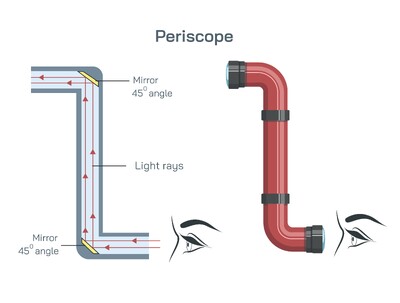
The phenomenon also explains why mirrors are used in homes, vehicles, and optical instruments. Plane mirrors provide accurate representations of objects, allowing people to see themselves or their surroundings clearly. The predictable behavior of reflected light makes plane mirrors reliable tools for observation.
In daily life, the reflection of a bulb in a mirror demonstrates how light interacts with surfaces and how the human eye interprets reflected rays. This understanding extends to other reflective surfaces such as calm water, polished metal, and glass. All these surfaces reflect light in ways similar to a plane mirror when they are smooth.
From a scientific perspective, the reflection of a bulb in a plane mirror illustrates the principles of geometric optics. It shows how light rays behave in predictable patterns and how images are formed without the need for lenses or complex systems. This simplicity makes the plane mirror one of the most important optical elements in physics.
The concept also highlights the difference between real and virtual images. Unlike images formed by lenses or curved mirrors, which may project onto screens, the image in a plane mirror exists only as a visual perception. This distinction helps learners understand broader optical concepts and image classification.
Seeing a glowing bulb through a plane mirror is not merely a basic observation but a complete illustration of how light, surfaces, and human perception interact in a controlled and predictable manner. At a deeper level, this phenomenon represents the foundation of geometric optics, where light is treated as rays that obey strict rules. The simplicity of the setup hides the richness of physical processes involved, making it one of the most important demonstrations in the study of light.
When a bulb glows, it functions as an extended luminous object rather than a single point source. Every point on the filament emits light in all directions. Each of these points effectively acts as an independent source of rays. When such rays reach a plane mirror, each one follows the same reflection rule. This means that the mirror forms not one image but a continuous set of image points, corresponding to every emitting point on the bulb. Together, these image points reconstruct the full image of the bulb behind the mirror.
The smoothness of the plane mirror is crucial at the microscopic level. Although the mirror appears flat to the naked eye, its surface is polished so finely that irregularities are much smaller than the wavelength of visible light. This microscopic smoothness ensures specular reflection, where parallel incident rays remain parallel after reflection. If the surface were even slightly rough on the scale of light waves, the bulb’s image would blur or disappear entirely. This highlights the intimate connection between material science and optical performance.
Another subtle aspect of viewing a bulb in a plane mirror is brightness. The image always appears less bright than the real bulb, even though it is the same size. This reduction occurs because not all incident light is reflected; some is absorbed by the mirror or transmitted through the glass backing. Additionally, light spreads out as it travels, so fewer rays reach the observer’s eye. This explains why reflections are never as intense as the original light source.
Depth perception also plays an interesting role. The brain perceives the bulb’s image as being behind the mirror, even though no light actually travels from that region. This illusion arises because the brain is trained to interpret light as traveling in straight lines. When reflected rays enter the eye, the brain extends them backward automatically. This learned interpretation is so strong that the image appears to occupy real space, even though it cannot be physically accessed.
The apparent distance of the image behind the mirror remains constant regardless of the observer’s position. This property distinguishes plane mirror images from perspective illusions. Whether the observer stands close to the mirror or moves sideways, the image maintains its position relative to the bulb. This demonstrates that image formation depends entirely on object position and mirror geometry, not on where the observer stands.
Lateral inversion, often misunderstood, is not a true left-right reversal caused by the mirror itself. Instead, it is a front-back reversal. The mirror reverses the direction perpendicular to its surface, which the human brain interprets as left-right reversal due to our own body symmetry. In the case of a bulb, this effect is subtle, but it becomes obvious when letters or asymmetric objects are reflected. Understanding this helps clarify common misconceptions about mirror images.
Thermal effects can also influence what is seen. A glowing bulb emits not only visible light but also heat. While heat does not affect reflection directly, prolonged exposure can slightly warm the mirror surface, potentially causing minor air disturbances near the mirror. In precision optical experiments, even such small effects must be controlled, showing how sensitive optical observations can be.
In experimental physics, plane mirrors are often used as reference tools because of their predictable behavior. The reflection of a bulb can be used to align optical instruments, verify straight-line propagation of light, and demonstrate ray tracing techniques. By comparing the real bulb and its image, students can validate theoretical predictions with direct observation.
Psychologically, the experience of seeing a bulb in a mirror reinforces the brain’s reliance on visual cues rather than physical reality. Even when one knows the image is virtual, the perception remains convincing. This emphasizes how optics is not only a physical science but also closely tied to human perception and cognition.
From a practical standpoint, this phenomenon explains why mirrors are effective in lighting design. Mirrors placed behind bulbs in lamps or reflectors redirect light efficiently into desired areas. Although these mirrors may not always be perfectly plane, the same reflection principles apply, enhancing illumination without additional energy consumption.
The observation also forms the basis for more advanced optical systems. Understanding plane mirror behavior is essential before studying curved mirrors, lenses, and complex optical instruments. Without this foundational knowledge, concepts like magnification, focal length, and real image formation become difficult to grasp.
In summary, seeing a bulb in a plane mirror is a deceptively simple event that encapsulates essential optical principles. It demonstrates how light travels, how surfaces interact with light, and how the human brain interprets visual information. This everyday experience bridges theory and reality, making it one of the most effective and enduring demonstrations in the study of optics.
In conclusion, seeing a bulb through a plane mirror is a clear and practical demonstration of light reflection and image formation. Light from the bulb strikes the mirror, reflects according to the law of reflection, and enters the observer’s eyes. The brain interprets these reflected rays as coming from behind the mirror, creating a virtual image that is upright, the same size as the bulb, and equally distant from the mirror surface. This simple phenomenon explains how plane mirrors work and why they are so effective in everyday life. Understanding this process deepens knowledge of basic optics and highlights how fundamental physics principles operate in common experiences.