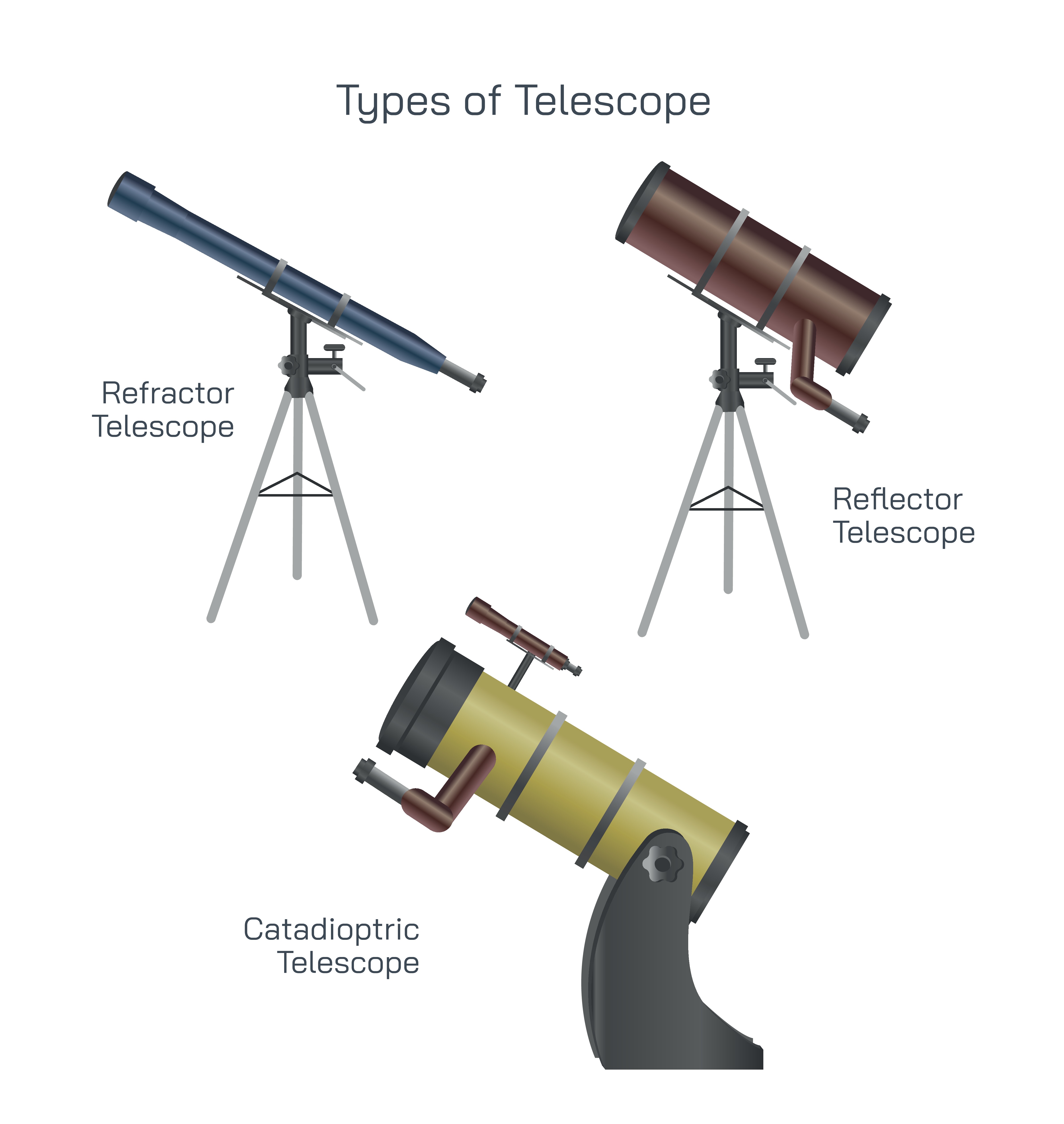
Telescopes are essential optical instruments used to observe distant objects in space by collecting and focusing light. Since celestial objects such as stars, planets, galaxies, and nebulae are extremely far away, they appear faint and small to the naked eye. Telescopes overcome this limitation by gathering more light than the human eye and forming a magnified image that allows detailed observation. Over centuries of scientific development, different types of telescopes have been designed to improve image clarity, brightness, and resolution. The three main types of optical telescopes are refractor telescopes, reflector telescopes, and catadioptric telescopes. Each type has a distinct structure, working principle, and area of application.
A refractor telescope is the oldest type of telescope and was the first to be used for astronomical observations. It works on the principle of refraction of light. In this type of telescope, light from a distant celestial object enters the telescope through a large objective lens located at the front end of a long tube. This objective lens bends, or refracts, the incoming light rays and brings them to a focus at a point inside the tube. An eyepiece lens placed near this focal point further magnifies the image, allowing the observer to see an enlarged and clearer view.
The key advantage of refractor telescopes is their simple and sealed design. Because the optical path is enclosed within a tube, the lenses are protected from dust and air currents. This results in stable images with high contrast, making refractor telescopes especially suitable for observing the Moon, planets, and double stars. They are widely used in educational settings and by beginners in astronomy because of their ease of use and minimal maintenance.
However, refractor telescopes also have limitations. Large objective lenses are difficult and expensive to manufacture. As the size of the lens increases, the telescope becomes longer and heavier, making it less practical for large-scale observations. Another drawback is chromatic aberration, a phenomenon where different colors of light focus at slightly different points, causing color fringes around bright objects. Although advanced lens designs can reduce this effect, it cannot be completely eliminated in simple refractors.
Reflector telescopes were developed to overcome some of the limitations of refractor telescopes. Instead of using lenses, reflector telescopes use mirrors to collect and focus light. In this design, light enters the telescope tube and strikes a large concave primary mirror located at the bottom of the tube. This mirror reflects the light back toward the top, where a smaller secondary mirror redirects the light to an eyepiece placed at the side or top of the telescope.
The use of mirrors offers several advantages. Mirrors do not suffer from chromatic aberration because reflection does not separate light into colors. This allows reflector telescopes to produce sharper images without color distortion. Additionally, mirrors can be supported from behind, making it easier to construct very large telescopes. As a result, most professional observatories use reflector telescopes with large primary mirrors to observe faint and distant objects such as galaxies and nebulae.
Reflector telescopes are particularly well suited for deep-sky observation. Their strong light-gathering ability allows astronomers to detect objects that are too faint to be seen with refractors of similar size. Reflectors are also generally more affordable than refractors when comparing telescopes of the same aperture. However, they require more maintenance. Mirrors can lose reflectivity over time and may need periodic cleaning and recoating. The open tube design can also allow dust and air turbulence to affect image quality.
Catadioptric telescopes represent a combination of refractor and reflector designs. They use both lenses and mirrors to form images. This hybrid approach allows catadioptric telescopes to achieve compact designs with long effective focal lengths. In these telescopes, light typically enters through a corrector lens at the front, reflects off a primary mirror at the back, then off a secondary mirror, and finally passes through a hole in the primary mirror to reach the eyepiece.
One of the most notable advantages of catadioptric telescopes is their compact size. Despite having a long focal length, they are much shorter than refractor or reflector telescopes with similar optical performance. This makes them portable and convenient for both amateur and professional astronomers. Catadioptric telescopes are versatile and can be used for planetary observation, deep-sky viewing, and astrophotography.
The image quality produced by catadioptric telescopes is generally excellent, with reduced optical aberrations due to the corrective lens. However, these telescopes tend to be more expensive and complex than simple refractors or reflectors. They may also require more precise alignment to maintain optimal performance.
The choice between refractor, reflector, and catadioptric telescopes depends on the observer’s needs and experience level. Refractor telescopes are ideal for beginners and for observing bright objects with high contrast. Reflector telescopes are preferred for deep-sky exploration and professional research due to their large apertures and cost efficiency. Catadioptric telescopes offer a balance between performance and portability, making them popular among advanced amateurs and astrophotographers.
Understanding the types of telescopes also helps in learning basic optical physics concepts such as refraction, reflection, focal length, and magnification. Telescopes serve as practical examples of how light behaves when interacting with lenses and mirrors. This makes them valuable tools not only in astronomy but also in physics education.
Throughout history, improvements in telescope design have led to major discoveries about the universe. By enabling detailed observation of celestial bodies, telescopes have expanded human knowledge of planetary motion, stellar evolution, and cosmic structure. Each type of telescope has contributed uniquely to these discoveries through its specific optical strengths.
In modern times, telescopes are used in a wide range of applications, from backyard stargazing to advanced scientific research. Amateur astronomers use small telescopes to observe planets and star clusters, while large observatories use massive reflector systems to study distant galaxies. Catadioptric telescopes bridge this gap by offering powerful performance in a compact form.
In conclusion, the main types of telescopes—refractor, reflector, and catadioptric—differ in their construction, working principles, and applications. Refractor telescopes use lenses and are known for their simplicity and clarity. Reflector telescopes use mirrors and excel in light-gathering ability and deep-sky observation. Catadioptric telescopes combine lenses and mirrors to provide compact and versatile designs. Understanding these telescope types provides a strong foundation for exploring astronomy, appreciating optical science, and observing the vast universe beyond Earth.