Brewster’s Law — Polarization of Light
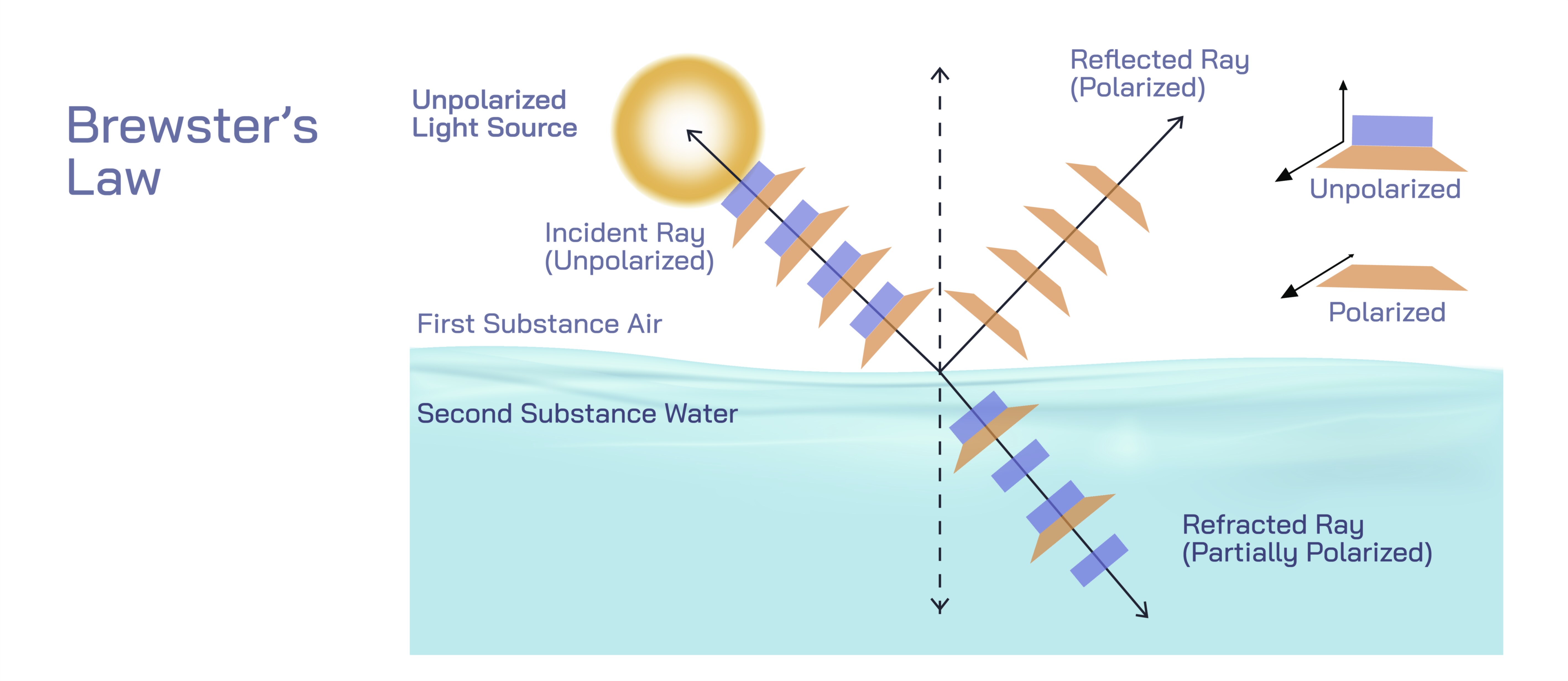
Brewster’s Law describes a remarkable and elegant phenomenon in optics that reveals how light can become polarized when it reflects from a surface under very specific conditions. Even without using mathematical expressions, the central idea can be understood by imagining light not as a simple, uniform ray but as a complex vibration that travels through space in many possible directions. When light encounters a boundary between two different media, such as air and glass or air and water, part of it enters the new medium while another part reflects back. Normally, the reflected light is a mixture of vibrations in multiple directions, giving it an unpolarized nature. Brewster’s Law explains that at one special angle of incidence, the reflected light loses certain components of its vibration and becomes perfectly polarized. This transformation occurs because the interaction between the incoming light wave and the electrons in the surface medium reaches a unique geometric alignment, causing only specific directions of vibration to persist in the reflected beam.
To picture this more clearly, imagine light as a bundle of tiny arrows pointing in different directions as it moves forward. When this bundle hits a surface at most angles, the reflected arrows retain many orientations, producing a mixed pattern. However, when the light strikes the boundary at the precise angle described by Brewster’s Law, the arrows pointing in only one direction survive the reflection, leaving the reflected beam with vibrations confined to a single plane. This unique situation arises because the reflected and refracted rays align in such a way that the electrons within the material vibrate in a direction that cannot send energy back toward the source. As a result, the reflected beam becomes polarized, meaning its vibrations occur only in a single orientation. This behavior not only reveals the internal dynamics of waves interacting with matter but also demonstrates the underlying symmetry and predictability of optical phenomena.
The significance of Brewster’s Law extends far beyond theoretical interest, because polarization plays a critical role in everyday life and modern technology. One of the most familiar applications is in polarized sunglasses. These lenses are designed to block horizontally polarized light, which is commonly produced when sunlight reflects off surfaces like roads, water, glass, or metal. Because Brewster’s Law explains exactly how and why this horizontal polarization forms, manufacturers can design filters that selectively remove it, reducing glare and improving visual comfort. Another important application appears in photography, where polarizing filters enhance image clarity by minimizing unwanted reflections from shiny surfaces. This allows photographers to capture more vivid colors and reduce visual distractions that would otherwise obscure important details in the scene.
In scientific and industrial settings, Brewster’s Law is used to create and control polarized light in laboratories, enabling researchers to study optical materials, chemical compositions, and molecular structures. Devices such as lasers rely on carefully controlled polarization states, and Brewster-angle windows are incorporated into laser cavities to eliminate certain orientations of light, ensuring that the output remains consistent and stable. In telecommunications, polarization plays an essential role in the transmission of signals through fiber-optic cables, and understanding how light interacts with surfaces at the Brewster angle helps engineers design systems that minimize loss and maintain signal purity. Even in fields like geology and materials science, polarization microscopes use concepts derived from Brewster’s Law to analyze crystal structures, mineral samples, and other anisotropic materials whose optical behavior changes depending on direction.
At a deeper conceptual level, Brewster’s Law offers insight into the nature of electromagnetic waves and how they interact with matter. When light encounters a surface, its electric field component interacts with the electrons present in the material. These electrons oscillate in response to the incoming wave, and depending on the direction of their oscillation, they either radiate energy backward or forward. Brewster’s Law identifies the angle at which the electrons oscillate in a direction that cannot emit energy back toward the source, eliminating one component of the reflected light. This selective suppression of certain vibrations reveals a fascinating interplay between geometry, wave behavior, and material response. It demonstrates that polarization is not merely a convenient property we exploit, but a natural consequence of how electromagnetic fields behave under precise physical conditions.
The beauty of Brewster’s Law lies in its ability to connect an everyday phenomenon—glare on a sunny day—to the deeper principles governing the behavior of light. It shows that even the light we casually observe is governed by strict patterns and conditions, and that understanding these patterns allows us to manipulate and control light for practical benefit. Whether used to enhance vision, improve communication technologies, refine scientific instruments, or deepen our understanding of wave behavior, the principle continues to influence a wide range of fields. In essence, Brewster’s Law stands as a testament to the harmony between theory and observation, revealing how the invisible orientations of light vibrations shape the visible world around us and providing a foundation for technologies that rely on the controlled use of polarized light.