The parts of an atom form the fundamental building blocks of all matter in the universe. Everything that exists in the physical world, from the air we breathe to the stars in the sky, is composed of atoms. Understanding the structure of an atom provides a foundation for learning physics, chemistry, biology, and material science. Although atoms are extremely small and invisible to the naked eye, their internal organization determines the properties of substances and governs how matter behaves and interacts.
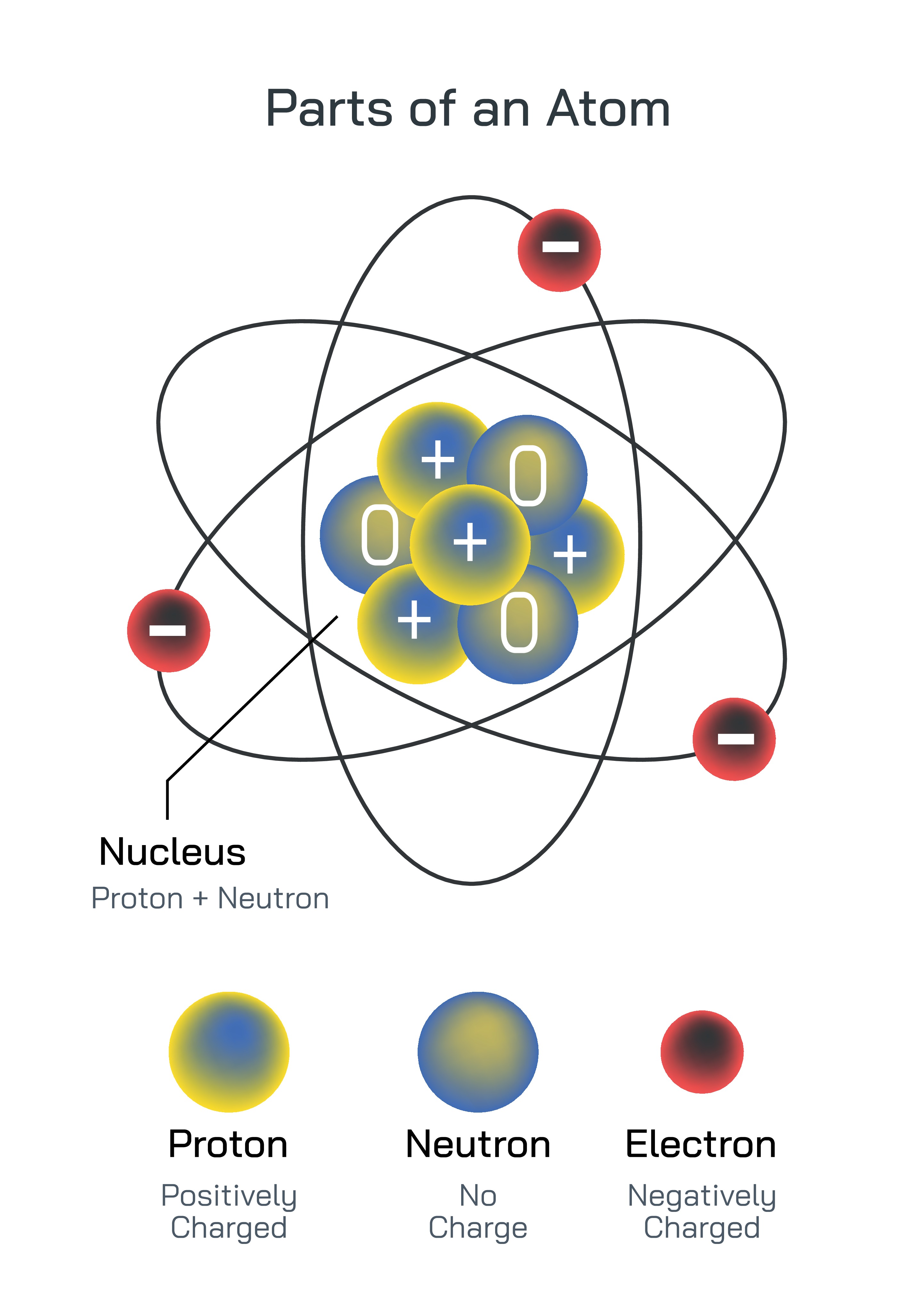
An atom consists of a central core surrounded by smaller particles that move around it. This organized structure gives the atom both stability and functionality. Despite its tiny size, an atom contains distinct regions and components, each with a specific role. The three main parts of an atom are protons, neutrons, and electrons. These are known as subatomic particles because they are smaller than the atom itself.
At the center of the atom lies the nucleus, which acts as the dense core. The nucleus contains protons and neutrons packed tightly together. Although the nucleus occupies only a very small portion of the atom’s total volume, it contains almost all of the atom’s mass. This dense concentration of matter makes the nucleus the most important structural component of the atom. The stability of the atom largely depends on the balance and interaction between particles inside the nucleus.
Protons are positively charged subatomic particles found within the nucleus. Each proton carries a single unit of positive electrical charge. The number of protons in the nucleus is known as the atomic number, and this number uniquely identifies an element. No two different elements have the same number of protons. This makes protons the defining feature of an atom’s identity. Changing the number of protons changes the element itself.
Neutrons are neutral subatomic particles that also reside in the nucleus. They have no electrical charge, but their mass is nearly equal to that of protons. Neutrons play a crucial role in maintaining nuclear stability. They help reduce the repulsive force between positively charged protons by adding strong nuclear attraction without increasing electrical repulsion. The number of neutrons can vary within atoms of the same element, leading to different atomic forms with slightly different masses.
Electrons are negatively charged subatomic particles that exist outside the nucleus. They move rapidly around the nucleus in regions known as the electron cloud. Electrons are much smaller and lighter than protons and neutrons, contributing very little to the atom’s mass. Despite this, electrons are extremely important because they determine how atoms interact with each other. Chemical reactions, bonding, and electrical behavior are all controlled by electron arrangement and movement.
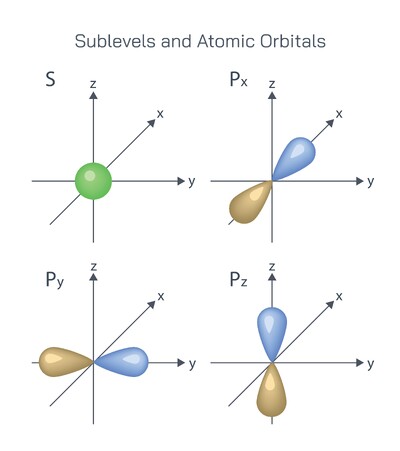
The electron cloud does not consist of fixed paths but rather regions where electrons are most likely to be found. These regions are arranged in layers or energy levels around the nucleus. Each energy level can hold a specific number of electrons. The distribution of electrons across these levels influences the atom’s size, reactivity, and bonding capacity. Atoms tend to achieve stability by filling or balancing their outermost electron levels.
The attraction between the positively charged nucleus and negatively charged electrons holds the atom together. This force ensures that electrons remain bound to the atom rather than drifting away. At the same time, electrons remain in constant motion, creating a balance between attraction and energy. This balance gives atoms their stable structure while allowing interaction with other atoms.
The mass number of an atom is determined by the total number of protons and neutrons in the nucleus. Since electrons have negligible mass, they are not included in this calculation. The mass number provides information about the weight of an atom relative to others. Differences in neutron numbers affect atomic mass without altering chemical identity, which explains why some elements exist in multiple atomic forms.
Atoms are electrically neutral when the number of protons equals the number of electrons. This balance of positive and negative charges ensures overall neutrality. If an atom gains or loses electrons, it becomes electrically charged. Such charged atoms play an important role in electrical conduction, chemical reactions, and many natural processes.
The structure of an atom explains why different substances have different properties. The arrangement of electrons determines whether a material conducts electricity, reacts with other substances, or remains stable. Atomic structure also influences physical properties such as hardness, color, and melting point. Even small changes at the atomic level can result in major differences in material behavior.
From a scientific perspective, atoms are the foundation of matter organization. When atoms combine, they form molecules, and when molecules combine, they form substances. The interactions between atomic parts govern all chemical and physical transformations in nature. Understanding atomic structure helps explain natural phenomena ranging from chemical reactions to energy production.
In educational contexts, learning about the parts of an atom provides a gateway to advanced scientific concepts. It helps students understand how matter is built, how energy is transferred, and how substances interact. Atomic theory forms the basis for disciplines such as chemistry, nuclear science, and quantum physics.
The parts of an atom represent one of the most important concepts in science because they explain how all matter is formed, structured, and transformed. Atoms are the smallest units of matter that retain the identity of an element, and their internal organization governs both the physical and chemical behavior of substances. Although atoms are incredibly small, their structure is highly organized and follows precise natural rules that determine how matter exists in the universe.
At the heart of every atom is the nucleus, a compact and extremely dense central region. The nucleus is responsible for almost all of the atom’s mass and serves as the anchor for the entire atomic structure. Despite occupying only a tiny fraction of the atom’s total size, the nucleus plays a dominant role in defining atomic properties. The particles within the nucleus are held together by strong attractive forces that overcome the natural repulsion between positively charged components. This balance of forces ensures that the nucleus remains stable under normal conditions.
Protons are one of the two main particles found inside the nucleus. Each proton carries a positive electrical charge and contributes significantly to the mass of the atom. The number of protons in an atom determines its elemental identity and position in the periodic table. For example, an atom with one proton is hydrogen, while an atom with six protons is carbon. This fixed proton count defines the chemical nature of the atom and influences how it interacts with other atoms. Protons therefore act as the identity markers of matter.
Neutrons are the second type of particle found in the nucleus. They carry no electrical charge, which allows them to act as stabilizing agents within the nucleus. By adding mass without increasing electrical repulsion, neutrons help hold the nucleus together. Atoms of the same element can have different numbers of neutrons, leading to variations in atomic mass. These variations do not change the element’s chemical behavior but can influence nuclear properties and stability. Neutrons are especially important in nuclear reactions and energy-related processes.
Surrounding the nucleus is the region occupied by electrons, known as the electron cloud. Electrons are negatively charged particles that move rapidly around the nucleus. Although they contribute very little to the atom’s mass, they play a crucial role in determining how atoms interact with one another. The behavior of electrons governs chemical bonding, electrical conductivity, and reactivity. Without electrons, atoms would not be able to form molecules or compounds.
Electrons exist in organized regions around the nucleus called energy levels or shells. Each energy level can hold only a limited number of electrons, and electrons naturally occupy the lowest available energy states. The outermost energy level, often called the valence shell, is particularly important because it determines how an atom reacts with others. Atoms tend to achieve stability by having a balanced or filled outer shell, which explains why some elements are highly reactive while others are largely unreactive.
The electron cloud is not a rigid structure but a dynamic region where electrons are most likely to be found. This cloud-like distribution reflects the constant motion and energy of electrons. Rather than following fixed paths, electrons occupy probability regions influenced by energy and attraction to the nucleus. This arrangement allows atoms to interact flexibly with their environment and form complex structures.
The electrical forces within an atom play a vital role in maintaining its structure. The attraction between the positively charged nucleus and the negatively charged electrons keeps the atom intact. At the same time, electrons possess energy that prevents them from collapsing into the nucleus. This balance between attraction and motion creates a stable atomic system that can exist for long periods.
The total mass of an atom depends primarily on the number of protons and neutrons in the nucleus. Because electrons are so light, their mass contribution is negligible. The combination of protons and neutrons gives each atom its mass number, which is used to compare atomic weights. Variations in neutron count lead to atoms of the same element having slightly different masses, which can influence physical properties and nuclear behavior.
Atoms are normally electrically neutral because the number of positively charged protons equals the number of negatively charged electrons. However, atoms can lose or gain electrons under certain conditions, resulting in charged particles. These charged forms of atoms are essential in many natural and technological processes, including electricity, chemical reactions, and biological signaling.
The structure of an atom explains why different elements behave differently. Elements with loosely held outer electrons tend to be highly reactive, while those with stable electron arrangements are less likely to interact. This variation in atomic structure gives rise to the vast diversity of materials found in nature, from metals and gases to complex organic compounds.
At a broader level, atomic structure forms the foundation of all scientific understanding of matter. When atoms bond together, they form molecules, which in turn create substances with unique properties. The interactions between atomic parts govern chemical reactions, energy transformations, and physical changes. From the formation of water to the release of energy in stars, atomic structure plays a central role.
In education and research, understanding the parts of an atom opens the door to advanced scientific fields. It provides insight into how matter behaves, how energy is stored and released, and how complex systems are built from simple components. Atomic structure is fundamental to chemistry, physics, biology, medicine, and material science.
In essence, the atom is a finely balanced system composed of distinct but interconnected parts. Protons define identity, neutrons provide stability, and electrons enable interaction. Together, these components create the building blocks of everything in the universe, demonstrating how immense complexity arises from an elegantly organized microscopic structure.
The parts of an atom together form a remarkably stable and organized system that underlies all matter and energy interactions in the universe. Although atoms are extraordinarily small, their internal structure follows strict physical principles that determine how substances form, change, and interact. The behavior of solids, liquids, gases, and even plasma can ultimately be traced back to the arrangement and interaction of subatomic particles within atoms. Understanding atomic structure therefore provides a unifying explanation for countless natural phenomena.
At the center of atomic structure is the nucleus, which functions as the gravitational and electrical anchor of the atom. The nucleus is incredibly dense, containing nearly all of the atom’s mass within a space that is tiny compared to the atom’s overall size. This means that most of an atom consists of empty space, with electrons moving through regions far from the nucleus. Despite this emptiness, atoms are stable because of the powerful forces acting between their internal components.
The particles inside the nucleus are bound together by a strong attractive force that operates only at extremely short distances. This force is powerful enough to overcome the natural repulsion between positively charged protons. Without this stabilizing interaction, atomic nuclei would break apart. The balance between attraction and repulsion inside the nucleus determines whether an atom is stable or prone to decay. This balance is especially important in heavier atoms, where the number of protons increases repulsive forces.
Protons play a central role not only in defining atomic identity but also in shaping atomic behavior. Because protons carry a positive charge, they influence how strongly electrons are attracted to the nucleus. Atoms with more protons exert a stronger pull on electrons, affecting atomic size and chemical reactivity. This attraction governs how closely electrons remain bound and how easily they can be shared or transferred during interactions with other atoms.
Neutrons add another layer of complexity to atomic structure. Their presence increases nuclear mass and contributes to stability without altering electrical charge. Variations in neutron number allow atoms of the same element to exist in different forms with slightly different masses. These variations can influence physical properties and nuclear behavior, such as how atoms respond to radiation or participate in nuclear reactions. Neutrons are therefore critical in understanding atomic energy and transformation processes.
Outside the nucleus, electrons occupy a vast region relative to nuclear size. These electrons are in constant motion and are held near the nucleus by electrical attraction. Their arrangement determines how atoms bond with one another and form larger structures. The electron distribution defines the shape, size, and chemical nature of the atom, making electrons the primary drivers of chemical change.
Electrons are organized into energy regions that reflect different levels of energy rather than fixed orbits. Lower-energy regions are closer to the nucleus, while higher-energy regions extend farther outward. Electrons naturally occupy the lowest available energy states, creating a structured but flexible arrangement. This organization explains why atoms release or absorb energy under certain conditions, such as when heated or exposed to light.
The outermost electrons of an atom are especially significant because they are involved in interactions with other atoms. These electrons determine whether an atom tends to react easily or remain stable. Atoms with nearly complete outer regions tend to be less reactive, while those with unbalanced outer regions often seek interaction. This tendency drives the formation of chemical bonds and the creation of molecules.
Electrical neutrality is another important aspect of atomic structure. In a stable atom, the positive charge of protons is balanced by the negative charge of electrons. This balance ensures that atoms do not strongly repel or attract each other electrically under normal conditions. However, when electrons are gained or lost, this balance changes, producing charged particles that behave differently from neutral atoms. These charged forms play essential roles in electrical phenomena and chemical processes.
Atomic mass is largely determined by the number of protons and neutrons in the nucleus. Because electrons contribute very little mass, changes in electron number do not significantly affect atomic weight. Differences in mass among atoms influence how substances behave physically, including density and stability. Understanding atomic mass is essential for comparing elements and predicting how they interact.
The structure of an atom also explains why matter can exist in different states. Changes in energy affect electron behavior, which in turn influences how atoms interact with each other. When energy increases, electrons may occupy higher-energy regions, leading to changes in bonding and physical state. This relationship explains processes such as melting, boiling, and condensation at the atomic level.
Atoms are not static entities; they constantly interact with their surroundings. Energy exchange, particle movement, and bonding interactions occur continuously, even in stable materials. These interactions allow atoms to form molecules, break apart, and rearrange in response to environmental conditions. This dynamic behavior is the foundation of chemistry and material science.
In larger systems, atomic interactions scale up to produce complex structures. Molecules form when atoms share or exchange electrons, and these molecules combine to create substances with unique properties. Biological systems, technological materials, and natural elements all arise from these atomic interactions. The diversity of matter observed in the universe is a direct result of variations in atomic structure and behavior.
From a scientific and educational perspective, atomic structure serves as a gateway to understanding more advanced concepts. It explains how energy is stored and released, how materials are formed, and how reactions occur. Fields such as chemistry, physics, medicine, and engineering all rely on atomic theory as a foundational framework.
In summary, the atom is a finely balanced system composed of interconnected parts, each with a specific role. The nucleus provides mass and stability, protons define identity, neutrons ensure balance, and electrons enable interaction. Together, these components create the foundation of all matter, demonstrating how complex and diverse phenomena arise from an orderly and consistent microscopic structure.
In conclusion, the parts of an atom work together to create the smallest unit of matter that retains the properties of an element. The nucleus provides mass and identity through protons and neutrons, while electrons control interaction and chemical behavior. This intricate structure allows atoms to form the diverse materials that make up the universe. Understanding the parts of an atom reveals the hidden architecture of matter and highlights the elegance of nature at its most fundamental level.