How Reflection Works in Plane, Concave, and Convex Mirrors: A Detailed Description.
Understanding the Basic Principle Behind Reflection
Reflection is the fundamental optical process in which light bounces off a surface, allowing us to see objects and form images. The underlying rule that governs reflection is simple: the angle at which light strikes a surface equals the angle at which it returns. This principle applies to all mirror types, but the image produced varies significantly depending on whether the mirror is flat, curves inward, or curves outward. The behavior of reflected rays, the direction they travel, and the type of image they produce all depend on the geometry of the mirror’s reflective surface. Examining plane mirrors, concave mirrors, and convex mirrors reveals how curvature alters the pathway of light and transforms visual perception.
Plane Mirror: Straightforward Reflection and Virtual Image Formation
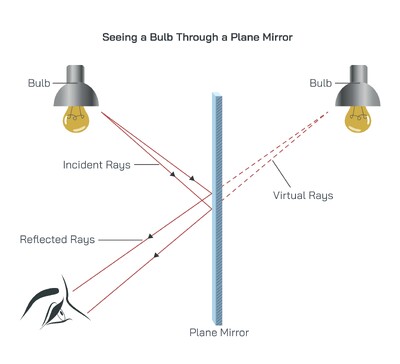
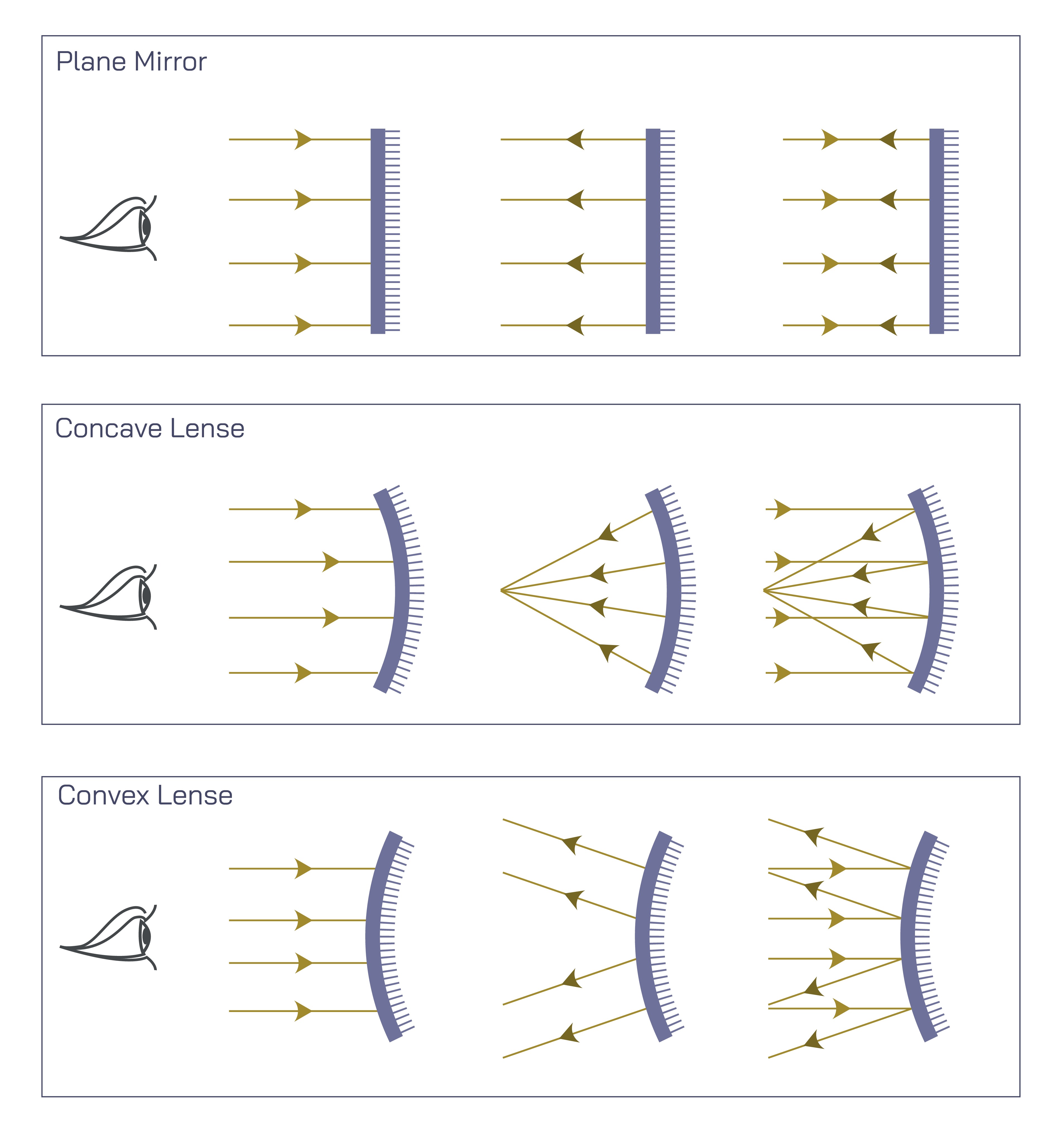
A plane mirror has a perfectly flat reflective surface, making it the simplest and most predictable type of mirror. When parallel rays of light reach a plane mirror, they bounce off with equal angles, remaining parallel after reflection. Because the surface has no curvature, the rays do not converge or diverge; instead, they appear to originate from a point behind the mirror. This creates a virtual image—one that cannot be projected onto a screen because the reflected rays do not actually meet. The image formed in a plane mirror is upright, the same size as the object, and appears the same distance behind the mirror as the object is in front. The simplicity of the plane mirror’s geometry makes it ideal for daily use, such as dressing mirrors, car mirrors, and decorative applications.
Concave Mirror: Converging Mirror That Focuses Light
A concave mirror curves inward like the inside of a bowl, causing it to behave as a converging mirror. When parallel rays of light strike its surface, the curvature directs the reflected rays toward a focal point in front of the mirror. Because of this focusing ability, concave mirrors can form real images when light rays meet physically at a point. When an object is placed far from the mirror, a reduced, inverted real image appears near the focal region. As the object moves closer, the image changes size and location, demonstrating the mirror’s adjustable imaging capability. When the object is placed between the mirror’s focal point and its surface, the reflected rays diverge so that they appear to come from behind the mirror, forming a virtual, upright, enlarged image. This magnifying effect is why concave mirrors are used in makeup mirrors, telescopes, flashlights, and vehicle headlights.
How Concave Mirrors Create Focusing and Magnification Effects
The inward curvature of a concave mirror causes incident rays to reflect inward. As rays follow symmetrical paths, they meet at the focal point. The position of the object relative to this focal point determines whether the mirror produces a magnified, reduced, upright, or inverted image. This versatility makes concave mirrors essential for devices requiring light concentration or precise magnification. Their thermodynamic focusing ability even allows them to concentrate sunlight for solar heating applications.
Convex Mirror: Diverging Mirror That Spreads Light
A convex mirror curves outward, causing light rays to spread apart after reflection. Instead of converging, the rays diverge outward and appear to originate from a point behind the mirror. This gives convex mirrors the characteristic of forming virtual, upright, and reduced images. Because the reflected rays move away from one another, the mirror provides a wider field of view compared to both plane and concave mirrors. This makes convex mirrors highly valuable for safety applications, such as roadside mirrors, vehicle rear-view mirrors, and surveillance systems. Their ability to compress large scenes into small images helps users monitor wide areas effortlessly.
How Convex Mirrors Enhance Visibility and Safety
The outward curvature forces reflected rays to diverge, making objects appear smaller but allowing a broader area to be observed. This panoramic reflection reduces blind spots and helps drivers or pedestrians see approaching objects from multiple directions. The disadvantage is that objects appear farther away than they actually are, but the benefit of increased situational awareness outweighs this limitation in safety-critical environments.
Comparing the Three Mirror Types to Understand Light Behavior
Plane mirrors preserve the direction and distance of light rays without altering their spacing. Concave mirrors bend rays inward, focusing or magnifying images depending on object placement. Convex mirrors bend rays outward, reducing image size but expanding the visible area. These differences arise directly from the curvature of the reflective surface and determine how each mirror type is used in practical settings. Understanding these behaviors allows for intelligent application in engineering, physics, visualization tools, and everyday life.
Why Mirror Geometry Matters for Image Formation
The geometry of the reflective surface controls whether light rays come together, move apart, or remain parallel. Even slight curvature changes the pathway of light dramatically, creating new image properties such as magnification, real-image projection, or wide-angle visibility. Recognizing how each mirror interacts with light helps explain everyday optical experiences and supports learning in physics, engineering, and optical design.
The Importance of Reflection Principles in Real-World Applications
Reflection governs everything from how we see ourselves to how devices capture images, illuminate spaces, or guide vehicles. Plane mirrors serve basic reflection needs, concave mirrors focus and magnify, and convex mirrors expand visibility. These principles underpin technologies used in medicine, astronomy, transportation, architecture, and safety engineering. By understanding how light behaves when encountering different mirror shapes, we gain clearer insight into the optical world and the science behind many tools we rely on daily.