Access to clean water is essential for health, hygiene, and survival. In many situations, especially during emergencies, outdoor activities, rural living, or educational demonstrations, a simple DIY water filter can help improve water clarity and remove visible impurities. Learning how to make a DIY water filter at home is an excellent way to understand the basic principles of water filtration and the importance of clean water. While a homemade filter does not replace advanced purification systems, it demonstrates how natural materials can reduce dirt, debris, and suspended particles from water.
A DIY water filter works on the principle of physical filtration. Physical filtration involves passing water through layers of materials that trap particles of different sizes. As water flows downward through the filter, larger impurities are removed first, followed by smaller particles. This layered approach mimics natural filtration processes found in soil and underground water systems. Each layer in the filter has a specific role in improving water clarity.
To make a simple DIY water filter at home, commonly available materials are used. These materials are chosen because they are easy to find, inexpensive, and effective for demonstration purposes. The filter is usually constructed in a transparent container so that the filtration process can be clearly observed. Transparency helps learners understand how water changes as it passes through each layer.
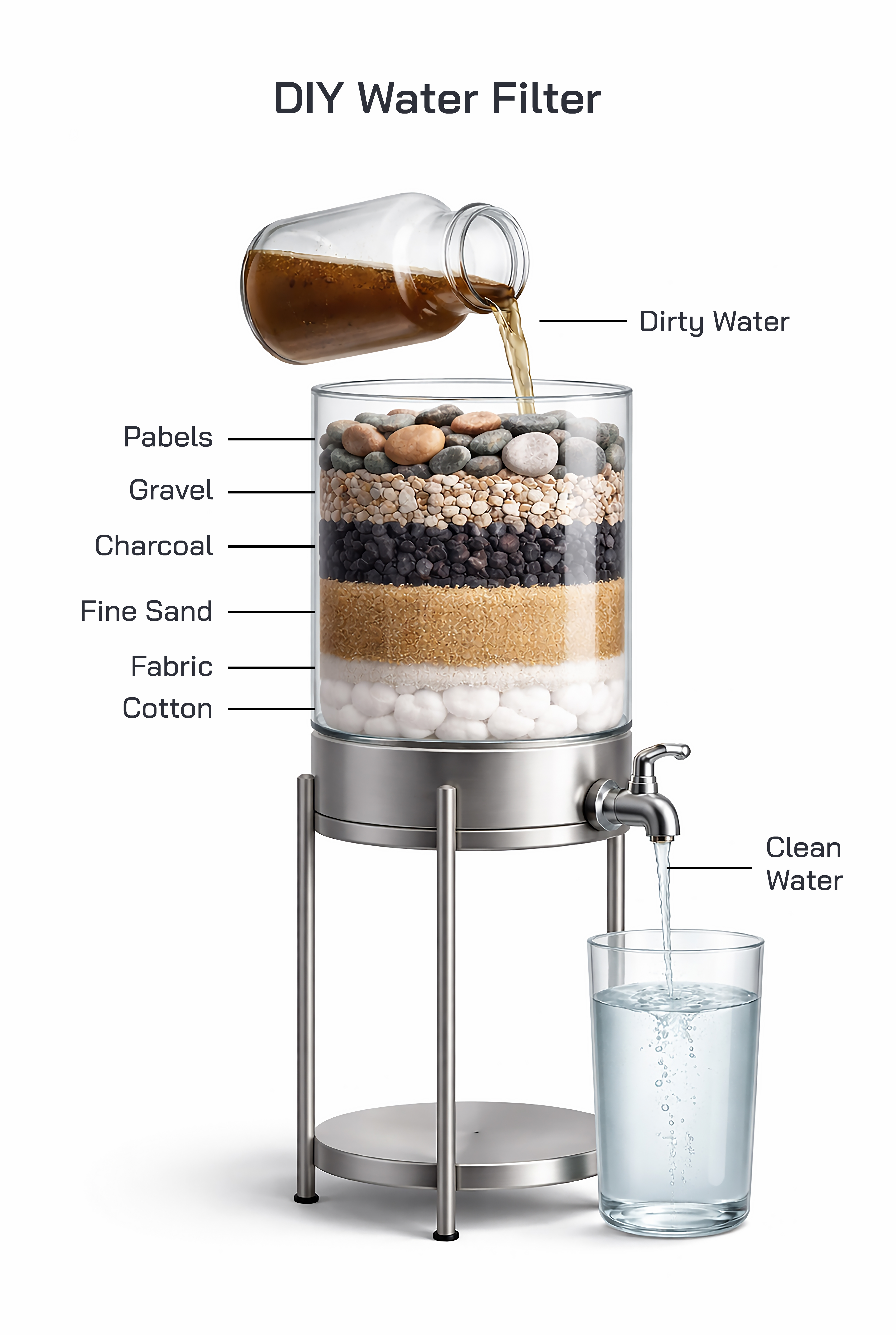
The bottom layer of a DIY water filter typically consists of cotton or soft fabric. This layer acts as a final barrier that prevents fine particles from escaping the filter. Cotton fibers trap tiny sediments and help clarify the filtered water. Fabric also provides structural support for the layers above it and prevents materials from mixing.
Above the cotton layer, fine sand is added. Fine sand plays a crucial role in removing very small particles that pass through the upper layers. Because fine sand has tightly packed grains, it slows down water flow and increases contact time, allowing more impurities to be trapped. This layer significantly improves the clarity of the filtered water.
The next layer consists of charcoal, often made from activated or natural charcoal. Charcoal has a porous structure that helps absorb certain substances from water. It improves odor and color and enhances the overall quality of the filtered water. Charcoal is widely used in commercial water filters because of its ability to attract and hold impurities within its pores.
Above the charcoal layer, gravel is placed. Gravel consists of small stones that remove larger particles and debris. This layer helps prevent clogging of the lower layers and allows water to flow evenly through the filter. Gravel also supports the layers above it, maintaining proper spacing and structure.
At the top of the filter, pebbles or larger stones are added. This top layer removes large debris such as leaves, insects, or visible dirt. It also helps distribute incoming water evenly across the filter surface, preventing disturbance of the lower layers. This even distribution improves filtration efficiency.
To assemble the DIY water filter, a clean container is placed upright with a small outlet or opening at the bottom for filtered water to exit. The layers are added one by one, starting with cotton at the bottom and finishing with pebbles at the top. Dirty water is poured slowly onto the top layer, allowing gravity to pull the water downward through each filtration stage.
As water passes through the filter, visible changes can be observed. The water that exits the bottom appears clearer than the water that entered the filter. Suspended particles are trapped within the layers, demonstrating the effectiveness of physical filtration. This transformation highlights the importance of filtration in improving water quality.
The working principle of a DIY water filter is based on gravity and material density. Gravity causes water to flow downward, while materials of different sizes trap particles according to their size. Larger impurities are stopped early, while finer impurities are removed later. This gradual reduction in particle size is essential for effective filtration.
DIY water filters are commonly used for educational purposes. They are popular science projects that help students understand environmental science, water conservation, and public health. By building a filter, learners gain hands-on experience with concepts such as separation, flow rate, and material properties. This practical approach makes abstract ideas easier to understand.
In emergency situations, a DIY water filter can help improve water clarity when clean water is unavailable. However, it is important to understand the limitations of homemade filters. While they remove visible dirt and particles, they do not eliminate microorganisms or harmful substances completely. Additional purification steps are required to make water safer for drinking.
A homemade water filter should always be followed by further treatment methods if the water is intended for consumption. These methods may include boiling or other purification techniques. The DIY filter primarily serves as a pre-treatment step that reduces turbidity and improves appearance.
The use of natural filtration materials reflects traditional water-cleaning practices used for centuries. Ancient civilizations relied on sand, gravel, and charcoal to improve water quality long before modern treatment plants existed. This historical connection highlights the effectiveness of simple filtration methods when applied correctly.
DIY water filters also promote environmental awareness. They demonstrate how natural materials can be reused for practical purposes and encourage sustainable thinking. Building a filter fosters appreciation for clean water resources and emphasizes the importance of protecting water sources from pollution.
From a scientific perspective, the DIY water filter illustrates fundamental principles of physics and environmental science. It shows how gravity, particle size, and material structure influence water movement and filtration. This makes it an excellent tool for classroom demonstrations and home learning activities.
The design of a DIY water filter can be modified to explore different outcomes. Changing the thickness of layers or the type of materials used allows experimentation and observation of results. These variations help learners understand how filtration efficiency depends on design choices.
In household settings, DIY water filters can be used to clean water for non-drinking purposes such as gardening, cleaning, or demonstration. They are particularly useful in teaching children about water safety and environmental responsibility in a hands-on way.
Access to clean and safe water has always been one of the most fundamental requirements for human survival, public health, and environmental balance. Long before modern water treatment plants existed, humans relied on simple filtration methods using natural materials to improve water quality. A DIY water filter represents this timeless concept in its most basic form. While simple in construction, it demonstrates powerful scientific principles that explain how impurities can be reduced using gravity, layering, and material properties. Exploring a DIY water filter in depth helps build a strong understanding of water purification, environmental science, and responsible water use.
At its foundation, a DIY water filter operates by imitating natural filtration processes that occur underground. When rainwater enters the soil, it passes through layers of rocks, sand, and organic matter before reaching groundwater reserves. During this journey, larger contaminants are trapped near the surface, while smaller particles are gradually removed as the water travels deeper. A homemade water filter recreates this layered system on a small scale, allowing visible observation of how water quality improves step by step.
The effectiveness of a DIY filter depends largely on the arrangement and function of its layers. Each layer is selected for its ability to trap impurities of a specific size or type. The order of these layers is critical. Starting with larger materials at the top and progressing to finer materials at the bottom ensures that the filter does not clog quickly and that water flows smoothly. This structured design allows the filter to perform consistently rather than randomly.
The bottom cotton or cloth layer plays a crucial role in the final stage of filtration. Cotton fibers form a dense network that captures very fine particles that manage to pass through the upper layers. Without this layer, fine sediments could escape into the filtered water. Cotton also stabilizes the entire structure, preventing sand or charcoal from washing out of the container. Its role is subtle but essential for clarity.
Above the cotton, the fine sand layer acts as the primary polishing stage of filtration. Sand grains are tightly packed, creating narrow pathways through which water must pass. This slows the flow and increases contact time between water and the filtering material. As a result, suspended particles that are invisible to the naked eye become trapped. This layer is responsible for the most noticeable improvement in water clarity.
The charcoal layer introduces a different type of filtration mechanism. Unlike sand and gravel, which mainly perform mechanical filtration, charcoal contributes an absorptive function. Its porous structure provides a large surface area that can hold impurities. This layer helps reduce unpleasant odors and coloration in water. Historically, charcoal has been used in water storage vessels for this very reason, demonstrating its long-standing role in water treatment.
Gravel serves as a support and transition layer. Small stones allow water to move freely while trapping larger particles that might otherwise disturb the sand and charcoal layers. Gravel also prevents compaction of finer materials, ensuring consistent flow. This structural role is important because uneven water movement can reduce filtration efficiency and create channels that allow contaminants to bypass the filter.
At the top, larger stones or pebbles act as the first line of defense. They intercept leaves, insects, and visible debris before the water reaches finer layers. This top layer also spreads water evenly across the filter surface. Even distribution prevents erosion of lower layers and maintains filter integrity during use.
Gravity is the driving force behind the entire process. As water is poured into the filter, gravity pulls it downward through each layer. The speed of flow is naturally regulated by material density and grain size. Slower flow generally results in better filtration because water remains in contact with filtering materials for a longer period. This demonstrates how physical forces influence filtration efficiency.
One of the most educational aspects of a DIY water filter is its visual transformation. Dirty or cloudy water enters the system, and clearer water emerges at the bottom. This visible change reinforces the importance of filtration and makes abstract concepts tangible. It allows learners to see how pollution can be reduced through simple methods and why filtration is a critical step in water treatment.
However, it is important to recognize the limitations of a DIY water filter. While it significantly improves water appearance by removing dirt, sediments, and debris, it does not guarantee safety for drinking. Harmful microorganisms, dissolved chemicals, and invisible pathogens may remain. This limitation highlights the difference between filtration and purification. Filtration improves physical quality, while purification addresses biological and chemical safety.
Because of these limitations, DIY water filters are best understood as pre-treatment systems. They prepare water for additional purification steps by reducing turbidity and organic matter. Clearer water responds more effectively to further treatment methods, such as heating or advanced purification technologies. This concept mirrors real-world water treatment processes, where multiple stages are combined to achieve safe drinking water.
DIY water filters are especially valuable in education. They encourage hands-on learning and critical thinking. Students can experiment with different materials, layer thicknesses, and flow rates to observe changes in performance. These experiments teach cause-and-effect relationships and foster curiosity about environmental science and engineering.
From an environmental perspective, DIY water filters promote sustainability awareness. They demonstrate how natural and reusable materials can serve practical purposes. This understanding encourages responsible resource use and highlights the importance of protecting water sources from contamination. When people understand how much effort is required to clean water, they often become more conscious of water conservation.
Historically, simple filtration systems were used by many civilizations. Sand and charcoal filters were common in ancient cultures where access to clean water was limited. These traditional methods laid the groundwork for modern filtration technologies. Studying DIY filters connects modern learners with this historical knowledge and shows how scientific progress builds upon simple observations.
In emergency and survival contexts, understanding basic filtration principles can be life-saving. While not sufficient alone, a homemade filter can reduce visible contamination when no other options are available. This knowledge empowers individuals to respond more effectively in challenging situations.
In conclusion, a DIY water filter is far more than a simple science project. It is a powerful educational tool that demonstrates natural filtration processes, material properties, and the importance of clean water. Through layered design, gravity-driven flow, and physical separation, it reveals how impurities can be reduced using simple resources. Although it does not replace advanced purification systems, it provides foundational knowledge that deepens appreciation for water treatment, environmental responsibility, and sustainable living. Making a DIY water filter at home is a simple and educational process that demonstrates how water can be cleaned using layered filtration materials. By using pebbles, gravel, charcoal, fine sand, fabric, and cotton, dirty water can be transformed into clearer water through physical filtration. Although homemade filters are not a substitute for professional purification systems, they play an important role in education, awareness, and emergency preparedness. Understanding how a DIY water filter works highlights the value of clean water, the science behind filtration, and the importance of responsible water use in everyday life.