The representation of complex numbers is a fundamental concept in mathematics that allows abstract numerical expressions to be visualized, analyzed, and understood more clearly. Complex numbers extend the real number system by including an imaginary component, making them essential in advanced mathematics, physics, engineering, and many applied sciences. To fully understand complex numbers, it is important to study the different ways in which they can be represented, the steps involved in representing them, and practical examples that demonstrate their meaning on the complex plane.
Introduction to Complex Numbers
A complex number consists of two parts: a real part and an imaginary part. Unlike real numbers, which can be shown on a single number line, complex numbers require a two-dimensional framework for representation. This need led to the development of the complex plane, also known as the Argand plane. The complex plane provides a geometric interpretation of complex numbers, allowing each number to be represented as a point or vector in a plane.
Representation is important because it bridges the gap between algebra and geometry. Through representation, complex numbers are no longer just symbols but become meaningful objects with position, distance, and direction.
Types of Representation of Complex Numbers
Complex numbers can be represented in several standard forms, each offering a different perspective and usefulness depending on the context. The most common types are algebraic representation, geometric representation, and polar representation.
Algebraic Representation of Complex Numbers
In algebraic representation, a complex number is expressed in terms of its real and imaginary components. This form highlights the numerical structure of the complex number and is particularly useful for arithmetic operations such as addition and subtraction. The algebraic form clearly separates the real and imaginary parts, making it easy to identify them.
This representation is widely used in basic algebra and introductory complex number problems. It serves as the foundation for understanding more advanced representations and helps students transition from real numbers to complex numbers smoothly.
Geometric Representation on the Complex Plane
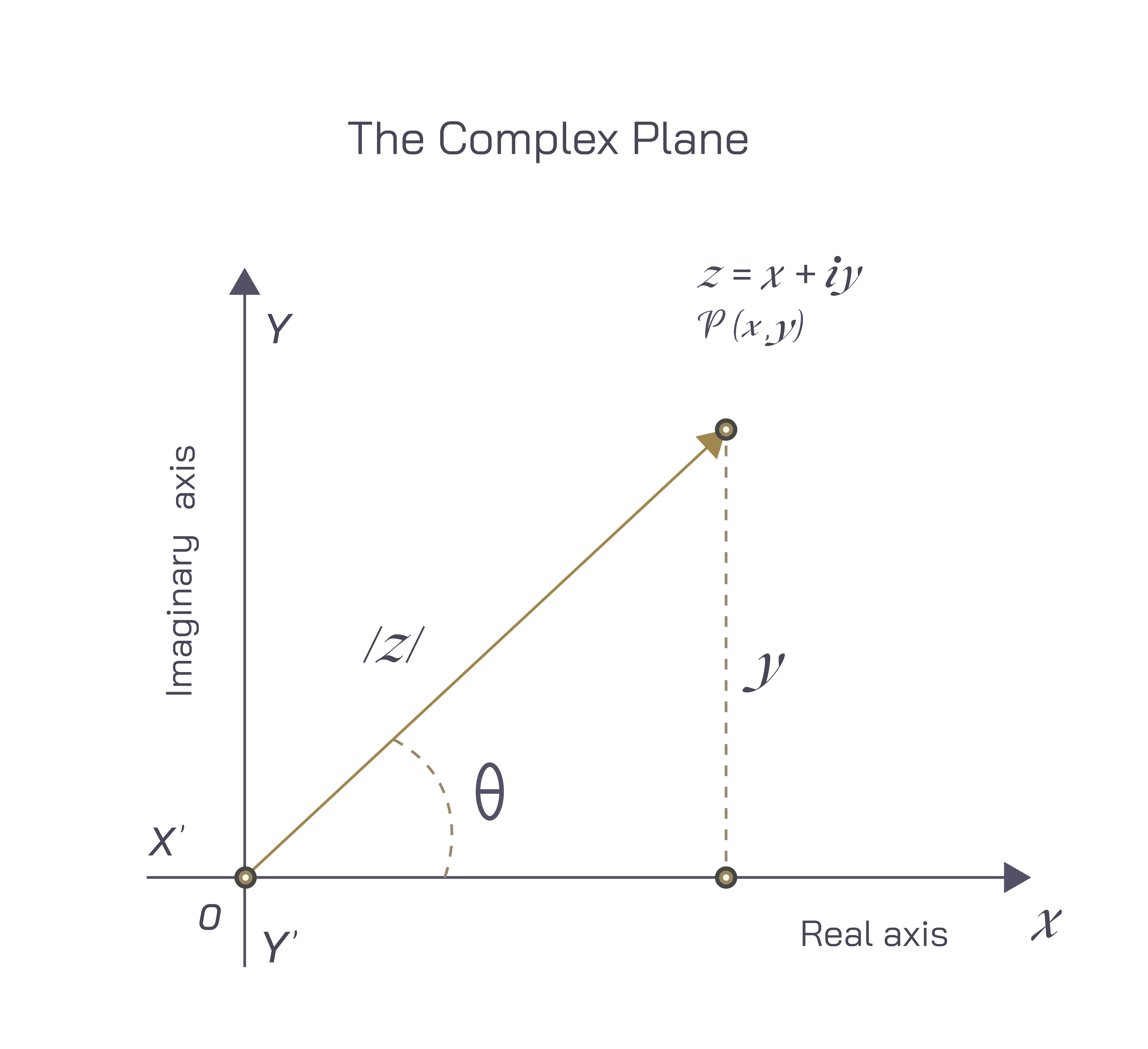
Geometric representation places complex numbers on the complex plane using two perpendicular axes. The horizontal axis represents real values, while the vertical axis represents imaginary values. Each complex number corresponds to a unique point on this plane. The coordinates of the point reflect the real and imaginary parts of the number.
In geometric representation, the complex number can also be visualized as a vector drawn from the origin to the point representing the number. This vector form provides insight into both the magnitude and direction of the complex number. It helps learners understand spatial relationships between complex numbers and observe patterns that are not immediately obvious from algebraic expressions.
Polar Representation of Complex Numbers
Polar representation describes a complex number in terms of its distance from the origin and the angle it makes with the positive real axis. Instead of focusing on horizontal and vertical components, this form emphasizes magnitude and direction. Polar representation is especially useful when dealing with rotations, oscillations, and periodic behavior.
This form connects complex numbers to trigonometry and geometry, making it a powerful tool in advanced mathematics and engineering applications. It also simplifies certain operations by converting them into geometric transformations.
Steps to Represent Complex Numbers
The process of representing complex numbers follows a clear and logical sequence. First, identify the real and imaginary components of the complex number. Next, draw the real axis horizontally and the imaginary axis vertically to form the complex plane. Locate the point corresponding to the real value along the real axis and the imaginary value along the imaginary axis. Mark the point where these two values intersect.
Once the point is plotted, draw a line from the origin to the point. This line represents the complex number as a vector. The length of this line gives the magnitude of the complex number, while the angle it makes with the real axis gives the direction. This stepwise approach ensures accuracy and reinforces the connection between numerical values and their geometric meaning.
Examples of Representation of Complex Numbers
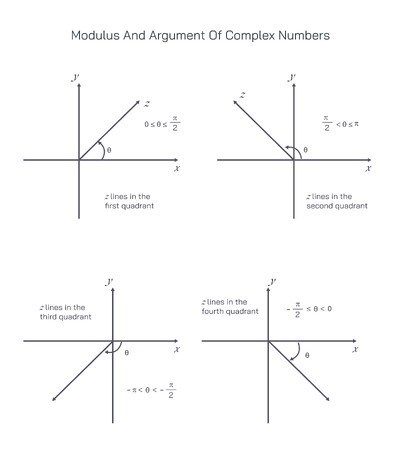
Examples play a crucial role in understanding complex number representation. When a complex number has a positive real part and a positive imaginary part, it lies in the first quadrant of the complex plane. If the real part is negative and the imaginary part is positive, the point lies in the second quadrant. Similarly, negative values of both components place the number in the third quadrant, while a positive real part and negative imaginary part place it in the fourth quadrant.
Through repeated examples, students learn to quickly identify the position of a complex number and understand how changes in its components affect its location. Examples also help clarify the relationship between algebraic form and geometric form.
Importance of Modulus and Argument in Representation
When representing complex numbers geometrically, two important quantities arise naturally. One is the distance of the point from the origin, which reflects the size or strength of the complex number. The other is the angle that the line joining the origin to the point makes with the real axis, which reflects its direction. Together, these properties provide a complete geometric description of the complex number.
Understanding these ideas enhances comprehension of polar representation and prepares learners for more advanced topics such as complex transformations and rotations.
Educational and Practical Significance
The representation of complex numbers is a key topic in higher secondary and undergraduate mathematics. It develops spatial reasoning skills and strengthens conceptual understanding. In practical fields such as electrical engineering, signal processing, and physics, complex number representation is indispensable. It allows alternating currents, waves, and oscillations to be described in a compact and intuitive way.
By mastering representation techniques, students gain the ability to interpret mathematical results visually and apply them effectively in real-world situations.
Conclusion
The representation of complex numbers transforms abstract algebraic expressions into meaningful geometric objects. Through algebraic, geometric, and polar representations, complex numbers can be understood from multiple perspectives. Step-by-step representation on the complex plane clarifies their structure, while examples reinforce learning and build confidence. Understanding these representations lays a strong foundation for advanced mathematical concepts and practical applications across science and engineering.