The modulus and argument of complex numbers are two fundamental ideas that give geometric meaning to complex numbers when they are represented on the complex plane. These concepts help translate abstract numerical values into clear visual properties such as distance and direction. By understanding modulus and argument, learners gain deeper insight into how complex numbers behave, how they are positioned relative to one another, and how they can be interpreted as vectors in a two-dimensional space.
Complex Numbers and the Need for Geometric Interpretation
Complex numbers consist of two components, one real and one imaginary. While real numbers alone can be represented on a straight number line, complex numbers require a two-dimensional framework for complete representation. The complex plane provides this framework by combining a horizontal real axis and a vertical imaginary axis. Every complex number corresponds to a unique point on this plane, allowing numerical values to be interpreted geometrically.
Once a complex number is plotted on the complex plane, two important geometric properties immediately become apparent. The first is how far the point lies from the origin, and the second is the direction in which the point lies relative to the positive real axis. These two properties are known as the modulus and the argument of the complex number.
Meaning of Modulus of a Complex Number
The modulus of a complex number represents its distance from the origin on the complex plane. Geometrically, it is the length of the straight line joining the origin to the point that represents the complex number. This idea is similar to measuring how far a point is from the center in a coordinate plane.
The modulus is always a non-negative quantity because distance cannot be negative. A complex number located farther from the origin has a larger modulus, while a complex number closer to the origin has a smaller modulus. If the complex number lies exactly at the origin, its modulus is zero. This concept allows complex numbers to be compared based on their size or magnitude, even though they exist in two dimensions rather than one.
Geometric Significance of Modulus
From a geometric point of view, the modulus gives a sense of strength or intensity associated with a complex number. When complex numbers are interpreted as vectors, the modulus corresponds to the length of the vector. This interpretation is widely used in physics, engineering, and signal analysis, where complex numbers describe quantities such as waves, alternating currents, and oscillations.
The modulus does not depend on the direction of the complex number, only on how far it is from the origin. Two complex numbers located in different directions but at the same distance from the origin have equal modulus values. This highlights the role of modulus as a measure of size rather than orientation.
Meaning of Argument of a Complex Number
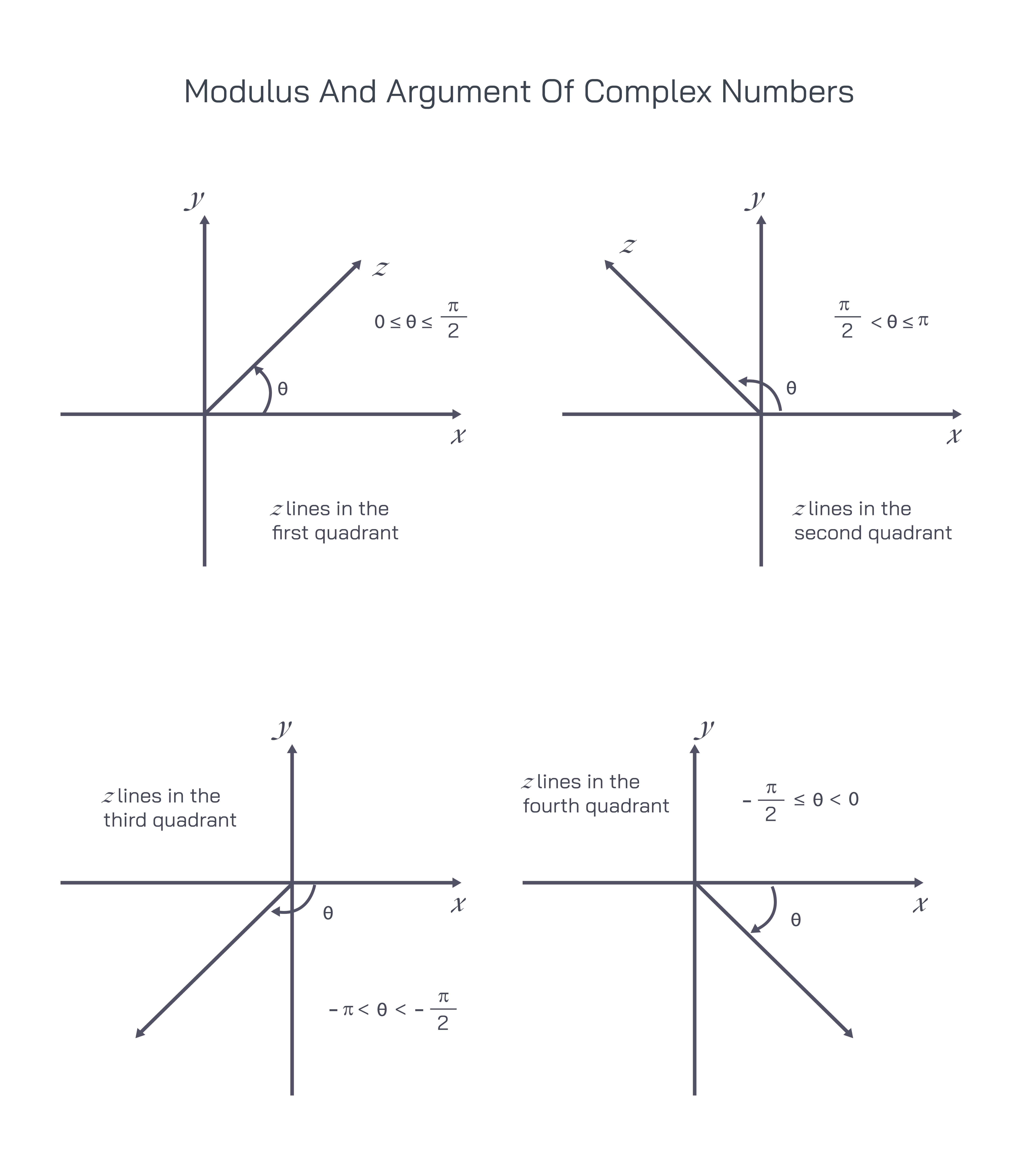
The argument of a complex number represents its direction on the complex plane. It is defined as the angle made by the line joining the origin to the point representing the complex number with the positive direction of the real axis. This angle tells us where the complex number lies relative to the horizontal axis.
The argument provides directional information and can be positive or negative depending on the quadrant in which the complex number lies. It is measured by rotating from the positive real axis toward the line joining the origin to the point. The sense of rotation determines the sign of the argument.
Quadrant-Wise Interpretation of Argument
The complex plane is divided into four quadrants, and the argument of a complex number depends on the quadrant in which it is located. When a complex number lies in the first quadrant, both its real and imaginary components are positive, and its argument is a positive angle measured upward from the real axis. In the second quadrant, the real component is negative while the imaginary component is positive, and the argument lies between a right angle and a straight angle measured from the real axis.
In the third quadrant, both real and imaginary components are negative, and the argument corresponds to a direction pointing downwards and leftwards. In the fourth quadrant, the real component is positive and the imaginary component is negative, resulting in a negative angle measured downward from the real axis. This quadrant-based interpretation ensures that each complex number has a unique directional description.
Principal Value of Argument
Although a complex number can be associated with multiple directional angles due to full rotations around the origin, a standard range is often chosen to represent its argument uniquely. This selected value is called the principal value of the argument. It ensures consistency when comparing arguments of different complex numbers and is widely used in mathematical analysis and education.
The concept of a principal value helps avoid ambiguity and allows arguments to be represented within a defined interval. This makes graphical interpretation clearer and simplifies the study of complex number behavior.
Relationship Between Modulus and Argument
Together, modulus and argument fully describe the position of a complex number on the complex plane. The modulus specifies how far the number lies from the origin, while the argument specifies the direction in which it lies. This pair of values provides an alternative way of representing complex numbers, focusing on geometric interpretation rather than purely algebraic form.
This combined description is especially useful when studying transformations such as rotations and scaling. Changes in modulus affect the distance from the origin, while changes in argument affect the direction. This separation of size and direction makes complex numbers easier to visualize and manipulate conceptually.
Importance in Mathematics and Applications
The concepts of modulus and argument play a crucial role in higher mathematics, particularly in complex analysis. They are essential for understanding geometric transformations, wave behavior, and rotational motion. In engineering and physics, these ideas help describe alternating currents, signal phases, and oscillatory systems in a clear and intuitive manner.
In education, modulus and argument help students develop spatial reasoning and bridge the gap between algebra and geometry. By visualizing complex numbers as vectors with length and direction, learners gain a deeper and more intuitive understanding of abstract mathematical ideas.
Conclusion
The modulus and argument of complex numbers provide a complete geometric description of complex values on the complex plane. The modulus represents distance from the origin, while the argument represents direction relative to the real axis. Together, they transform complex numbers from abstract expressions into meaningful geometric entities. Understanding these concepts strengthens mathematical intuition, supports advanced learning, and reveals the elegant connection between numbers and geometry.