Lateral inversion is a common yet fascinating optical phenomenon observed when objects are viewed in a plane mirror. It refers to the apparent left–right reversal of an image compared to the original object. While this effect is familiar from everyday experiences such as looking at text or raising a hand in front of a mirror, the underlying reason for lateral inversion lies in the way light reflects and how the human brain interprets reflected rays. Understanding lateral inversion provides clear insight into mirror behavior, light reflection, and image formation.
A plane mirror is a flat, smooth reflective surface that reflects light in a regular and predictable manner. When light strikes a plane mirror, it follows a fundamental optical rule known as the law of reflection. This rule states that the angle at which light strikes the mirror surface is equal to the angle at which it reflects away. Because the surface is smooth, reflected rays remain orderly rather than scattering, allowing a clear image to form.
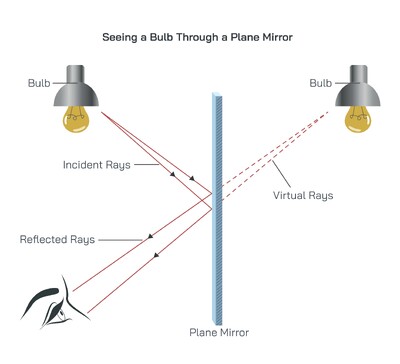
When an object is placed in front of a plane mirror, light rays from every point on the object travel toward the mirror. These rays strike the mirror and reflect back into the surrounding space. Some of the reflected rays enter the observer’s eyes. The brain assumes that light always travels in straight lines, so it traces the reflected rays backward. These backward extensions appear to meet at a point behind the mirror, creating the perception of an image. This perceived image is known as a virtual image.
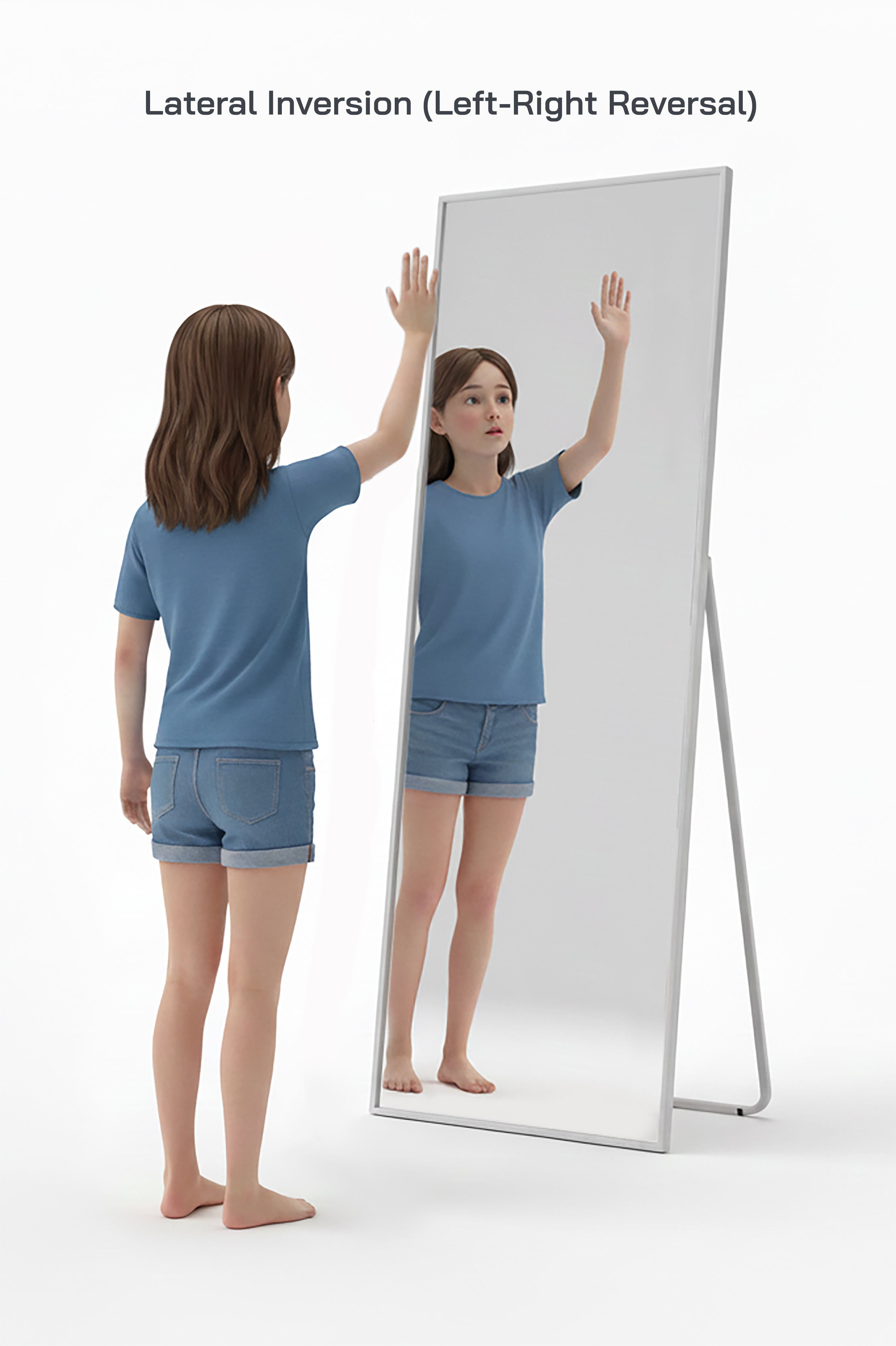
The image formed in a plane mirror has several consistent properties. It appears upright, meaning it is not upside down. It is the same size as the object, and it appears to be located the same distance behind the mirror as the object is in front. Despite these similarities, one important difference exists between the object and its image: the left and right sides appear reversed. This reversal is what we call lateral inversion.
To understand lateral inversion, it is important to clarify what is actually reversed. A plane mirror does not swap left and right in a physical sense. Instead, it reverses the image along the axis perpendicular to the mirror surface. In simpler terms, the mirror reverses front and back. However, because humans interpret images based on their own orientation, this front–back reversal is perceived as a left–right reversal.
For example, when you raise your right hand in front of a mirror, the image appears to raise its left hand. In reality, the mirror image is facing you, so its right side corresponds to your left side. The mirror does not change left into right directly; it flips the image depth-wise. This depth reversal creates the illusion of left–right inversion from the observer’s perspective.
Lateral inversion becomes especially noticeable when observing text in a mirror. Letters appear reversed because the front-facing orientation of the object is flipped. Words become difficult to read because the spatial arrangement of letters is mirrored. This effect highlights how the orientation of objects relative to the mirror surface influences perception.
Light reflection plays a central role in this phenomenon. When light rays reflect from the mirror, their horizontal direction changes, but their vertical orientation remains the same. This is why images in a plane mirror are upright rather than inverted vertically. The mirror maintains vertical alignment while reversing depth, leading to the apparent horizontal reversal.
Ray diagrams are often used to explain lateral inversion visually. In these diagrams, light rays from an object strike the mirror and reflect according to the law of reflection. The reflected rays are then extended backward to locate the virtual image. These diagrams clearly show that the image is formed behind the mirror and that the orientation of the image differs from the object in a predictable way.
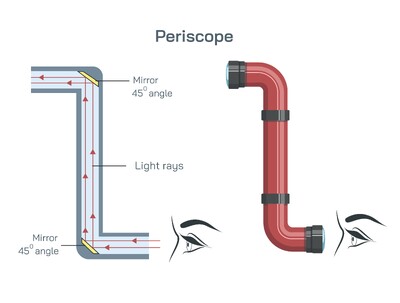
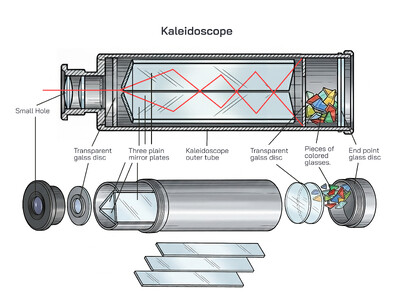
The concept of lateral inversion is important in understanding everyday optical devices. Mirrors used in homes, vehicles, and scientific instruments rely on predictable reflection behavior. Knowing how images reverse helps in designing and using mirrors effectively, especially in applications where orientation matters.
In educational settings, lateral inversion is commonly demonstrated using simple experiments. Students may observe their hands, arrows, or written text in a mirror to see how orientation changes. These demonstrations make abstract optical principles more tangible and help learners connect theory with observation.
The phenomenon also explains why certain mirror-related tasks require adaptation. For example, mirror writing appears reversed when viewed directly but reads normally when reflected. This principle is sometimes used intentionally in design and security applications. Understanding lateral inversion allows such effects to be used purposefully rather than appearing confusing.
From a psychological perspective, the brain plays a key role in interpreting mirror images. Humans are accustomed to interacting with people who face the same direction. When confronted with a mirror image that faces them, the brain interprets orientation differently. This interpretation contributes to the perception of left–right reversal, even though the physical process involves depth inversion.
Lateral inversion does not occur in the same way with all reflective surfaces. Curved mirrors and lenses create different image properties due to changes in reflection angles and light convergence. The consistent behavior of plane mirrors makes lateral inversion predictable and easy to study, reinforcing their importance in basic optics.
The smoothness of the mirror surface is essential for clear lateral inversion. Any irregularities on the surface cause diffuse reflection, scattering light in many directions. This scattering disrupts image formation and reduces clarity. High-quality plane mirrors are polished to ensure regular reflection and accurate image orientation.
In practical life, lateral inversion affects how people position objects using mirrors. Activities such as driving, grooming, or aligning tools require an understanding of reversed orientation. With experience, the brain quickly adapts to this reversal, allowing smooth interaction with mirror images.
Lateral inversion is often introduced as a simple left–right reversal seen in a plane mirror, but a deeper examination reveals that it is a subtle outcome of geometry, light behavior, spatial orientation, and human perception working together. What makes lateral inversion especially interesting is that it is not a direct physical flipping of left and right by the mirror itself, but rather an effect that emerges when a three-dimensional object is reflected across a flat surface and then interpreted by the human brain.
At the most fundamental level, lateral inversion begins with how a plane mirror interacts with light. A plane mirror reflects light in a highly ordered manner because its surface is flat and polished. Each ray of light striking the mirror obeys the law of reflection, maintaining equal angles of incidence and reflection. This law ensures that spatial relationships between points on an object are preserved in a precise way. However, the mirror introduces a reversal along one specific dimension: the dimension perpendicular to its surface.
When an object stands in front of a mirror, every point on that object has a corresponding image point behind the mirror. The mirror does not rotate the object or twist it sideways. Instead, it produces a symmetrical counterpart across the mirror plane. This symmetry is similar to folding space along the mirror surface. The object and its image are mirror-symmetric, meaning that depth is reversed while height and width remain unchanged.
This depth reversal is the true physical transformation caused by the mirror. What was in front of the mirror appears behind it, and what faced toward the mirror now faces away in the image. Because humans naturally define left and right based on facing direction, this front–back reversal is mentally reinterpreted as a left–right swap. Thus, lateral inversion is as much a perceptual phenomenon as it is an optical one.
To understand this more clearly, imagine labeling the directions around an object as up–down, left–right, and front–back. A plane mirror preserves up–down and left–right directions but reverses front–back. However, when the image faces the observer, the observer mentally rotates the image to compare it with the real object. During this mental comparison, the preserved left–right orientation becomes confusing, and the depth reversal is perceived as a horizontal reversal. This is why lateral inversion feels intuitive yet puzzling.
The behavior of letters and symbols in a mirror provides a powerful illustration of this effect. Letters such as “A” or “H,” which are symmetrical, appear unchanged, while letters like “F” or “R” appear reversed. This does not happen because the mirror selectively flips letters, but because asymmetrical shapes reveal the direction reversal more clearly. Written text emphasizes lateral inversion because reading depends heavily on left-to-right spatial order.
Another important aspect of lateral inversion is that it does not depend on the observer’s position. Whether a person stands to the left, right, or center of the mirror, the image always exhibits the same inversion. This consistency confirms that lateral inversion is determined by the object–mirror relationship, not by where the observer stands. The observer merely receives reflected rays and interprets them visually.
In three-dimensional space, lateral inversion becomes even more intriguing. A mirror image cannot be superimposed onto the original object without lifting it out of the plane. This property, known as chirality, explains why mirror images of certain objects are fundamentally different. Human hands are a classic example. A right hand and its mirror image cannot be perfectly aligned without flipping one through space. This physical impossibility reinforces the idea that mirrors reverse depth, creating non-superimposable images.
The concept of lateral inversion also plays a role in learning coordination and motor skills. Activities performed while watching a mirror, such as dancing, exercising, or practicing medical procedures, require the brain to adapt to reversed spatial cues. Over time, the brain learns to compensate automatically, demonstrating neural adaptability. This adaptation shows that lateral inversion is not just an optical phenomenon but also a neurological challenge.
In technology and design, lateral inversion must often be corrected intentionally. Cameras, video conferencing systems, and optical instruments may reverse images digitally so that users see themselves in a familiar orientation. This correction highlights how deeply humans rely on consistent spatial interpretation and how disorienting uncorrected mirror inversion can be in certain contexts.
From an educational standpoint, lateral inversion serves as a gateway to more advanced optical concepts. Once students understand why a plane mirror produces lateral inversion, they are better prepared to study image rotation, reflection symmetry, coordinate transformations, and even concepts used in physics, mathematics, and computer graphics. The mirror becomes a real-world model of abstract spatial transformations.
Historically, lateral inversion has influenced art and craftsmanship. Artists working from mirrors must mentally reverse their movements, and engravers historically carved mirror-reversed designs so that printed results appeared correct. These practices demonstrate practical awareness of mirror inversion long before formal optical theory was developed.
Importantly, lateral inversion does not imply distortion. The image remains the same size, shape, and proportion as the object. Distances are preserved symmetrically, and vertical orientation remains unchanged. This precision is why plane mirrors are so useful and reliable despite the inversion effect. The mirror provides an accurate spatial representation, simply reflected across a plane.
Lateral inversion is the visual outcome of reflecting three-dimensional space across a flat surface and interpreting that reflection with a human brain adapted to face-forward interactions. It arises from depth reversal, not a direct swapping of left and right, and becomes noticeable because of how humans compare mirror images with real objects. This phenomenon transforms an ordinary mirror into a powerful tool for understanding light behavior, spatial symmetry, and human perception. By exploring lateral inversion in detail, one gains a deeper appreciation of how simple optical principles shape everyday visual experience.
Lateral inversion can be understood more deeply when it is examined as a spatial transformation rather than a simple visual trick. A plane mirror does not merely reflect objects; it creates a geometrical mapping between real space and virtual space. This mapping follows strict symmetry rules, and lateral inversion emerges as a natural consequence of reflecting three-dimensional space across a two-dimensional plane. The mirror acts as a boundary that divides space into two symmetrical halves, with every point in front of the mirror having a corresponding point behind it.
From a geometrical perspective, a plane mirror performs a reflection transformation across a single axis. This axis is perpendicular to the mirror surface. All spatial coordinates parallel to the mirror remain unchanged, while the coordinate perpendicular to the mirror changes direction. This means that height and horizontal spread are preserved exactly, while depth is reversed. This is why objects appear neither stretched nor compressed, and why their vertical orientation remains upright. The mirror does not rotate objects; it reflects them.
The confusion that gives rise to the idea of left–right reversal stems from how humans define orientation. Humans naturally define left and right relative to the direction they are facing. When an image appears to face the observer from behind the mirror, the observer instinctively compares the image to another person standing face-to-face. In face-to-face interactions, another person’s left side aligns with the observer’s right side. This familiar comparison causes the brain to label the mirror image as left–right reversed, even though the mirror itself has only reversed depth.
This perceptual reinterpretation becomes clearer when imagining a coordinate system. If a person labels the directions around them as up, down, left, right, front, and back, a plane mirror only swaps front and back. Left remains left relative to the mirror surface, and right remains right. However, because the image appears to turn around and face the observer, the observer mentally rotates the coordinate system of the image. It is during this mental rotation that left and right seem to exchange positions.
Lateral inversion is therefore a powerful demonstration of how perception and physical reality can differ. Physically, the mirror obeys simple optical laws and geometrical symmetry. Perceptually, the brain adds layers of interpretation based on experience, body orientation, and expectations. This makes lateral inversion an excellent example of how vision is not a passive recording of reality, but an active process of interpretation.
Another important dimension of lateral inversion is its relationship with symmetry and asymmetry. Objects that are symmetrical along their vertical axis appear unchanged in a mirror, making lateral inversion less noticeable. Asymmetrical objects, however, reveal inversion clearly. This is why human faces, which are only approximately symmetrical, often look subtly “different” in mirrors compared to photographs. The mirror reveals a version of the face that is spatially reversed, which can feel unfamiliar because people are more accustomed to seeing their photographic orientation.
In three-dimensional contexts, lateral inversion highlights the concept of non-superimposable mirror images. Certain shapes and structures cannot be aligned with their mirror images without flipping them through space. This property explains why a mirror image of a right hand behaves like a left hand. This phenomenon is not limited to optics; it appears in chemistry, biology, and crystallography, where mirror-image structures exhibit different properties despite having the same basic components.
Lateral inversion also affects motion perception. When a person moves in front of a mirror, the image appears to move in a way that feels intuitive, even though the spatial mapping is reversed. This occurs because motion parallel to the mirror surface remains unchanged, while motion toward or away from the mirror is reversed. The brain quickly adapts to this mapping, allowing smooth interaction with mirror images. This adaptability demonstrates the flexibility of human spatial processing.
In learning environments, lateral inversion challenges students to think beyond surface-level descriptions. It encourages them to distinguish between physical transformations and perceptual interpretations. When students understand that mirrors reverse depth rather than left and right, they gain a clearer conceptual framework for studying optics, coordinate geometry, and spatial reasoning. This understanding becomes especially valuable when transitioning to more advanced topics involving rotations, reflections, and transformations.
Technological systems often account for lateral inversion deliberately. Some digital displays reverse mirror images to match real-world orientation, while others preserve inversion for familiarity. The choice depends on context and user expectations. This shows that lateral inversion is not inherently problematic; it is only problematic when it conflicts with human intuition or task requirements.
Historically, awareness of lateral inversion influenced craftsmanship and engineering long before formal optical theory. Artisans learned through experience that designs seen in mirrors or reflective surfaces appeared reversed. This practical knowledge allowed them to compensate intentionally. Such historical adaptations underline how closely human activity has always been linked to optical phenomena.
At its core, lateral inversion is a manifestation of reflection symmetry in physical space combined with cognitive interpretation. The mirror performs a precise, rule-based transformation, while the brain interprets the result through a lens shaped by everyday interactions and expectations. The apparent left–right reversal is therefore not a flaw or distortion, but a predictable outcome of how reflective symmetry interacts with human perception.
By studying lateral inversion in depth, one gains insight not only into how mirrors work, but also into how humans understand space itself. The phenomenon reveals that vision depends as much on interpretation as on light, and that even the simplest optical devices can expose profound connections between physics, geometry, and cognition.
In conclusion, lateral inversion is the apparent left–right reversal observed when objects are viewed in a plane mirror. This effect arises from the reflection of light and the formation of a virtual image behind the mirror. While the mirror reverses depth rather than left and right directly, human perception interprets this change as horizontal reversal. By understanding how light reflects in a mirror and how images are formed, lateral inversion becomes a clear and logical outcome of basic optical principles. This phenomenon not only explains everyday mirror experiences but also serves as a foundational concept in the study of light and reflection.