Casimir Effect — Quantum Vacuum Force
The Casimir Effect stands as one of the most intriguing and conceptually transformative phenomena in modern physics, revealing that even what we perceive as “empty space” is far from empty. Instead, the vacuum at the quantum level seethes with fluctuating energy, constantly producing transient particle–antiparticle pairs that appear and disappear too rapidly to be detected directly but nonetheless exert measurable force. The Casimir Effect shows that these vacuum fluctuations are not merely mathematical curiosities but physically real, capable of pushing or pulling objects depending on their geometry, separation, and the constraints they impose on the surrounding quantum fields. This extraordinary effect strengthens the idea that the universe is supported by a deep underlying field structure, where classical emptiness dissolves into a dynamic sea of activity. To understand the Casimir Effect in its full conceptual richness, one must explore not only the quantum behavior of vacuum energy but also the way physical boundaries alter the structure of that energy, creating regions where the vacuum forces differ on either side of an object. These differences lead to a net force, demonstrating that the vacuum itself can generate push or pressure without any traditional physical medium.
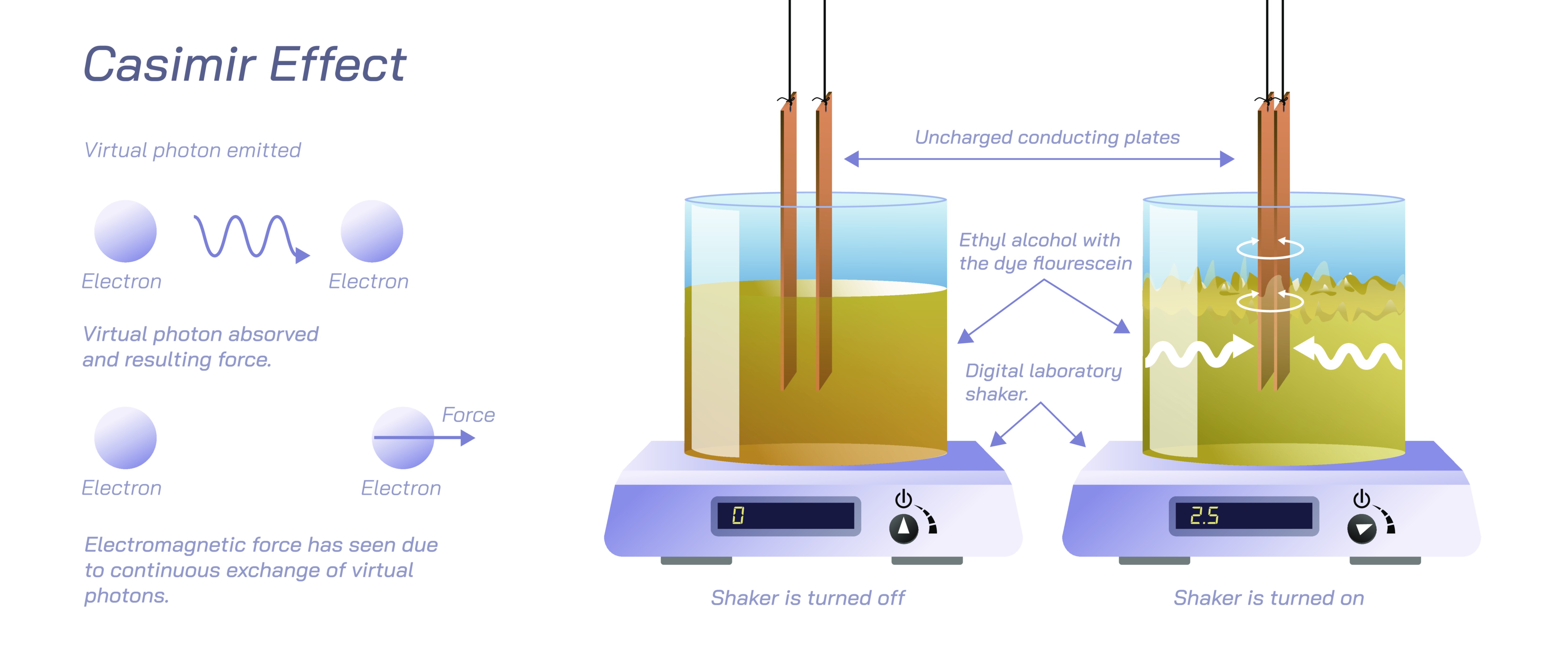
The effect was first predicted in 1948 by Dutch physicist Hendrik Casimir, who sought to explain why two uncharged, parallel metal plates positioned very close together might experience a force that could not be attributed to electric charge, magnetism, or any conventional interaction. His theoretical prediction suggested that the presence of the plates restricts the types of quantum fluctuations that can arise in the intervening space. Outside the plates, the quantum vacuum remains unconstrained, supporting a wide range of energy states produced by the fluctuating electromagnetic field. Inside the narrow gap between the plates, however, the geometry only allows certain wavelengths of these vacuum fluctuations to exist. Because long-wavelength fluctuations cannot fit in the tiny space between the plates, the vacuum energy density inside the gap becomes lower than the vacuum energy density outside it. This imbalance creates a net force pushing the plates together. It is not the plates themselves generating the force but rather the vacuum energy difference created by their presence. This demonstration of seemingly empty space exerting pressure challenged the classical intuition that forces require traditional forms of matter or energy carriers.
Although Casimir's initial prediction involved an attractive force between parallel plates, the underlying physics allows for much more complex behavior depending on the arrangement and properties of the boundaries. Certain geometries, such as spherical cavities or specifically shaped surfaces, can actually give rise to repulsive Casimir forces. This discovery broadened the scope of the phenomenon, showing that the Casimir Effect is not simply a quirky example of attraction but a more general expression of how boundaries govern the quantum field structure. The realization that vacuum forces could be either attractive or repulsive depending on geometry opened new theoretical avenues, as physicists began exploring how manipulating boundaries might enable new technologies. In microelectromechanical systems (MEMS), for example, Casimir forces can become non-negligible and even problematic, causing tiny components to stick together. Engineers studying nanoscale devices need to account for these vacuum forces, as they become significant when objects are separated by only a few nanometers. Thus, a phenomenon once confined to theoretical physics has become directly relevant to the development of advanced technologies.
The quantum vacuum, often described as the lowest energy state of a field, embodies a fluctuating reality that cannot be fully eliminated, even at absolute zero. At these scales, quantum mechanics dictates that fields cannot remain perfectly still; doing so would violate the uncertainty principle, which forbids precise simultaneous knowledge of certain physical quantities. This constant fluctuation produces a foam-like background where energy momentarily condenses as virtual particles that interact with boundaries in subtle but detectable ways. The Casimir Effect is one of the clearest manifestations of these vacuum fluctuations, serving as direct experimental evidence that quantum fields permeate space even in the absence of matter. Over the years, experimental confirmations of the effect have grown increasingly precise. Modern measurements use ultra-sensitive force detectors and meticulously crafted metal plates or spheres to confirm the subtle pressure generated by vacuum energy. These experiments consistently validate Casimir’s prediction, reinforcing the notion that the quantum vacuum is a real physical entity.
The Casimir Effect also holds profound implications for quantum field theory and cosmology. If vacuum energy exists in a measurable form, as the effect demonstrates, then its large-scale contribution to the universe raises fundamental questions. One of the great mysteries in modern physics is the discrepancy between the theoretically predicted vacuum energy density and the actual observed expansion rate of the universe. Quantum field theory predicts a vacuum energy far larger than what is consistent with astronomical observations. This vast mismatch, sometimes called the “cosmological constant problem,” remains one of the most significant unresolved questions in science. The Casimir Effect offers a controlled, laboratory-scale manifestation of vacuum energy, reminding physicists that although the vacuum contributes energy, the way this energy influences gravity or large-scale structure remains deeply perplexing. The effect thus sits at the intersection of quantum theory and cosmology, challenging scientists to reconcile traditional models with the complexities revealed through precise measurement.
Another fascinating aspect of the Casimir Effect is how it influences the conceptual picture of forces themselves. Traditional forces typically require some mediating particle or field: electromagnetism uses photons, gravity uses spacetime curvature, and nuclear forces use bosons. The Casimir force, however, emerges not from a fundamental force field but from a change in the allowed modes of the electromagnetic vacuum. It shows that forces can arise even when no classical field is acting, simply because the structure of the vacuum has been altered. This insight complicates our intuitive understanding of interactions and challenges the clear-cut distinctions once made between empty space and fields. The vacuum becomes an active player rather than a passive backdrop, and the boundaries we impose shape its behavior in ways that turn geometric constraints into measurable forces.
The Casimir Effect also paves a path toward potential future technologies. By exploiting repulsive Casimir forces through carefully engineered materials and geometries, researchers hope to reduce friction in nanoscale devices or even create forms of quantum levitation. Although these ideas remain mostly experimental, the possibility that vacuum fluctuations could support stable, frictionless configurations is compelling. The push toward metamaterials—engineered structures capable of manipulating electromagnetic fields—makes it increasingly feasible to tailor the vacuum environment and influence Casimir forces deliberately. This connection between fundamental physics and applied engineering reveals how discoveries rooted in the quantum world eventually shape real-world technology.
In summary, the Casimir Effect is not merely a peculiar footnote in physics but a powerful demonstration that the vacuum is a dynamic, energy-filled medium capable of exerting real, measurable forces. Its discovery deepened our understanding of quantum fields, challenged long-held assumptions about empty space, and opened new avenues for technological innovation. It ties together concepts from quantum mechanics, thermodynamics, relativity, and cosmology, showing that even at the smallest scales, the universe behaves in ways that defy classical expectations. Through the Casimir Effect, we glimpse the profound truth that reality extends far beyond what our senses perceive, and that the silent fluctuations of the quantum vacuum shape both the microscopic and the cosmic frameworks in which all matter exists.