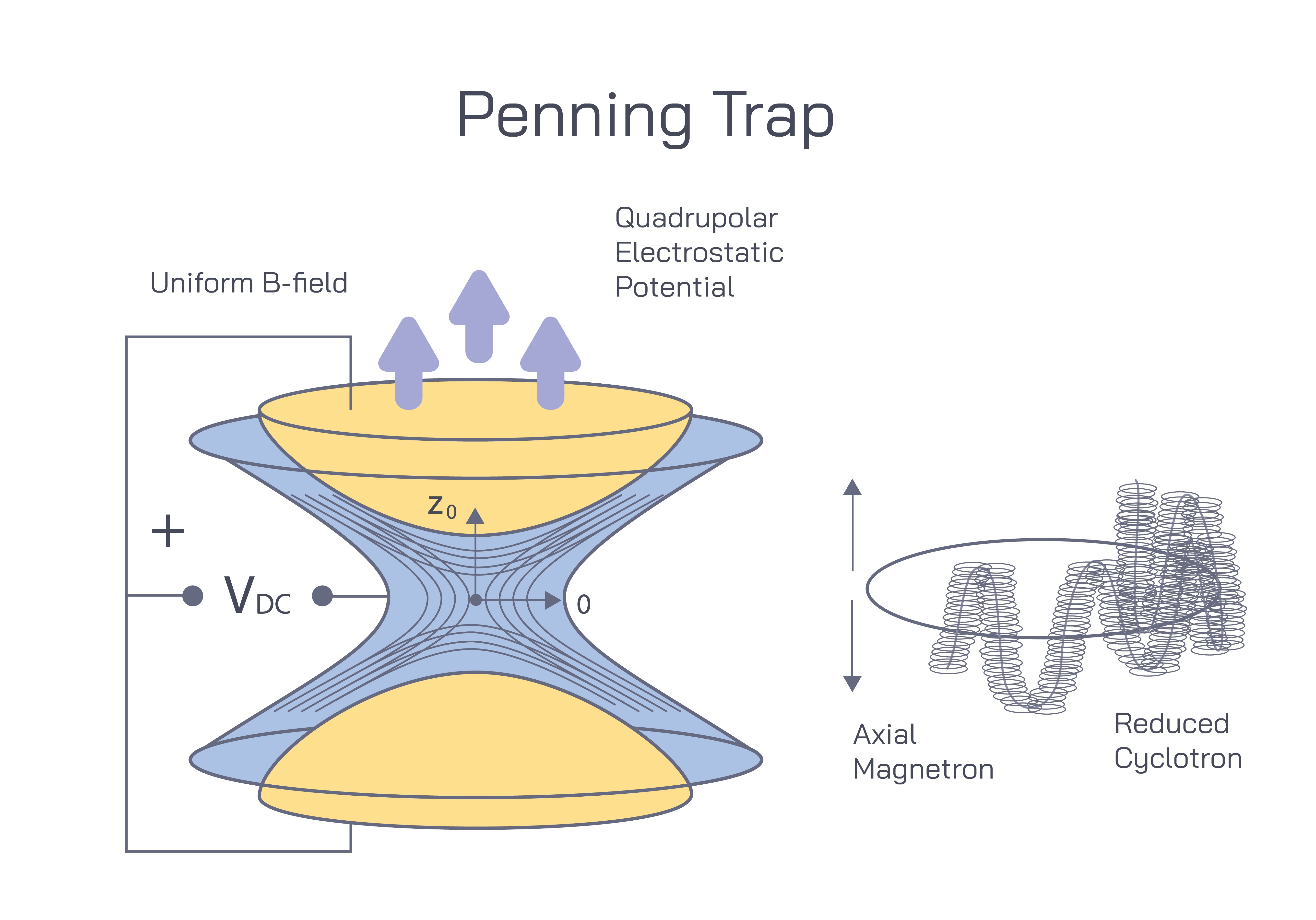
A Penning trap is a highly specialized scientific device used to confine charged particles, such as ions or electrons, within a small region of space using a precise combination of electric and magnetic fields. It is an essential tool in modern experimental physics, particularly in areas requiring extremely accurate measurements of particle properties. The Penning trap allows charged particles to be isolated from their surroundings without physical contact, enabling long observation times and highly controlled experimental conditions.
The fundamental concept behind the Penning trap lies in the behavior of charged particles in electromagnetic fields. A charged particle moving in a magnetic field experiences a force that causes it to follow a curved path rather than moving in a straight line. At the same time, an electric field can be used to control particle motion along a specific direction. By carefully combining these two fields, the Penning trap creates a stable environment in which charged particles remain confined in all three spatial dimensions.
Structurally, a Penning trap consists of a set of electrodes arranged symmetrically around a central region. The most common design uses three electrodes: one ring-shaped electrode and two end-cap electrodes positioned above and below the ring. These electrodes are placed inside a high-vacuum chamber to minimize collisions with gas molecules, which could otherwise disturb the trapped particles. A strong, uniform magnetic field is applied along the axis of symmetry of the trap, typically generated by a superconducting magnet.
The magnetic field in a Penning trap provides radial confinement. When a charged particle enters the trap, the magnetic field forces it to move in a circular path perpendicular to the field direction. This circular motion prevents the particle from moving outward and escaping the trap radially. The strength of the magnetic field determines how tightly the particle is confined, with stronger fields producing smaller circular paths.
The electric field in the Penning trap is produced by applying a voltage difference between the ring electrode and the end-cap electrodes. This voltage arrangement creates an electric quadrupole field that confines particles along the axial direction. If a charged particle moves too far toward one of the end caps, the electric field pushes it back toward the center of the trap. In this way, the electric field prevents the particle from escaping along the axis of the magnetic field.
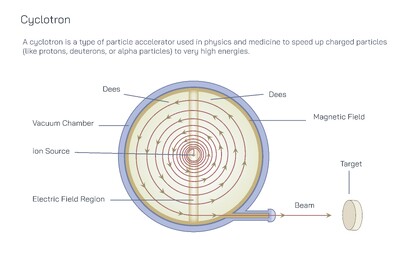
The motion of a charged particle inside a Penning trap is not simple but consists of three distinct components that together result in stable confinement. The first component is cyclotron motion, which is the rapid circular motion of the particle caused by the magnetic field. This motion occurs perpendicular to the magnetic field and is a key feature used in precision measurements, as its frequency depends on the particle’s charge and mass.
The second component of motion is known as magnetron motion. This is a slower circular drift that arises from the combined effect of the electric and magnetic fields. Magnetron motion causes the particle to orbit the center of the trap at a larger radius and lower frequency than the cyclotron motion. Although slower, this motion contributes significantly to the overall stability of radial confinement.
The third component is axial oscillation. This motion occurs along the direction of the magnetic field and is controlled primarily by the electric quadrupole field. When a charged particle moves upward or downward along the axis, the electric field pulls it back toward the center, causing it to oscillate between the two end-cap electrodes. This oscillatory motion ensures that the particle remains confined along the axial direction.
The combination of cyclotron motion, magnetron drift, and axial oscillation results in a complex but well-defined trajectory that keeps the charged particle trapped in space. Because the trap uses static electric and magnetic fields, the particle can remain confined for extremely long durations. In carefully controlled environments, particles have been stored in Penning traps for days, weeks, or even longer, allowing detailed study without significant energy loss.
One of the most important applications of the Penning trap is in high-precision mass spectrometry. By measuring the cyclotron frequency of a trapped ion in a known magnetic field, scientists can determine its mass with extraordinary accuracy. This capability is crucial for refining atomic mass values, studying nuclear reactions, and testing theoretical models in physics and chemistry.
Penning traps also play a vital role in fundamental physics research. They are used to study the properties of elementary particles and antiparticles with high precision. By comparing the behavior of particles and their corresponding antiparticles under identical conditions, researchers can test fundamental symmetries of nature and explore questions related to the structure of matter and the laws of physics.
In atomic and quantum physics, Penning traps enable precision spectroscopy experiments. Trapped ions can be probed using electromagnetic radiation to study their energy levels and transitions. These measurements provide insights into quantum mechanics, atomic structure, and interactions between particles and fields. The high level of control offered by the Penning trap makes it ideal for such sensitive experiments.
The operational environment of a Penning trap is carefully maintained to ensure stability and accuracy. Ultra-high vacuum conditions reduce unwanted interactions, while temperature control minimizes noise and drift. Advanced detection techniques are used to monitor particle motion indirectly by measuring tiny electrical signals induced in the electrodes. These non-invasive methods allow continuous observation without disturbing the trapped particles.
In conclusion, a Penning trap is a powerful and precise device used to confine charged particles through the combined action of electric and magnetic fields. The magnetic field ensures radial confinement through circular particle motion, while the electric field provides axial stability through oscillatory behavior. Together, these mechanisms create a stable trapping environment that allows long-term confinement and highly accurate measurement of particle properties. The Penning trap is an indispensable instrument in modern physics, supporting research in mass measurement, atomic studies, quantum experiments, and fundamental investigations into the nature of matter and energy.