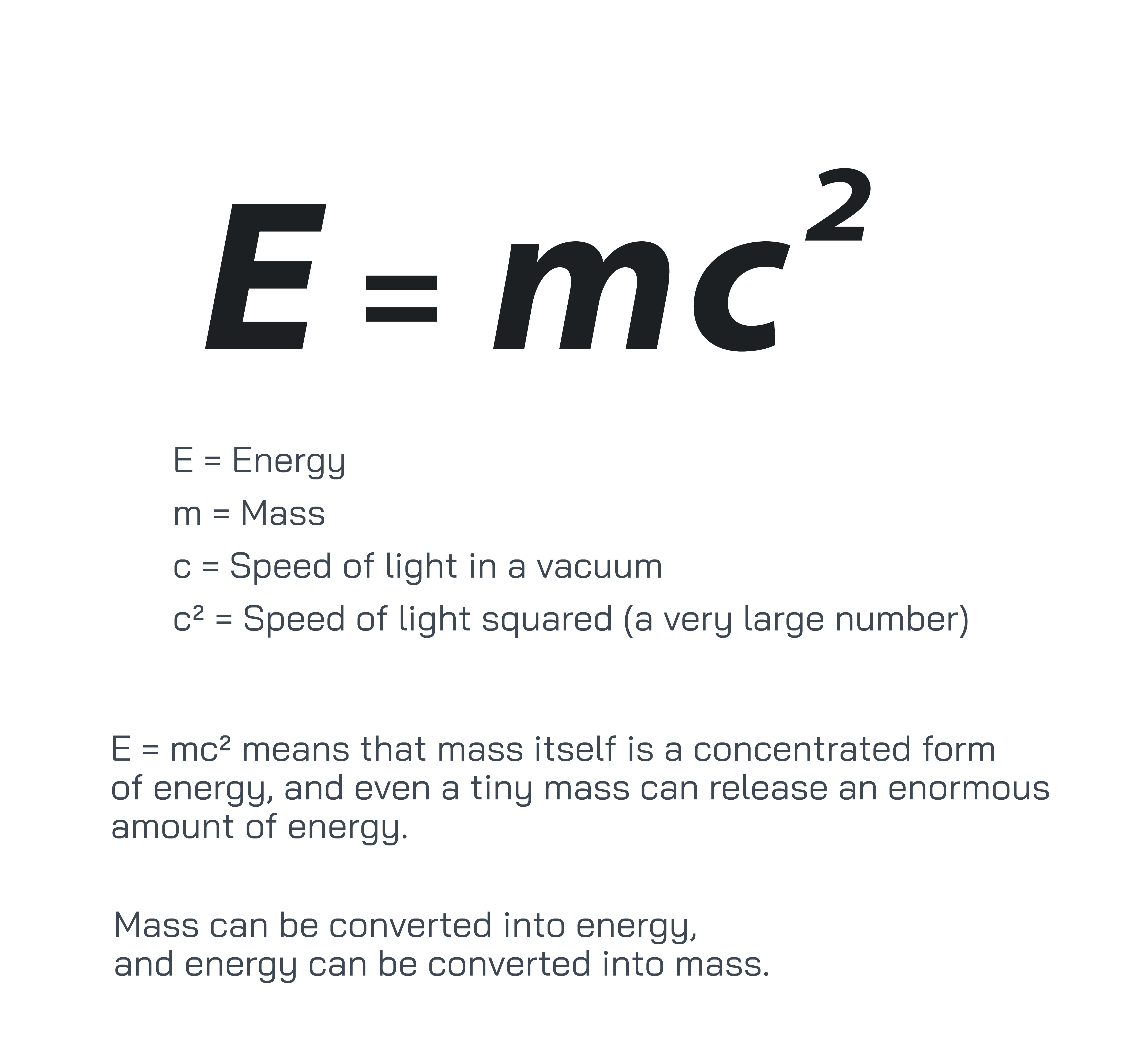
E = mc² is one of the most well-known equations in science and represents a revolutionary idea that transformed humanity’s understanding of the physical universe. Introduced by Albert Einstein, this equation expresses the concept of mass–energy equivalence, stating that mass and energy are not separate entities but different forms of the same fundamental substance. The equation reveals that even a very small amount of mass contains an enormous amount of energy, fundamentally reshaping classical physics and laying the groundwork for modern scientific thought.
To understand the exact meaning of E = mc², it is important to interpret each component of the equation. The symbol E represents energy, which is the capacity to do work or cause change. The symbol m represents mass, which refers to the amount of matter contained in an object. The symbol c represents the speed of light in a vacuum, a universal constant that has an exceptionally large value. When mass is multiplied by the square of the speed of light, the result is an immense quantity of energy. This shows that mass itself is a concentrated form of energy.
Before the introduction of this equation, mass and energy were treated as entirely separate concepts in classical physics. Mass was considered a fixed property of matter, while energy was associated with motion, heat, or force. E = mc² demonstrated that mass can be converted into energy and energy can be converted into mass. This idea challenged long-standing assumptions and provided a deeper understanding of how the universe operates at both microscopic and cosmic scales.
The equation implies that when an object loses mass, it releases energy, and when energy is absorbed, mass increases, even if the change is extremely small. Under everyday conditions, these changes are so tiny that they are not noticeable. However, in extreme physical processes, such as nuclear reactions, the conversion becomes measurable and powerful. This explains why nuclear reactions can release vast amounts of energy from relatively small quantities of matter.
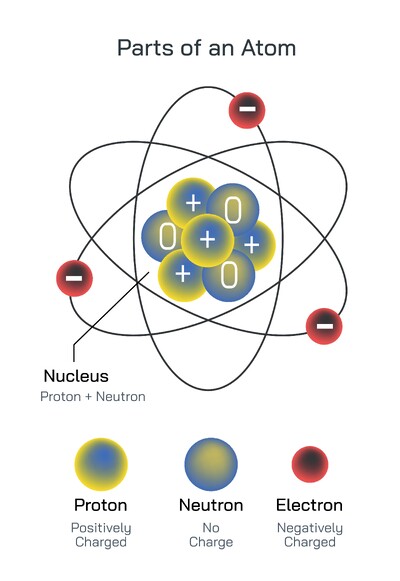
In nuclear fission, heavy atomic nuclei split into smaller nuclei, and a small portion of their mass is converted into energy. In nuclear fusion, light nuclei combine to form heavier nuclei, again converting mass into energy. In both cases, the energy released follows the principle described by E = mc². This is the same process that powers stars, including the Sun. Deep within the Sun, hydrogen nuclei fuse to form helium, and the tiny loss of mass during this process is released as radiant energy that provides heat and light to the solar system.
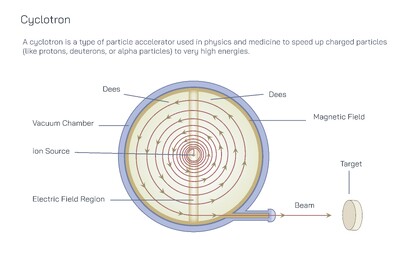
The importance of E = mc² extends far beyond nuclear physics. It plays a critical role in understanding particle physics, where particles can be created from energy and annihilated back into energy. High-energy environments, such as those studied in particle accelerators, regularly demonstrate this principle. When sufficient energy is concentrated in a small region of space, new particles with measurable mass can form, confirming that energy and mass are interchangeable.
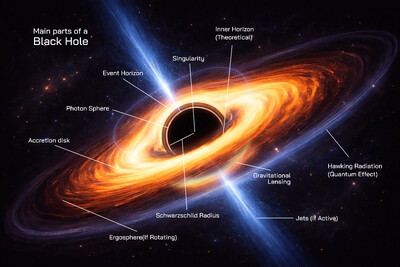
This equation is also central to Einstein’s broader theory of relativity, which redefined concepts of space, time, and gravity. Mass–energy equivalence implies that energy contributes to gravitational effects just as mass does. This understanding is essential for explaining phenomena such as gravitational fields around massive stars, black holes, and the curvature of space-time. In this sense, E = mc² is not just an isolated formula but a cornerstone of modern physics.
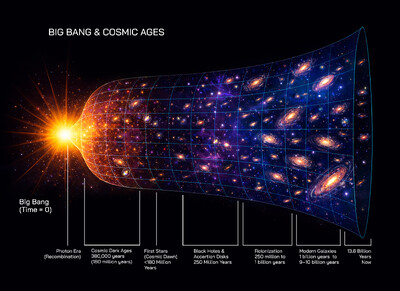
In cosmology, the equation helps scientists understand the evolution of the universe. During the early moments after the Big Bang, enormous amounts of energy were present, and particles formed as energy condensed into matter. The balance between mass and energy influenced the structure, expansion, and development of the cosmos. Even today, observations of cosmic radiation and stellar behavior are interpreted through the lens of mass–energy equivalence.
The equation also carries philosophical significance. It reveals that matter, which appears solid and permanent, is actually a form of stored energy. This insight blurs the distinction between physical substance and dynamic processes, offering a more unified view of reality. It suggests that the universe is fundamentally interconnected, with mass and energy continuously interacting according to precise physical laws.
In practical terms, E = mc² has influenced technology, medicine, and scientific research. Nuclear power generation relies on controlled mass-to-energy conversion. Medical imaging and cancer treatments use principles derived from nuclear physics. Space science, astrophysics, and advanced materials research all depend on the understanding that mass and energy are deeply linked.
In conclusion, the exact meaning of E = mc² is that mass and energy are equivalent and interchangeable, connected by the square of the speed of light. This equation reveals that mass is a concentrated form of energy and that even a tiny amount of matter can produce an enormous amount of energy under the right conditions. Introduced by Albert Einstein, this idea transformed physics, reshaped scientific understanding, and continues to influence modern technology and cosmological research. E = mc² stands as a profound statement about the nature of reality, illustrating the deep unity between matter, energy, and the fundamental laws of the universe.