Osmosis in a plant cell is a fundamental biological process that explains how water moves across the cell membrane and how this movement affects the shape, firmness, and survival of plant cells. Unlike animal cells, plant cells possess a rigid cell wall and a large central vacuole, which play a crucial role in osmotic behavior. Understanding osmosis in plant cells is essential for explaining plant rigidity, growth, wilting, water absorption, and overall plant health.
Osmosis is defined as the movement of water molecules from a region of higher water concentration to a region of lower water concentration through a selectively permeable membrane. In plant cells, this selectively permeable membrane is the plasma membrane, which allows water to pass freely while restricting the movement of many dissolved substances. The cell wall, although freely permeable, provides mechanical support and prevents excessive expansion of the cell.
A typical plant cell contains cytoplasm, a nucleus, organelles, and a large central vacuole filled with cell sap. The vacuole plays a major role in osmosis because it stores water and dissolved solutes. The concentration of solutes inside the vacuole relative to the surrounding solution determines the direction and extent of water movement.
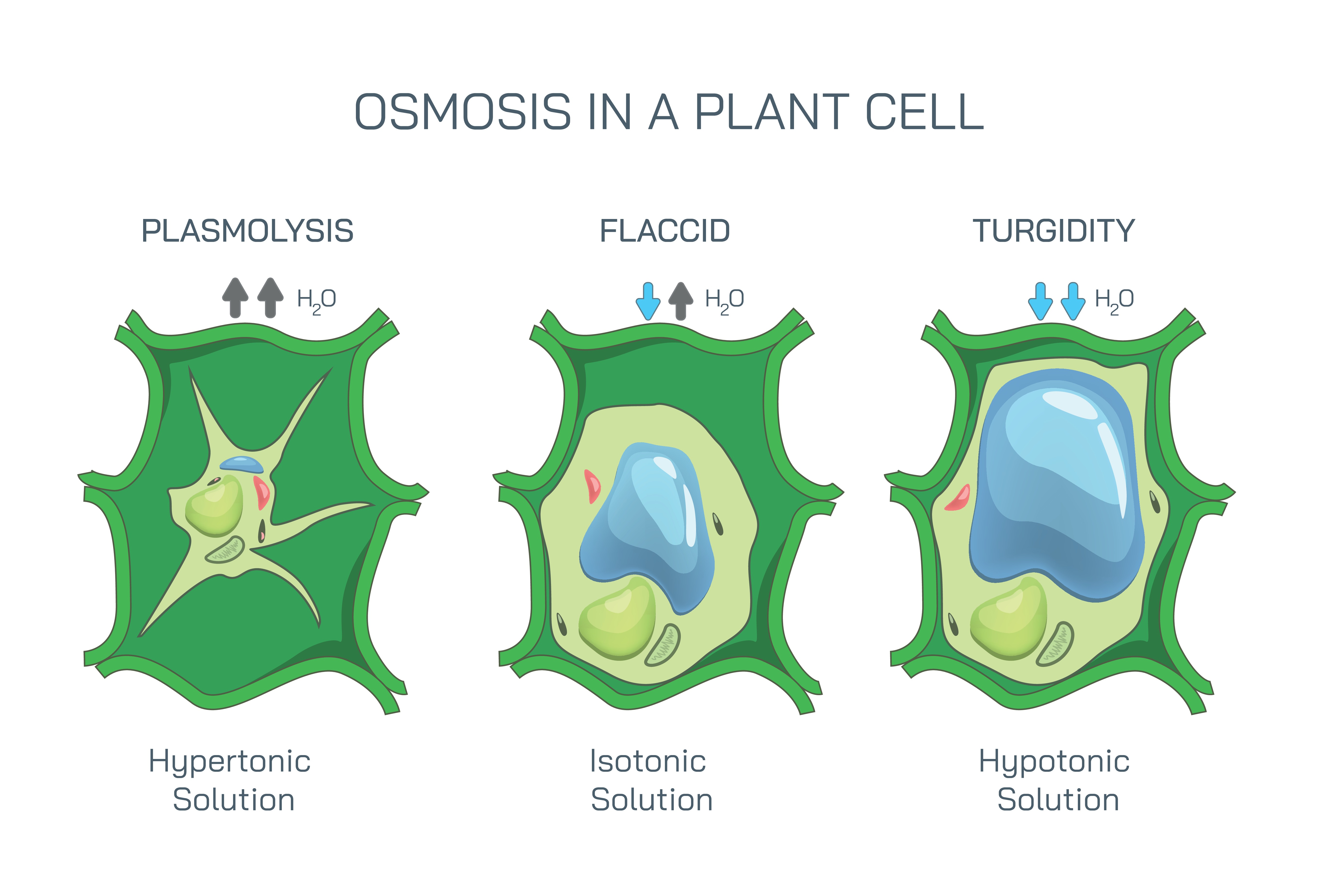
When a plant cell is placed in a hypertonic solution, the surrounding solution has a lower water concentration compared to the cell sap. As a result, water moves out of the cell through the plasma membrane by osmosis. This outward movement of water causes the vacuole to shrink, and the cytoplasm begins to pull away from the cell wall. This condition is known as plasmolysis. During plasmolysis, the cell wall remains intact, but the living contents of the cell contract inward. Plasmolysis leads to loss of rigidity and disrupts normal cellular functions. If prolonged, it can cause damage to the cell and impair plant tissues, often observed as wilting in plants.
Plasmolysis demonstrates the importance of osmotic balance in plant cells. It shows that although the cell wall provides support, the internal pressure generated by water inside the vacuole is essential for maintaining cell shape. In agricultural and environmental contexts, plasmolysis explains why plants wilt in saline soils or during drought conditions when water availability is low.
When a plant cell is placed in an isotonic solution, the concentration of water inside the cell is equal to that of the surrounding solution. In this condition, water moves into and out of the cell at equal rates, resulting in no net movement of water. The cell neither gains nor loses water overall. As a result, the vacuole is partially filled, and the cell becomes flaccid. A flaccid cell lacks internal pressure and appears limp, but it is not damaged.
Flaccidity in plant cells highlights the difference between plant and animal cells. In animal cells, isotonic conditions are ideal because they maintain normal cell shape. In contrast, plant cells require a hypotonic environment to remain firm. When many plant cells become flaccid, tissues lose firmness, causing leaves and stems to droop slightly. This condition can occur when plants are deprived of adequate water for short periods.
When a plant cell is placed in a hypotonic solution, the surrounding solution has a higher water concentration compared to the cell sap. In this case, water enters the cell by osmosis. As water flows into the vacuole, it expands and presses the cytoplasm against the cell wall. This inward pressure generated by the vacuole is called turgor pressure. The cell wall resists further expansion, preventing the cell from bursting.
This condition is known as turgidity, and it represents the ideal state for most plant cells. Turgid cells are firm and fully expanded, providing mechanical support to plant tissues. Turgor pressure is responsible for keeping leaves upright, maintaining stem rigidity, and supporting overall plant structure. It also plays a vital role in plant growth by allowing cell expansion during development.
Turgidity is especially important in non-woody plants that rely on internal water pressure rather than rigid tissues for support. When cells lose turgor pressure due to water loss, plants begin to wilt. Restoring water availability allows osmosis to resume, increasing turgor pressure and restoring plant firmness.
The presence of the cell wall makes osmosis in plant cells unique. Unlike animal cells, plant cells do not burst in hypotonic solutions because the rigid cell wall counteracts excessive internal pressure. This structural adaptation allows plants to thrive in environments where water availability fluctuates.
Osmosis in plant cells is closely linked to water absorption by roots. Root hair cells absorb water from the soil through osmosis, driven by differences in solute concentration between the soil water and the cell sap. This absorbed water moves upward through plant tissues, contributing to nutrient transport and photosynthesis.
Osmosis also plays a role in stomatal movement. Guard cells surrounding stomata gain or lose water through osmosis, causing them to open or close. This mechanism regulates gas exchange and water loss in plants, demonstrating the broader physiological importance of osmosis beyond individual cells.
From an experimental perspective, osmosis in plant cells is often demonstrated using epidermal cells of onion or leaf tissues. Observing plasmolysis and deplasmolysis under a microscope provides clear visual evidence of osmotic processes and helps students understand membrane permeability and water movement.
In summary, osmosis in a plant cell is a vital process that governs water balance, structural support, and physiological function. Hypertonic conditions lead to plasmolysis, isotonic conditions result in flaccid cells, and hypotonic conditions produce turgid cells. The interaction between the plasma membrane, vacuole, and cell wall allows plant cells to regulate water intake effectively and maintain stability in changing environments. Understanding osmosis in plant cells is essential for explaining plant growth, wilting, water transport, and survival, making it one of the most important concepts in plant biology.