Chlamydomonas is a unicellular, microscopic green alga that plays an important role in the study of biology, ecology, and photosynthesis. It is a simple yet highly efficient organism that exhibits many characteristics of both plants and animals. Because of this unique combination of features, Chlamydomonas is often described as a plant-like protist and is widely used as a model organism in scientific research. Understanding what Chlamydomonas is provides insight into the evolution of plants, cellular organization, and fundamental life processes.
Chlamydomonas belongs to the group of green algae and is typically found in freshwater environments such as ponds, ditches, lakes, and slow-moving streams. Some species are also found in moist soil and even snow-covered regions, demonstrating their remarkable adaptability. Despite being microscopic, Chlamydomonas plays a significant role in aquatic ecosystems by contributing to primary productivity and oxygen production through photosynthesis.
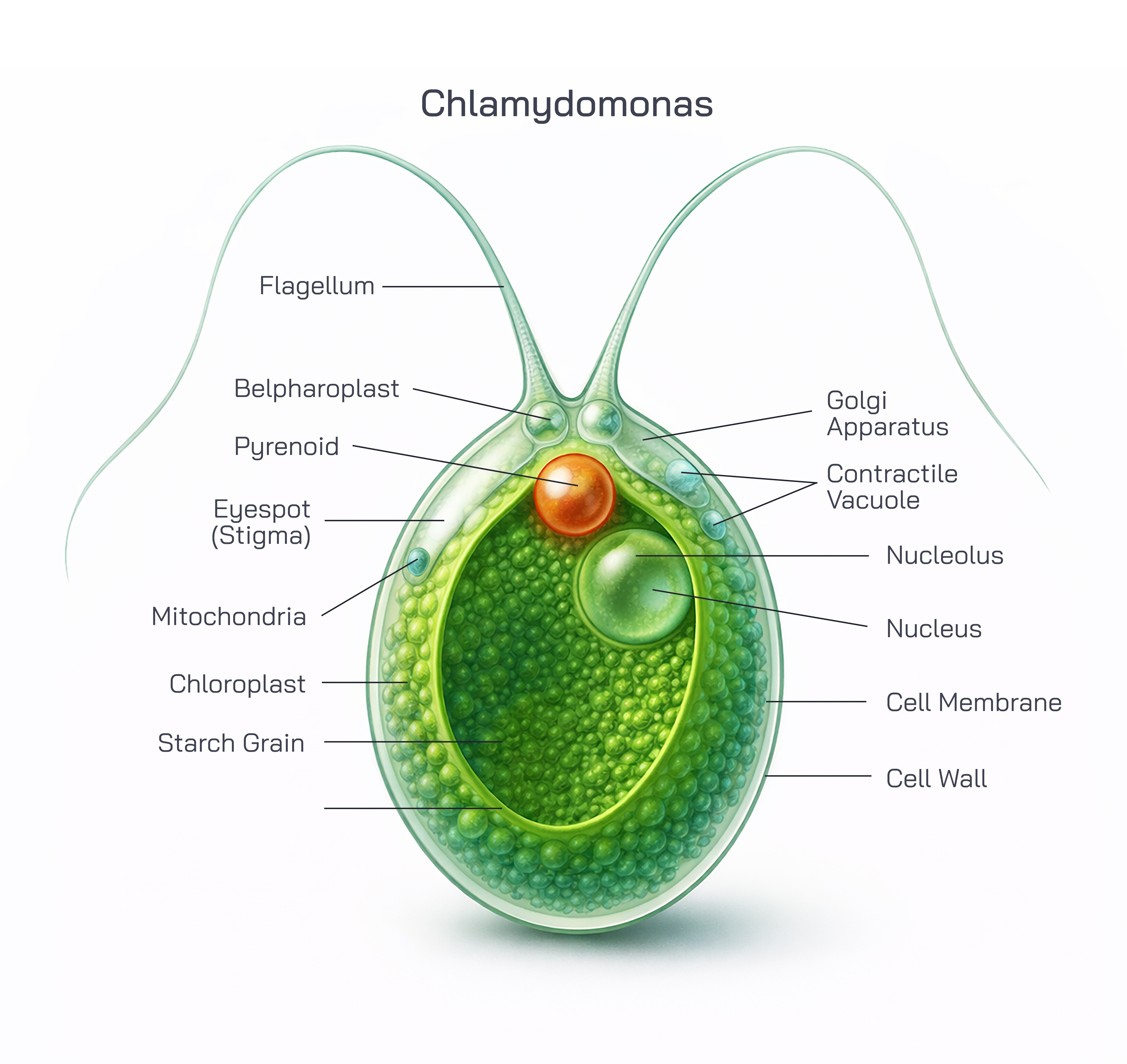
Structurally, Chlamydomonas has a simple but well-organized cell body. The cell is usually spherical or oval in shape and is surrounded by a thin cell wall. Inside the cell, the most prominent feature is a large, cup-shaped chloroplast that occupies a major portion of the cell. This chloroplast contains chlorophyll, the green pigment responsible for absorbing light energy during photosynthesis. The presence of chlorophyll gives Chlamydomonas its green color and allows it to manufacture its own food.
Within the chloroplast, there is often a structure called a pyrenoid. The pyrenoid is involved in the synthesis and storage of starch, which serves as a reserve food material for the organism. This feature highlights the plant-like nature of Chlamydomonas, as starch storage is a characteristic commonly associated with plants and green algae.
The nucleus of Chlamydomonas is located near the center of the cell and controls all cellular activities. It contains genetic material that governs growth, reproduction, and metabolic processes. Other cellular components such as mitochondria, endoplasmic reticulum, and ribosomes are also present, supporting respiration, protein synthesis, and energy production.
One of the most distinctive features of Chlamydomonas is the presence of two long, whip-like structures called flagella. These flagella emerge from the anterior end of the cell and are used for locomotion. By beating its flagella in a coordinated manner, Chlamydomonas can swim actively in water. This ability to move freely distinguishes it from many other plant-like organisms and gives it an animal-like characteristic.
Another important structure found in Chlamydomonas is the eyespot, also known as the stigma. The eyespot is a small, pigmented region located near the chloroplast. It is sensitive to light and helps the organism detect the direction and intensity of light. This light-sensing ability allows Chlamydomonas to move toward light sources, a behavior known as positive phototaxis. By moving toward light, the organism ensures optimal conditions for photosynthesis.
Nutrition in Chlamydomonas is primarily autotrophic, meaning it produces its own food through photosynthesis. Using sunlight, carbon dioxide, and water, Chlamydomonas synthesizes organic compounds that provide energy for growth and survival. Under certain conditions, however, some species of Chlamydomonas can also show heterotrophic behavior by absorbing organic substances from their surroundings. This flexibility in nutrition helps the organism survive in changing environmental conditions.
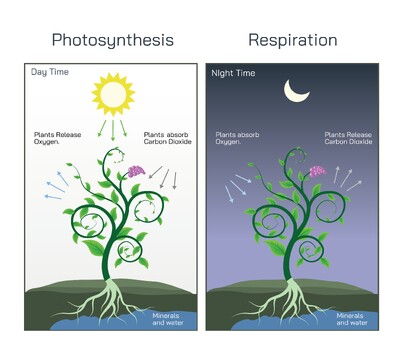
Respiration in Chlamydomonas occurs through the process of cellular respiration, in which organic compounds are broken down to release energy. Oxygen produced during photosynthesis may be used in respiration, while carbon dioxide released during respiration can be reused in photosynthesis. This balance of metabolic processes allows Chlamydomonas to efficiently manage energy and resources within a single cell.
Reproduction in Chlamydomonas can occur by both asexual and sexual methods, depending on environmental conditions. Asexual reproduction is the most common mode and usually occurs under favorable conditions. During this process, the parent cell divides to form several daughter cells within the original cell wall. These daughter cells are released when the parent cell wall breaks down, and each new cell grows into a mature Chlamydomonas organism.
Sexual reproduction in Chlamydomonas occurs under unfavorable conditions such as nutrient deficiency or environmental stress. In sexual reproduction, the organism produces gametes that are similar in size and shape, a condition known as isogamy. Two compatible gametes fuse to form a zygote, which develops a thick wall and becomes resistant to harsh conditions. When favorable conditions return, the zygote undergoes division to produce new haploid cells.
The life cycle of Chlamydomonas is relatively simple and typically haplontic, meaning the main vegetative phase is haploid. The diploid stage is brief and limited to the zygote. This type of life cycle is important in understanding the evolution of sexual reproduction and alternation of generations in plants.
Ecologically, Chlamydomonas plays an important role in aquatic ecosystems. As a photosynthetic organism, it contributes to the production of organic matter and serves as a food source for small aquatic animals. It also releases oxygen into the water, supporting the survival of other aerobic organisms. In this way, Chlamydomonas helps maintain ecological balance in freshwater habitats.
From a scientific perspective, Chlamydomonas is widely used as a model organism in research. Its simple structure, rapid growth, and well-studied genetics make it ideal for studying photosynthesis, flagellar movement, cell cycle regulation, and gene expression. Research on Chlamydomonas has contributed significantly to our understanding of plant biology and cellular processes.
In educational settings, Chlamydomonas is commonly studied in school and college biology courses. It serves as a classic example of unicellular algae and helps students understand basic concepts such as photosynthesis, locomotion, and reproduction in microorganisms. Diagrams of Chlamydomonas structure are especially useful for visualizing how a single cell can perform complex life functions.
In conclusion, Chlamydomonas is a unicellular green alga that exhibits both plant-like and animal-like characteristics. It possesses a chloroplast for photosynthesis, flagella for movement, and an eyespot for light detection. It reproduces both asexually and sexually and plays an important role in aquatic ecosystems as a primary producer. Due to its simplicity and versatility, Chlamydomonas is an important organism in biology education and scientific research. Understanding Chlamydomonas provides valuable insight into the fundamentals of life, cellular organization, and the evolutionary link between simple algae and higher plants.