Amoeba is a microscopic, unicellular organism that belongs to the group of protozoans and serves as a classic example for understanding the structure and functioning of a single living cell. Despite being composed of only one cell, an amoeba is capable of performing all essential life activities such as movement, feeding, respiration, excretion, growth, and reproduction. The structure of an amoeba is simple in appearance yet highly efficient, making it an important subject of study in basic biology and cell physiology.
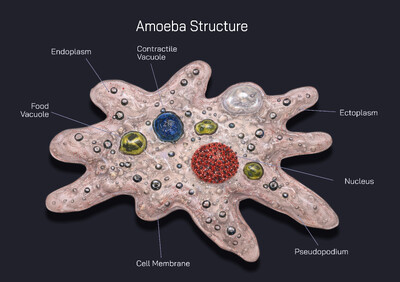
The amoeba does not have a fixed or definite shape. Its body is irregular and constantly changing due to the formation of temporary projections called pseudopodia. This flexible shape is a direct result of its soft cell membrane and fluid internal contents. The absence of a rigid cell wall allows the amoeba to adapt its shape easily, which is essential for its mode of movement and feeding.
The outer boundary of the amoeba is formed by a thin, flexible plasma membrane. This membrane encloses the entire cell and plays a crucial role in protecting the internal components while regulating the movement of substances into and out of the cell. The plasma membrane is selectively permeable, allowing essential nutrients, oxygen, and water to enter while enabling waste materials to leave the cell.
Inside the plasma membrane lies the cytoplasm, which is differentiated into two distinct regions known as ectoplasm and endoplasm. The ectoplasm is the outer, clear, and non-granular layer of the cytoplasm. It is relatively firm and plays an important role in maintaining the shape of pseudopodia during movement. The endoplasm is the inner, granular, and more fluid portion of the cytoplasm. It contains most of the cell organelles and is actively involved in metabolic processes.
One of the most prominent structures within the amoeba is the nucleus. The nucleus is usually spherical or oval in shape and is embedded within the endoplasm. It controls all vital activities of the cell, including growth, metabolism, and reproduction. The nucleus contains genetic material that directs protein synthesis and regulates cellular functions. Without the nucleus, the amoeba cannot survive for long, highlighting its importance as the control center of the cell.
Pseudopodia are temporary, finger-like projections formed by the flow of cytoplasm toward one side of the cell. These structures are essential for locomotion and feeding. During movement, the amoeba extends a pseudopodium in the direction it wants to move. The cytoplasm flows into this projection, and the rest of the body follows. This type of movement is known as amoeboid movement and is a distinctive feature of amoeba.
Feeding in amoeba occurs through a process called phagocytosis. When the amoeba encounters a food particle such as bacteria or small organic matter, it surrounds the particle using its pseudopodia. The food particle is then enclosed within a membrane-bound structure called a food vacuole. Inside the food vacuole, digestive enzymes break down the food into simpler substances that can be absorbed into the cytoplasm and used for energy, growth, and repair.
The food vacuole is a temporary organelle that forms whenever the amoeba feeds. After digestion is complete, the nutrients diffuse into the cytoplasm, and the undigested waste is expelled from the cell through the plasma membrane. This process ensures efficient utilization of available food and removal of unwanted material.
Another important organelle present in the amoeba is the contractile vacuole. This structure is especially prominent in freshwater amoeba and plays a vital role in osmoregulation. Because freshwater environments have a lower concentration of solutes compared to the cell interior, water continuously enters the amoeba by diffusion. The contractile vacuole collects this excess water and periodically expels it outside the cell, preventing the amoeba from bursting. This rhythmic contraction and expansion help maintain internal balance and cell integrity.
The endoplasm also contains various small granules and organelles involved in respiration, enzyme activity, and storage of nutrients. Respiration in amoeba occurs through simple diffusion of oxygen across the plasma membrane. Since the organism is very small and has a large surface area relative to its volume, diffusion is sufficient to meet its oxygen requirements.
Excretion in amoeba occurs through the diffusion of waste products such as carbon dioxide and ammonia across the plasma membrane. The absence of specialized excretory organs highlights the efficiency of simple diffusion in unicellular organisms. All metabolic waste products are continuously removed, ensuring cellular health.
The structural simplicity of amoeba makes it an excellent model for understanding fundamental biological processes. Each component of the amoeba is multifunctional and highly adapted to support life in aquatic environments. The flexible structure allows rapid response to environmental changes, efficient feeding, and effective movement.
In biological studies, amoeba is often used to demonstrate the concept that a single cell can function as a complete organism. Its structure shows how cellular organization alone is sufficient to carry out complex life processes without the need for tissues or organs. This makes amoeba a key organism in understanding the evolution of life and the transition from unicellular to multicellular forms.
In conclusion, the structure of an amoeba consists of a plasma membrane, cytoplasm divided into ectoplasm and endoplasm, nucleus, pseudopodia, food vacuoles, and a contractile vacuole. Each of these components plays a specific and essential role in survival. The amoeba’s simple yet efficient structure demonstrates how basic cellular organization supports all vital life functions, making it a foundational example in the study of cell biology and zoology.