Geotropism, also known as gravitropism, is a fundamental physiological process in plants that enables them to sense and respond to the force of gravity. This response plays a critical role in determining the orientation of plant organs such as roots and shoots, ensuring proper growth, stability, and survival. From the earliest stages of seed germination to the mature architecture of a fully developed plant, geotropism continuously guides the direction in which plant parts grow, allowing plants to anchor themselves securely in the soil while simultaneously reaching upward toward light and air.
At its core, geotropism is a type of tropic movement, meaning it is a directional growth response toward or away from an external stimulus. In this case, the stimulus is gravity. Unlike temporary movements caused by changes in water pressure within cells, geotropic responses involve differential growth rates on opposite sides of a plant organ. This uneven growth leads to bending or curvature, which ultimately aligns the organ in a direction that is either parallel or opposite to the gravitational pull. The remarkable precision of this response highlights the sophisticated internal coordination present in plants despite their lack of a nervous system.
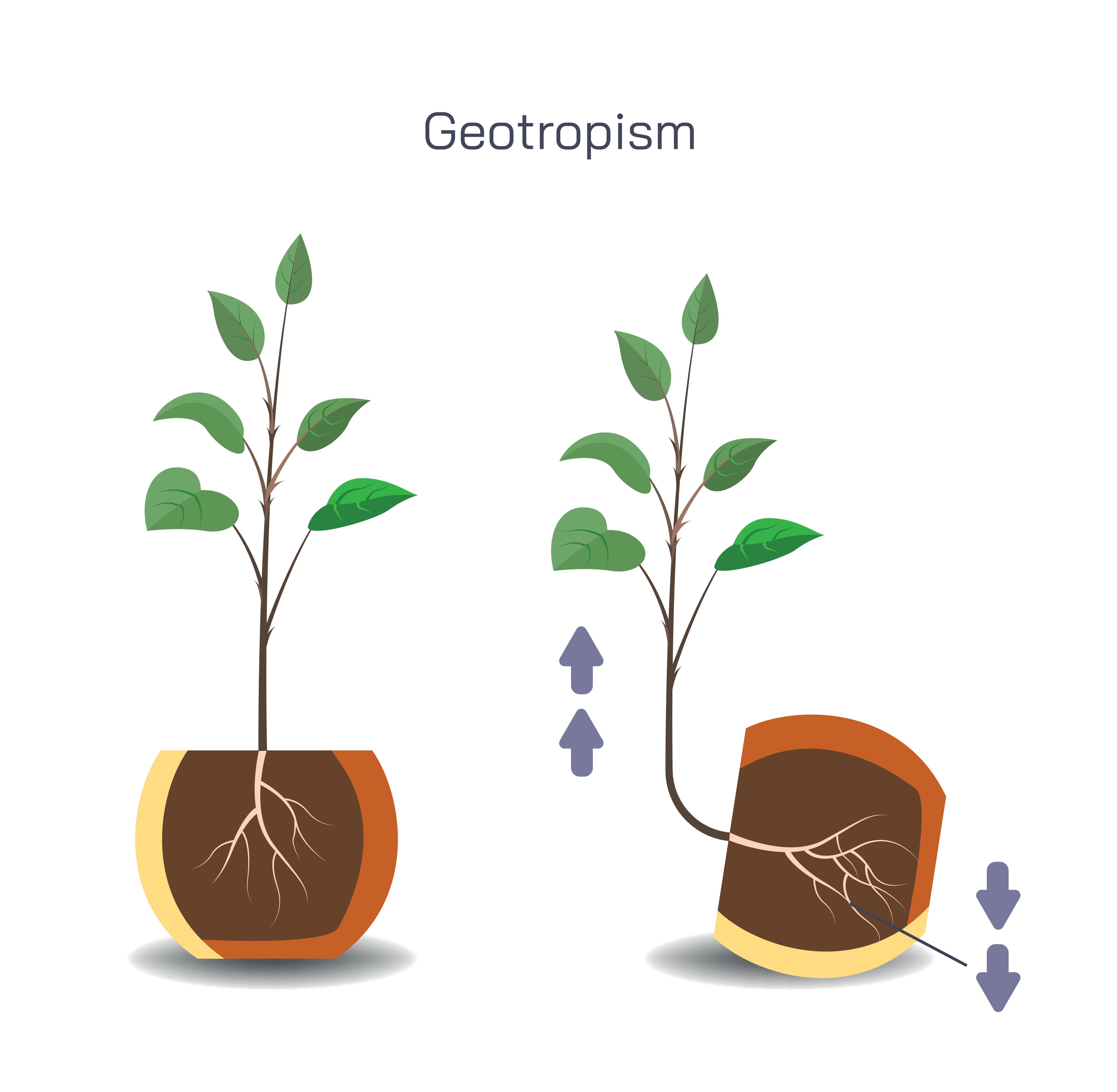
Roots typically exhibit positive geotropism, meaning they grow in the direction of gravitational pull. This downward growth allows roots to penetrate the soil, absorb water and essential minerals, and provide strong anchorage to the plant. Shoots, on the other hand, usually show negative geotropism, growing upward against gravity. This upward growth is crucial for exposing leaves to sunlight, facilitating photosynthesis, and supporting reproductive structures such as flowers and fruits. The opposite geotropic behaviors of roots and shoots work together to create a balanced and functional plant body.
The mechanism behind geotropism involves specialized cells and internal signaling pathways that translate the physical force of gravity into a biological response. In roots, gravity is perceived primarily in the root cap, a protective structure at the tip of the root. Within the cells of the root cap are dense, starch-filled organelles known as amyloplasts, often referred to as statoliths. When the orientation of the root changes, these statoliths settle toward the lower side of the cell under the influence of gravity. Their movement acts as a signal that informs the plant of its spatial orientation.
Once gravity is perceived, the signal is converted into a chemical response involving plant hormones, particularly auxins. Auxins are growth-regulating substances that play a central role in cell elongation. In response to gravity, auxins become unevenly distributed within the plant organ. In roots, a higher concentration of auxin accumulates on the lower side, where it inhibits cell elongation. Meanwhile, cells on the upper side elongate more rapidly. This difference in growth rates causes the root to bend downward. In shoots, the effect of auxin is different: higher auxin concentrations promote cell elongation. As a result, auxins accumulating on the lower side of a shoot cause those cells to grow faster, bending the shoot upward against gravity.
This contrasting effect of auxin in roots and shoots is a key feature of geotropism and illustrates how the same hormone can produce different outcomes depending on tissue sensitivity. The ability of plant cells to respond selectively to hormonal signals allows for precise control of growth direction and form. Over time, this coordinated growth results in the stable, predictable structure characteristic of most land plants.
Geotropism is not an isolated process but works in close coordination with other tropic responses, such as phototropism, which is growth in response to light, and hydrotropism, which is growth toward moisture. In natural environments, plants are often exposed to multiple stimuli simultaneously. For example, a seedling emerging from the soil must balance the downward pull of gravity with the directional cue of light. Through the integration of these signals, plants achieve optimal orientation, maximizing their chances of survival and reproduction.
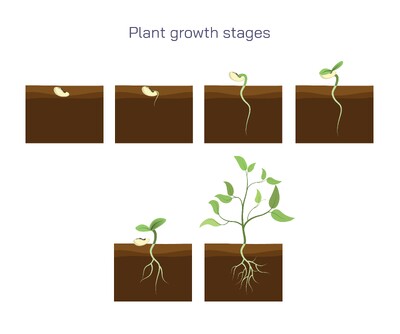
The importance of geotropism becomes especially evident during seed germination. When a seed begins to grow, it may be oriented in any direction within the soil. Geotropic responses ensure that the root consistently grows downward and the shoot grows upward, regardless of the seed’s initial position. This reliability is essential for successful establishment of the young plant. Without geotropism, roots might fail to reach water sources, and shoots might remain buried, unable to photosynthesize effectively.
Geotropism also contributes to a plant’s ability to recover from disturbances. If a plant is knocked over by wind, rain, or physical contact, geotropic responses help reorient the stem and restore vertical growth. This self-correcting ability enhances plant resilience and long-term survival in changing environments. In trees, continuous geotropic adjustment contributes to straight trunk growth and balanced branching, which are important for mechanical support and efficient resource distribution.
In agricultural and horticultural contexts, understanding geotropism has practical significance. Crop growth patterns, root system development, and overall plant architecture are influenced by gravitational responses. Farmers and growers can manipulate planting orientation, soil conditions, and cultivation techniques to encourage favorable growth habits. In controlled environments such as greenhouses or vertical farming systems, knowledge of geotropism helps optimize plant arrangement and maximize yield.
Scientific studies of geotropism have also extended beyond Earth. Experiments conducted in space, where gravitational forces are greatly reduced, have provided valuable insights into how plants sense gravity and how essential this stimulus is for normal growth. Observations from these experiments show that in microgravity conditions, plant roots and shoots lose their typical orientation, highlighting the central role gravity plays in shaping plant form and function.
In summary, geotropism is a vital growth response that enables plants to orient themselves correctly in relation to gravity. Through specialized gravity-sensing cells, hormone-mediated signaling, and differential growth, plants achieve the characteristic downward growth of roots and upward growth of shoots. This process supports essential functions such as nutrient absorption, photosynthesis, stability, and adaptation to environmental challenges. By guiding plant structure from germination through maturity, geotropism stands as one of the most important regulatory mechanisms in plant biology, reflecting the remarkable ability of plants to interpret and respond to the physical forces of their environment.