Roots are vital plant organs responsible for anchorage, absorption of water and minerals, and storage of food in some species. In flowering plants, roots are broadly classified into monocot roots and dicot roots based on the type of seed and overall plant structure. Though both perform similar basic functions, their internal anatomy, tissue arrangement, and developmental patterns show clear differences that are important in plant biology and agriculture.
Monocot Root – External and Internal Structure
Monocot roots are commonly found in plants such as grasses, wheat, rice, maize, and lilies. These plants typically possess a fibrous root system, where numerous thin roots arise from the base of the stem instead of one main root. This system provides strong surface anchorage and efficient absorption of water from the upper soil layers.
Externally, monocot roots are slender and uniform in thickness. Numerous root hairs develop near the tip, increasing the surface area for absorption. These roots usually do not penetrate very deep into the soil but spread widely.
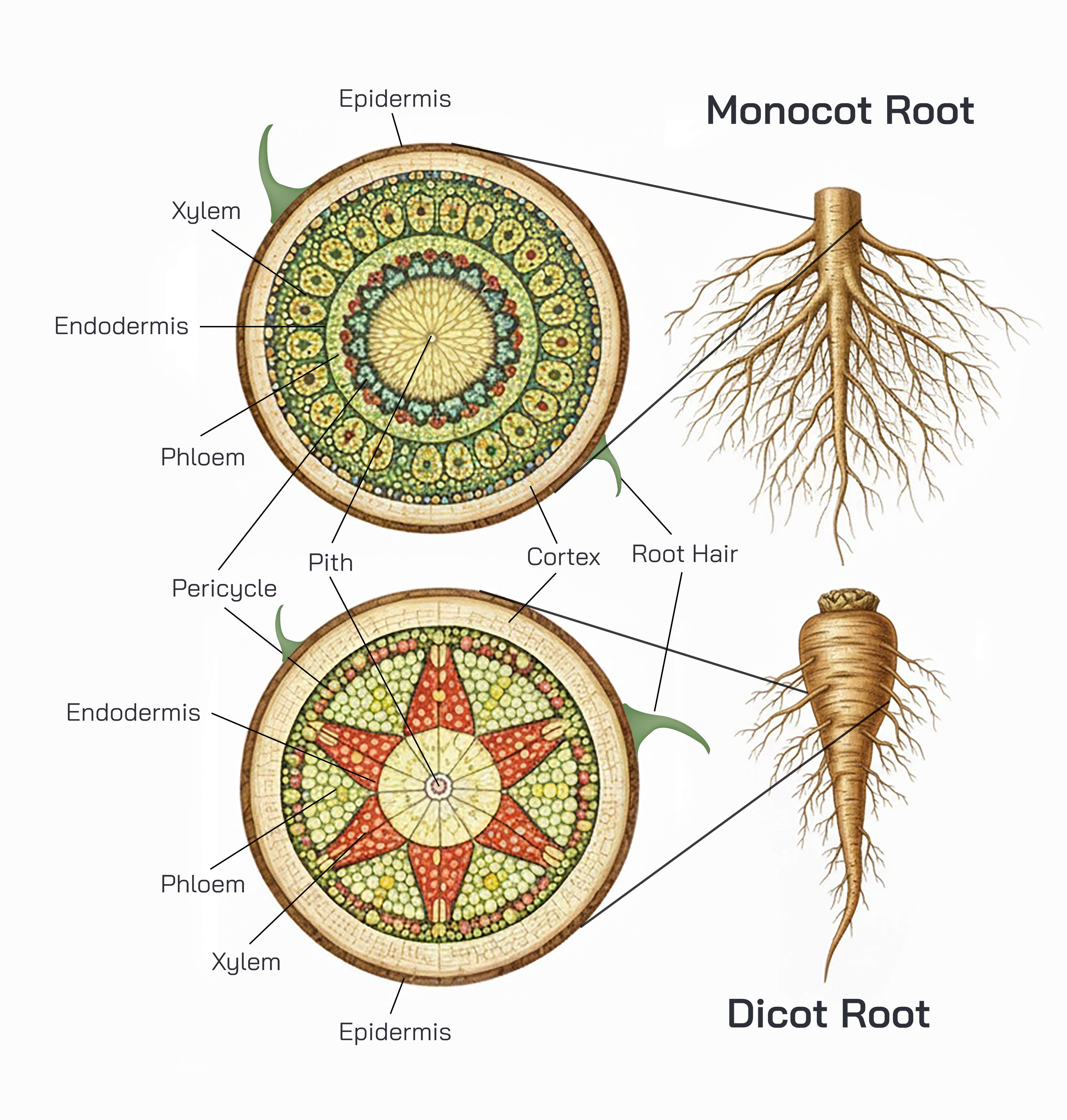
Internally, the monocot root shows a well-organized structure. The epidermis is the outermost layer and consists of thin-walled cells that protect the root and help in absorption. Beneath it lies the cortex, made up of several layers of parenchyma cells that store food and allow the movement of water toward the center.
The endodermis forms the inner boundary of the cortex and regulates the entry of water into the vascular tissues. Inside the endodermis is the pericycle, a layer of cells involved in the formation of lateral roots.
The most distinguishing feature of the monocot root is the presence of a large central pith. The vascular tissues are arranged radially around the pith. Xylem and phloem occur in alternate patches, usually in large numbers, forming a polyarch condition. This arrangement supports efficient conduction in plants with extensive fibrous root systems.
Dicot Root – External and Internal Structure
Dicot roots are characteristic of plants such as mustard, pea, gram, sunflower, and mango. These plants generally possess a tap root system, where a single main root grows downward and gives rise to lateral branches. This system provides strong anchorage and allows the plant to access water from deeper soil layers.
Externally, the dicot root appears thicker and more prominent due to the dominant primary root. Root hairs are present near the growing region and play a major role in absorption.
Internally, the dicot root structure also begins with the epidermis, which is responsible for protection and absorption. The cortex beneath it is broad and composed of parenchyma cells that store food and facilitate water movement.
The endodermis is clearly defined and controls the inward flow of water. Just inside it lies the pericycle, which later gives rise to lateral roots and contributes to secondary growth in some dicot plants.
The most striking feature of the dicot root is the absence or very small size of the pith. At the center, the xylem forms a star-shaped structure, with phloem patches located between the arms of the xylem. This radial arrangement is typically diarch to hexarch. The star-shaped xylem is a diagnostic feature that distinguishes dicot roots from monocot roots.
Functional Differences Between Monocot and Dicot Roots
Monocot roots are well adapted for rapid absorption of surface water and are ideal for plants growing in shallow soils or regions with frequent rainfall. Their fibrous nature helps prevent soil erosion and provides stability in loose soil.
Dicot roots, on the other hand, penetrate deeper into the soil, making them efficient in accessing underground water and minerals. The tap root system also allows many dicot plants to store food, supporting growth during unfavorable conditions.
Internally, the presence of a large pith in monocot roots supports extensive vascular bundles, while the compact central region of dicot roots allows for efficient transport and mechanical strength.
Biological and Agricultural Importance
Understanding the structure of monocot and dicot roots is essential in botany, agriculture, and plant breeding. Crop management practices such as irrigation, fertilization, and soil preparation depend heavily on root type. Monocot crops like rice and wheat require different soil conditions compared to dicot crops like legumes and vegetables.
Root anatomy also helps scientists identify plant groups, study nutrient uptake, and improve crop yield. Differences in vascular tissue arrangement influence how water and minerals are transported, affecting plant growth and productivity.
Roots are fundamental plant organs that ensure survival by anchoring the plant firmly in the soil, absorbing water and mineral nutrients, conducting these substances to aerial parts, and in some cases storing food. In flowering plants, the internal organization of roots shows clear differences based on whether the plant belongs to the monocotyledon or dicotyledon group. These differences are not superficial; they reflect deep evolutionary adaptations related to growth habit, habitat, physiology, and overall plant strategy. A detailed understanding of monocot and dicot roots therefore provides valuable insight into plant anatomy, function, and agricultural relevance.
Monocot roots are typically associated with plants such as grasses, cereals, palms, and lilies. These plants generally lack a persistent primary root and instead develop a fibrous root system. Numerous roots of similar thickness arise from the base of the stem and spread outward in the upper layers of soil. This growth pattern allows monocot plants to absorb water efficiently from surface soil, especially in environments where rainfall is frequent but shallow. The fibrous nature of monocot roots also provides excellent anchorage in loose or sandy soils and helps prevent soil erosion, which is particularly important in grasslands and crop fields.
Internally, the monocot root exhibits a well-defined and orderly arrangement of tissues. The outermost epidermis is made of thin-walled cells and bears root hairs that greatly increase the surface area for absorption. Beneath the epidermis lies the cortex, which consists of several layers of parenchyma cells. These cells store food temporarily and facilitate the movement of water from the epidermis toward the vascular tissues. The cortex in monocot roots is usually broad, reflecting the plant’s reliance on continuous absorption from the surrounding soil.
The endodermis in a monocot root forms a distinct boundary between the cortex and the vascular region. It contains specialized structures that regulate the movement of water and dissolved minerals into the central tissues, ensuring controlled absorption. Just inside the endodermis lies the pericycle, a thin layer of cells that plays a key role in the formation of lateral roots. In monocots, lateral roots arise from this pericycle, maintaining the fibrous nature of the root system.
One of the most characteristic features of the monocot root is the presence of a large, well-developed central pith. Surrounding the pith, the vascular tissues are arranged radially. Xylem and phloem occur in alternate patches, often in large numbers, forming what is known as a polyarch condition. This extensive vascular arrangement supports efficient conduction of water and nutrients throughout plants that often grow rapidly and possess large leaf surfaces, such as grasses and cereal crops.
Dicot roots, in contrast, are commonly found in plants such as beans, peas, mustard, sunflower, mango, and many trees. These plants typically develop a tap root system, where a single dominant primary root grows deep into the soil and gives rise to secondary and tertiary lateral roots. This deep penetration allows dicot plants to access water stored in lower soil layers, making them better adapted to environments with irregular rainfall or dry conditions. The tap root also provides strong anchorage, especially important for large shrubs and trees.
The internal structure of a dicot root begins with the epidermis, which is similar in function to that of monocot roots and bears root hairs for absorption. The cortex beneath the epidermis is usually wide and composed of parenchyma cells that store food and allow inward movement of water. In many dicot plants, this stored food supports early growth and helps the plant survive unfavorable conditions.
The endodermis in dicot roots is clearly visible and functions as a selective barrier, controlling the entry of water into the vascular system. Inside the endodermis, the pericycle plays a crucial role not only in the formation of lateral roots but also in secondary growth in many dicot plants. This secondary growth leads to an increase in root thickness, providing additional mechanical strength and transport capacity as the plant matures.
The most distinctive internal feature of a dicot root is the arrangement of vascular tissues at the center. The xylem forms a star-shaped structure, with arms radiating outward, while the phloem is located between these arms. This radial arrangement is usually diarch to hexarch, meaning the number of xylem arms is limited compared to monocots. The pith in dicot roots is either very small or completely absent, allowing the xylem to occupy the central region. This compact arrangement enhances structural strength and efficient vertical transport of water.
Functionally, monocot and dicot roots differ in their ecological roles. Monocot roots, with their fibrous system and extensive surface spread, are highly effective at rapid water uptake and soil binding. This makes monocot plants particularly suitable for cultivation in shallow soils and for stabilizing landscapes. Dicot roots, with their deep tap root system, excel at long-term water access, storage, and support, which is why many dicot plants dominate forests, orchards, and dryland ecosystems.
From an agricultural perspective, these differences are highly significant. Crops with monocot roots, such as rice and wheat, respond quickly to surface irrigation and fertilizers applied to topsoil. Dicot crops, such as pulses and oilseeds, often benefit from deeper soil preparation and are more tolerant of short-term drought. Understanding root anatomy helps farmers optimize irrigation, fertilizer placement, and crop rotation strategies.
In evolutionary terms, the structural differences between monocot and dicot roots reflect adaptation to different growth forms and environments. Monocot roots favor rapid growth and surface exploitation of resources, while dicot roots emphasize depth, strength, and long-term survival. Both systems represent successful strategies shaped by natural selection.
Monocot and dicot roots share the same fundamental functions but differ markedly in structure, organization, and ecological role. Monocot roots are characterized by fibrous systems, large central pith, and numerous vascular bundles, whereas dicot roots display tap root systems, star-shaped xylem, reduced pith, and potential for secondary growth. These anatomical differences are essential for understanding plant biology, crop management, and the diversity of strategies plants use to survive and thrive in varied environments.
Roots are not only organs of absorption and anchorage but also dynamic structures that reflect how plants interact with soil, water, climate, and nutrients over long periods of time. When monocot and dicot roots are studied in greater depth, their differences reveal how plants have evolved distinct strategies to survive in varied environments. These strategies influence growth rate, lifespan, resistance to stress, and agricultural productivity, making root anatomy a cornerstone of plant science.
In monocot plants, the fibrous root system develops as the primary root produced during germination is short-lived and soon replaced by numerous adventitious roots arising from the base of the stem. This continuous production of roots ensures that monocot plants maintain a dense network of absorptive surfaces close to the soil surface. Because nutrients such as nitrogen and phosphorus are often concentrated in the upper soil layers, fibrous roots are highly efficient at rapid nutrient uptake. This feature explains why monocot crops respond quickly to fertilizers applied near the soil surface and show fast vegetative growth.
The internal tissue organization of monocot roots supports this functional efficiency. The broad cortex allows temporary storage of water and dissolved minerals, buffering the plant against short-term fluctuations in soil moisture. The presence of a large pith in the center is another important adaptation. The pith acts as a storage region and helps maintain internal pressure, contributing to root flexibility. This flexibility allows monocot roots to tolerate mechanical stress caused by wind, grazing, or trampling, which is common in grass-dominated ecosystems.
Vascular tissues in monocot roots are arranged in many radial bundles, which ensures that water and minerals absorbed from multiple directions can be transported efficiently upward. This arrangement is especially advantageous for plants with narrow stems and long leaves, where rapid vertical transport is essential. Although monocot roots generally lack secondary growth, their extensive fibrous network compensates for this limitation by continuously producing new roots throughout the plant’s life.
Dicot roots, on the other hand, emphasize depth, strength, and long-term stability. The persistence of the primary root allows dicot plants to develop a deep tap root that penetrates far into the soil. This deep penetration enables access to groundwater reserves unavailable to shallow-rooted plants. As a result, many dicot plants are better adapted to dry environments and seasonal droughts. Trees, shrubs, and perennial herbs rely heavily on this deep-rooting strategy for survival over many years.
Internally, the dicot root structure supports both conduction and mechanical strength. The star-shaped xylem occupies the central region, forming a rigid framework that resists bending and compression. This structure is especially important in woody dicot plants, where roots must support large above-ground biomass. The reduced or absent pith allows vascular tissues to dominate the center, enhancing the efficiency of vertical transport.
One of the most significant advantages of dicot roots is their ability to undergo secondary growth. The pericycle and associated tissues contribute to the formation of secondary vascular tissues, leading to an increase in root diameter over time. This thickening strengthens the root and expands its conducting capacity. Secondary growth also allows dicot roots to store large quantities of food in the form of starch and other reserves, which are used during periods of dormancy or rapid regrowth.
Ecologically, the contrasting root systems of monocots and dicots influence soil structure and nutrient cycling. Fibrous monocot roots form dense mats that bind soil particles together, reducing erosion and improving soil stability. This is why grasses are commonly used for lawns, pastures, and erosion control. Dicot roots, with their deep penetration, create channels in the soil that improve aeration and water infiltration. These channels remain even after roots decay, benefiting subsequent plant growth.
The role of roots in symbiotic relationships further highlights differences between monocots and dicots. Many dicot roots form associations with nitrogen-fixing bacteria or mycorrhizal fungi, which enhance nutrient availability. While monocots also form mycorrhizal associations, the extent and type of these relationships often differ due to root structure and growth patterns. Such interactions significantly influence soil fertility and ecosystem productivity.
From a physiological perspective, root anatomy affects how plants respond to stress. Monocot roots, being shallow and numerous, are more sensitive to surface soil conditions such as temperature fluctuations and compaction. However, their rapid regeneration ability allows them to recover quickly from damage. Dicot roots are less sensitive to surface disturbances but may suffer more severely if the main tap root is damaged, as regeneration is slower and more energy-intensive.
In agricultural systems, understanding these differences is critical for sustainable crop management. Tillage practices, irrigation depth, and fertilizer placement must be tailored to root type. Shallow irrigation favors monocot crops, while deep irrigation supports dicot crops. Crop rotation schemes often alternate monocots and dicots to improve soil structure, balance nutrient use, and reduce pest buildup. Root anatomy thus directly influences farming efficiency and long-term soil health.
In evolutionary terms, monocot and dicot roots represent two successful solutions to the same fundamental challenges of plant life. Monocot roots prioritize rapid surface exploitation and resilience through numbers, while dicot roots prioritize depth, strength, and long-term resource access. Neither system is superior; each is optimized for specific ecological niches and life histories.
In summary, a deeper examination of monocot and dicot roots reveals how structure and function are intimately connected. Monocot roots, with their fibrous nature, large pith, and numerous vascular bundles, support fast growth and soil stabilization. Dicot roots, with their tap root system, star-shaped xylem, and capacity for secondary growth, support longevity, deep resource access, and structural strength. Together, these root systems illustrate the remarkable diversity of plant adaptations and underscore the importance of roots in shaping both natural ecosystems and human agriculture. Both monocot and dicot roots are specialized structures adapted to the needs of their respective plants. Monocot roots are characterized by fibrous systems, large pith, and numerous vascular bundles, while dicot roots show tap root systems, star-shaped xylem, and reduced or absent pith. These structural differences reflect evolutionary adaptations that enable plants to survive in diverse environments. Understanding these roots provides a strong foundation for studying plant anatomy, physiology, and agricultural science.