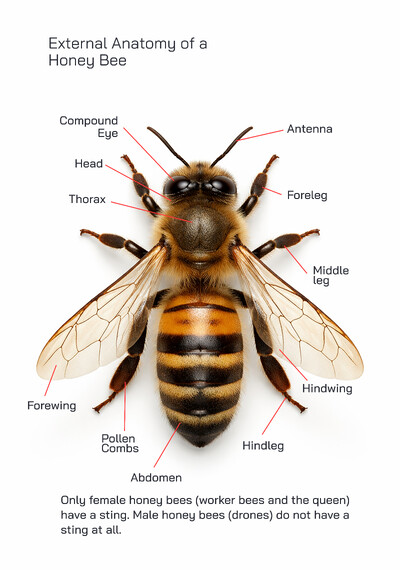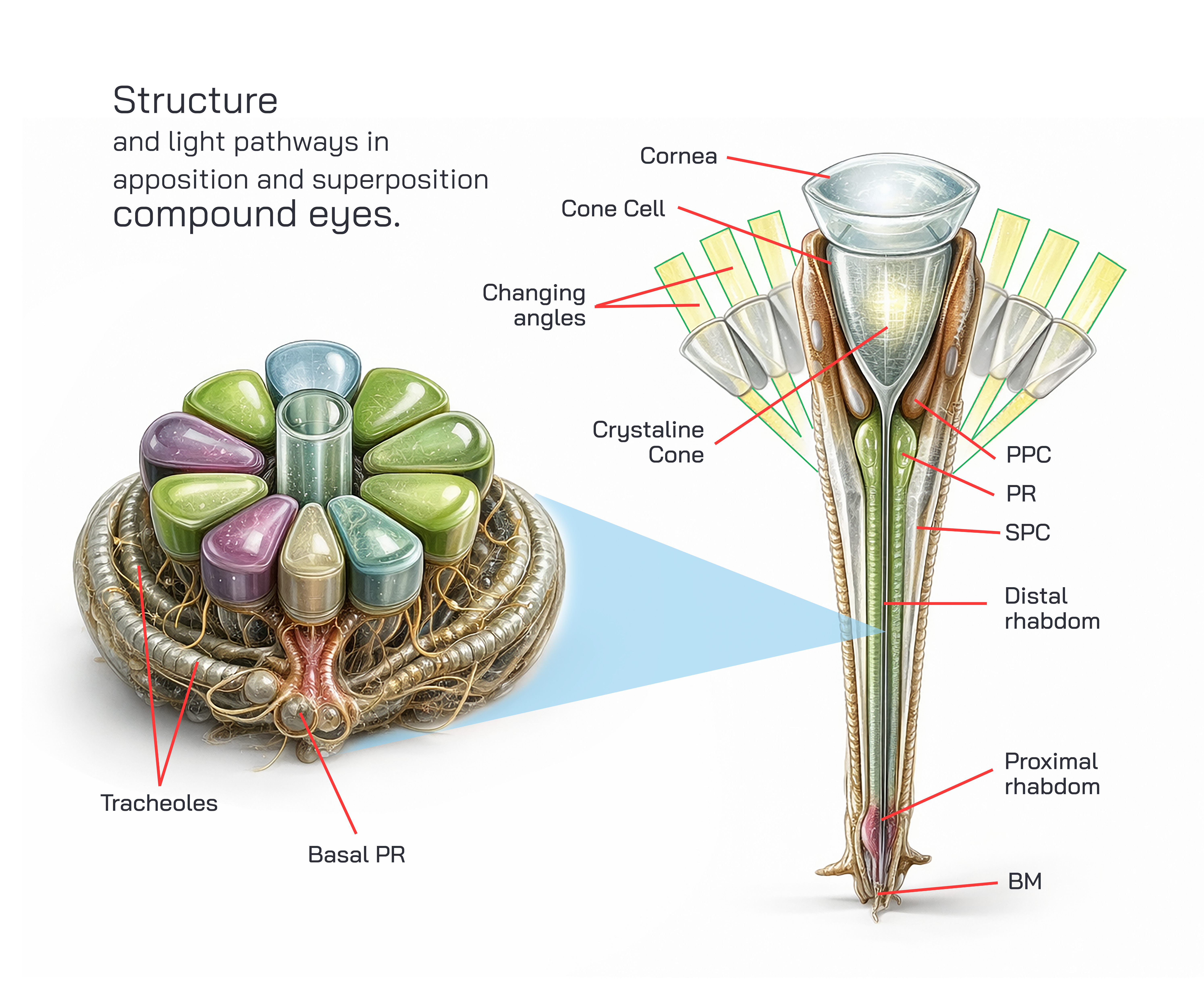
Compound eyes are one of the most distinctive visual systems found in the animal kingdom, primarily present in insects and other arthropods. Unlike single-lens eyes, compound eyes consist of numerous repeating visual units known as ommatidia. Each ommatidium functions as an independent light-detecting element, and together they form a sophisticated system capable of wide-angle vision, rapid motion detection, and efficient environmental awareness. Within compound eyes, two major structural and functional types are recognized based on how light travels through the eye: apposition compound eyes and superposition compound eyes. The differences between these two systems lie mainly in their internal structure and the pathways through which light reaches the photoreceptor cells.
Basic Structural Organization of an Ommatidium
An ommatidium represents the fundamental building block of a compound eye. Externally, it begins with a transparent corneal lens that allows light to enter. Beneath the cornea lies the crystalline cone, which helps guide incoming light deeper into the eye. Below this region are photoreceptor cells that form a light-sensitive structure called the rhabdom. Surrounding the ommatidium are pigment cells that control the direction of light and prevent unwanted scattering. The arrangement and behavior of these components determine whether the compound eye functions as an apposition type or a superposition type.
Structure and Light Pathway in Apposition Compound Eyes
Apposition compound eyes are commonly found in insects that are active during daylight conditions. In this type of eye, each ommatidium is optically isolated from its neighbors by dense pigment cells. Light entering through the corneal lens of one ommatidium is restricted to that single unit and does not mix with light entering adjacent units. As a result, each ommatidium receives light from only a narrow angle of the visual field.
In apposition eyes, the light pathway is relatively straightforward. Incoming light passes through the cornea and crystalline cone and directly reaches the rhabdom of the same ommatidium. The pigment cells surrounding the unit absorb stray light, ensuring precise directional sensitivity. This arrangement produces a mosaic image composed of many small points of light, each corresponding to one ommatidium. While the image resolution is limited by the number of ommatidia, apposition eyes provide sharp spatial discrimination under bright light conditions.
Because each ommatidium works independently, apposition eyes excel at detecting fine details and color differences when sufficient light is available. This visual system is particularly effective for insects that rely on accurate navigation, pattern recognition, and flower detection during the day. The trade-off for this precision is reduced sensitivity in low-light environments, as each photoreceptor receives only a small amount of light.
Structure and Light Pathway in Superposition Compound Eyes
Superposition compound eyes are typically found in insects and arthropods that are active during twilight or nighttime conditions. In these eyes, the internal structure is modified to increase light sensitivity. Unlike apposition eyes, the pigment cells in superposition eyes can migrate or are arranged in a way that allows light from multiple ommatidia to contribute to a single photoreceptor region.
In superposition eyes, light entering through several neighboring corneal lenses is refracted by crystalline cones in such a way that the light rays converge onto a common rhabdom. This means that a single photoreceptor structure receives light from multiple lenses simultaneously. The light pathway is therefore more complex, involving the combination of light from different angles before it reaches the photoreceptors.
This superimposed light greatly enhances sensitivity, allowing the eye to function effectively under dim lighting conditions. The increased brightness comes at the cost of reduced image sharpness, as the directional specificity of individual ommatidia is diminished. However, for nocturnal or low-light environments, sensitivity is more important than fine detail, making this system highly advantageous.
Functional Differences Between Apposition and Superposition Eyes
The primary functional difference between apposition and superposition compound eyes lies in the balance between resolution and sensitivity. Apposition eyes prioritize clarity and precision, making them suitable for bright environments where light is abundant. Superposition eyes prioritize brightness and sensitivity, enabling vision in conditions where light is scarce.
In apposition eyes, pigment cells remain fixed and block light overlap, ensuring strict separation between ommatidia. In superposition eyes, pigment distribution allows controlled light sharing between units. This structural difference directly influences the way images are formed and interpreted by the nervous system.
Biological Adaptation and Ecological Significance
The existence of two distinct compound eye types highlights the adaptability of arthropod vision. Species active during the day benefit from apposition eyes that provide detailed visual information necessary for tasks such as foraging, predator avoidance, and communication. Species active at night or in shaded environments benefit from superposition eyes that maximize light capture and improve survival in low-light conditions.
These visual adaptations play a crucial role in shaping insect behavior, habitat selection, and ecological interactions. Vision influences how insects locate food, choose mates, avoid danger, and navigate complex environments. The structure of the compound eye is therefore closely linked to lifestyle and ecological niche.
Neural Processing of Visual Information
Regardless of eye type, signals generated by photoreceptor cells are transmitted to the nervous system, where they are integrated and processed. The brain combines information from multiple ommatidia to create a coherent representation of the surroundings. In apposition eyes, this representation emphasizes spatial detail, while in superposition eyes it emphasizes brightness and motion detection.
The rapid processing speed of compound eyes allows insects to respond almost instantaneously to changes in their environment. This speed is especially important during flight, where constant adjustments are required to maintain stability and avoid obstacles.
Evolutionary Perspective
From an evolutionary standpoint, apposition and superposition compound eyes represent different solutions to the challenge of vision under varying environmental conditions. Rather than evolving a single versatile system, arthropods developed specialized eye structures optimized for specific lighting environments. This specialization has contributed significantly to their evolutionary success and ecological diversity.
Compound eyes represent one of the most successful and versatile visual solutions produced by evolution, allowing arthropods to thrive in an extraordinary range of environments. The distinction between apposition and superposition compound eyes is not merely anatomical, but deeply functional, reflecting how different species have adapted their vision to the availability of light, ecological demands, and behavioral patterns. Understanding these eye types provides insight into how insects perceive the world and why their visual systems differ so profoundly from those of vertebrates.
At the core of both apposition and superposition eyes lies the same basic modular design. The repetition of ommatidia allows visual processing to be distributed rather than centralized. This modularity ensures reliability, because damage to a few units does not completely compromise vision. It also allows evolutionary flexibility, as changes in ommatidial size, spacing, and internal arrangement can fine-tune visual performance without altering the entire eye. Over millions of years, this flexibility has enabled arthropods to refine their vision for specific ecological roles.
In apposition compound eyes, the strict optical isolation of ommatidia creates a system optimized for spatial accuracy. Each unit acts like a narrow viewing tube, capturing light only from a specific direction. This produces a highly ordered mosaic image in which the position of each light signal corresponds closely to the position of objects in the environment. While the image may lack the smooth continuity of vertebrate vision, it provides sufficient detail for recognizing shapes, edges, and patterns, especially under strong illumination. This makes apposition eyes particularly effective for insects that rely on visual cues such as flower markings, territorial displays, or precise landing surfaces.
Color discrimination is also more refined in apposition eyes. Because light is not mixed between neighboring ommatidia, different photoreceptors can specialize in detecting different wavelengths. Many day-active insects possess photoreceptors sensitive to ultraviolet, blue, and green light, allowing them to perceive patterns invisible to humans. These patterns play a crucial role in pollination, as flowers often display ultraviolet markings that guide insects toward nectar. In this way, apposition compound eyes support not only insect survival but also plant reproduction and ecosystem stability.
Superposition compound eyes, by contrast, represent a visual strategy focused on sensitivity rather than precision. In dim environments, isolating light to individual ommatidia would severely limit the amount of information reaching the photoreceptors. Superposition eyes solve this problem by allowing light from multiple lenses to converge onto a shared rhabdom. This optical summation dramatically increases brightness, enabling insects to detect shapes and movement even under very low light conditions. Although the resulting image is less sharp, it provides enough information for navigation, predator avoidance, and foraging at night.
The internal optics of superposition eyes are more complex and varied than those of apposition eyes. Different forms of superposition exist, depending on how light is redirected and combined. In all cases, however, the key principle remains the same: sacrificing spatial resolution to gain sensitivity. This trade-off reflects the reality of nocturnal environments, where detecting the presence of an object is often more important than resolving its fine details. For night-flying insects, the ability to see at all outweighs the need for visual precision.
Pigment cell behavior further distinguishes the two eye types. In apposition eyes, pigment cells remain fixed, maintaining strict separation between ommatidia regardless of lighting conditions. In superposition eyes, pigment distribution can be dynamic, adjusting to changes in light intensity. Under brighter conditions, pigment may limit light overlap to prevent excessive glare, while in darkness it allows maximum light sharing. This adaptability enhances visual performance across varying environments and times of day.
From a behavioral perspective, the differences between apposition and superposition eyes strongly influence how insects interact with their surroundings. Day-active insects with apposition eyes often rely on visual landmarks, color cues, and detailed pattern recognition. Their behavior tends to be visually guided, with precise flight paths and targeted movements. Nocturnal insects with superposition eyes rely more on motion detection, contrast, and brightness gradients. Their movements are often smoother and less visually precise, but highly effective in low-light conditions.
Neural processing complements these optical differences. In apposition eyes, the nervous system emphasizes spatial mapping, integrating signals from many narrowly focused ommatidia to create a structured representation of the environment. In superposition eyes, neural processing prioritizes sensitivity and motion, extracting meaningful information from a brighter but less detailed image. In both cases, the speed of processing is extremely high, allowing insects to respond rapidly to environmental changes.
The ecological significance of these visual systems is profound. Vision influences habitat selection, daily activity patterns, predator–prey relationships, and reproductive behavior. The evolution of apposition and superposition eyes has allowed arthropods to occupy ecological niches that would otherwise be inaccessible. Bright, open environments favor precision, while dark or shaded environments favor sensitivity. By evolving specialized eye types rather than a single generalized system, arthropods have maximized their adaptability and survival.
From an evolutionary standpoint, the coexistence of apposition and superposition compound eyes demonstrates that there is no single optimal solution to vision. Instead, evolution favors designs that balance trade-offs according to environmental demands. The compound eye, with its modular organization and optical flexibility, provides an ideal framework for such specialization. This diversity of visual strategies has played a major role in the extraordinary success and diversity of insects and other arthropods.
In summary, apposition and superposition compound eyes represent two distinct yet equally effective approaches to visual perception. Both arise from the same fundamental ommatidial architecture, yet differ in how light is guided, combined, and processed. These differences reflect adaptation to light availability, behavior, and ecological niche. Studying these systems not only deepens our understanding of insect biology but also reveals broader principles of sensory evolution, demonstrating how structure, function, and environment interact to shape the way organisms perceive the world.
Conclusion
The structure and light pathways of apposition and superposition compound eyes demonstrate the remarkable efficiency of biological design. By modifying how light is guided, shared, or restricted within the eye, arthropods achieve vision systems tailored to their ecological needs. Apposition eyes provide clarity and precision in bright light, while superposition eyes offer enhanced sensitivity in darkness. Together, these systems illustrate how structural variation leads to functional diversity, enabling insects and other arthropods to thrive in nearly every environment on Earth.