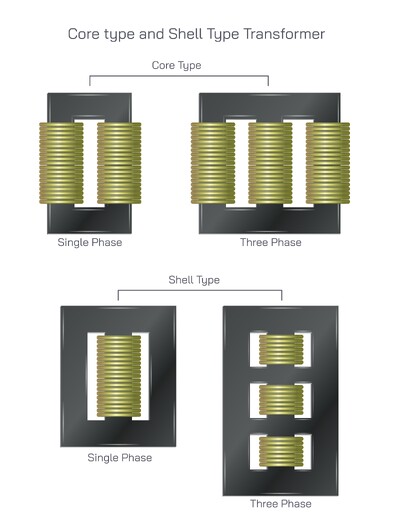
A transformer is a fundamental electrical device used in power systems to change the voltage level of alternating current electricity without altering its frequency. Transformers play a crucial role in the generation, transmission, and distribution of electrical energy, making them one of the most important components of modern electrical infrastructure. The image illustrating the types of transformer highlights two of the most commonly used forms: the step-up transformer and the step-down transformer. These two types differ primarily in how they modify voltage levels, yet both operate on the same basic physical principle of electromagnetic induction.
The core purpose of a transformer is to transfer electrical energy from one circuit to another through magnetic coupling. This transfer occurs without any direct electrical connection between the two circuits, which enhances safety and efficiency. Transformers work only with alternating current because a changing current is required to produce a changing magnetic field. This magnetic field is the medium through which energy is transferred from the primary coil to the secondary coil.
The basic structure of a transformer consists of three main parts: the primary coil, the secondary coil, and the magnetic core. The primary coil is connected to the input AC supply, while the secondary coil delivers the output voltage. The magnetic core, usually made of laminated soft iron or silicon steel, provides a low-resistance path for magnetic flux. Laminations are used to reduce energy losses caused by eddy currents, improving the overall efficiency of the transformer.
When an alternating voltage is applied to the primary coil, it produces an alternating current. This alternating current generates a continuously changing magnetic field around the primary winding. The magnetic field flows through the iron core and links with the secondary coil. According to the principle of electromagnetic induction, this changing magnetic field induces an alternating voltage in the secondary coil. The magnitude of this induced voltage depends on the number of turns in the secondary coil relative to the primary coil.
A step-up transformer is designed to increase voltage from the primary side to the secondary side. In this type of transformer, the secondary coil has more turns of wire than the primary coil. As a result, the induced voltage in the secondary winding is higher than the voltage applied to the primary winding. Step-up transformers are commonly used in power generation stations. Electricity generated at power plants is typically at a relatively low voltage. To transmit this electricity efficiently over long distances, the voltage must be increased. Higher voltage reduces current for the same power level, which significantly minimizes energy losses in transmission lines.
The diagram of the step-up transformer clearly shows the primary coil with fewer turns and the secondary coil with more turns wound around the same magnetic core. As alternating current flows through the primary coil, magnetic flux builds up in the core and induces a higher voltage in the secondary coil. This increased voltage is then sent to high-voltage transmission lines that carry electricity across cities, regions, and even entire countries.
In contrast, a step-down transformer is used to decrease voltage from the primary side to the secondary side. In this case, the primary coil has more turns of wire than the secondary coil. When alternating voltage is applied to the primary winding, the magnetic flux produced in the core induces a lower voltage in the secondary winding. Step-down transformers are widely used in power distribution systems. The high voltage used for transmission is not suitable for homes, offices, or most electrical appliances. Therefore, step-down transformers reduce the voltage to safe and usable levels before electricity reaches consumers.
The step-down transformer diagram shows a primary coil with a larger number of turns and a secondary coil with fewer turns. The same magnetic induction process occurs, but the voltage induced in the secondary coil is reduced. This lower voltage is then supplied to households and commercial buildings, enabling safe operation of lighting, electronics, and electrical equipment.
Although step-up and step-down transformers serve different purposes, their working principle remains the same. Both rely on the interaction between alternating current, magnetic flux, and coil windings. The ratio of the number of turns in the secondary coil to the primary coil determines whether the transformer increases or decreases voltage. This turns ratio is a key design parameter and directly influences the transformer’s output characteristics.
Transformers also help improve the efficiency and reliability of electrical systems. By allowing electricity to be transmitted at high voltage and low current, transformers reduce power losses due to heating in transmission lines. This makes long-distance electricity transmission economically viable and environmentally efficient. Without transformers, modern power grids would be impractical, as enormous amounts of energy would be lost during transmission.
In addition to step-up and step-down transformers, many other specialized transformers exist, such as isolation transformers, autotransformers, power transformers, and distribution transformers. However, step-up and step-down transformers form the foundation of electrical power systems and are the most commonly encountered types in everyday applications.
The magnetic core plays a vital role in transformer operation. By concentrating and guiding magnetic flux between the coils, the core ensures efficient energy transfer. Core materials are carefully selected to minimize hysteresis losses and eddy current losses, which can otherwise reduce efficiency and cause heating. The design of the core and windings directly affects the performance, size, and durability of the transformer.
Transformers are used in a wide range of applications beyond power transmission and distribution. They are found in electronic devices, adapters, chargers, industrial machinery, medical equipment, and renewable energy systems. In each case, the transformer is selected based on the required voltage levels, power rating, and operational conditions.
In summary, the types of transformer shown in the diagram—step-up and step-down transformers—illustrate how electrical voltage can be efficiently increased or decreased using electromagnetic induction. Step-up transformers raise voltage for efficient long-distance transmission, while step-down transformers reduce voltage for safe and practical use by consumers. Together, these transformers form the backbone of modern electrical power systems, enabling reliable electricity supply from generation stations to homes and industries. Their simple yet powerful operating principle makes transformers one of the most essential inventions in the field of electrical engineering.